The Process of Learning

fullsizeoutput_2a10

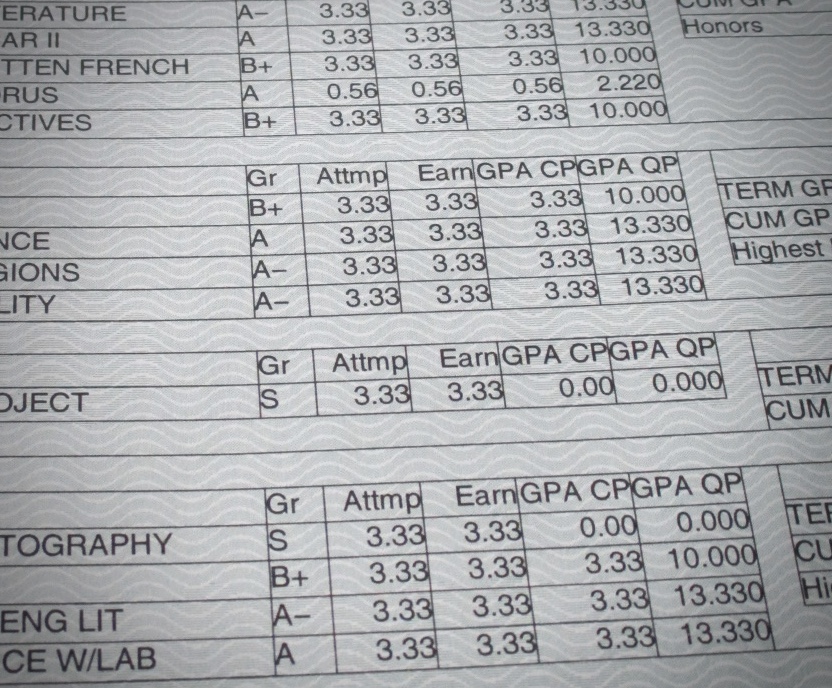
At dinner recently, my children mentioned the struggles some of their friends face with their parents. They recounted stories of friends who are grounded for having unacceptable grades when their parents check their Powerschool account.

Ugh, Powerschool. For those not familiar with academic technologies, Powerschool and other similar online grading tools can be valuable for checking on grades and making sure your child is on task, and also allowing them to adjust their studying and homework as necessary before grades close. But this type of technology can just as easily be abused as a micro-management tool.

When I was a student in high school (as with most parents of teenagers today), my parents saw my grades at the end of each quarter when I received my report card. Between report cards, I had the choice of what I would share with them and what I wouldn’t. If I chose not to share an “oops” grade, I had to be pretty certain that I could bring up my grade in that subject before the end of the marking period; and not sharing a bad test grade would give me extra drive and motivation to do so. Nowadays, parents can see grades along the way. Every day, if they’d like. Every. Single. Grade.

Here’s the thing. Learning is actually about growth, not grades. Learning is a process—one that we hone over time—that is sometimes successful, and sometimes not so much. The process of learning requires constant revision and self-evaluation.

Grades are part of the process of learning, and can help students with the self-assessment and re-evaluation necessary for improvement. Grades are not merely a product of the learning process, as people often think.

I work with college writers on a daily basis, and by the time students come to my office, they are already focused on the grade they will receive and not on the process of improving their writing. Very seldom does a day go by when I don’t say to one student or another, “Writing is a process.” Students want to focus on the product—the final, graded draft—and be done with it. But it is a rare writer (at any level) who can write a quality, finished essay the first time around and not have to go back and revise.

Overall, learning is a lot like writing. As students learn more challenging material [or learn a different subject matter … from a different teacher… in a different textbook or context], they have to put into practice what they know about learning, the subject at hand, and their past experiences, all while they constantly adjust their process to fit the situation. What worked last week for one bit of material might not work as well this week. A poor grade on a test or quiz will alert the self-aware student to what is not working, and will allow that student to re-evaluate and revise what he or she is doing.

Come to think of it, this is a lot like life. We are constantly editing and revising; we are examining our approach and making adjustments—fine-tuning, if you will. If we, as parents, don’t step back and offer our children some space to figure things out and some room to grow and examine their own performance, we are teaching them that learning is about the product, in this case, the grade. This parental approach to academics does a grave disservice to our children. Not only are we hijacking our children’s learning process to get the result we desire, we are teaching them that the grade is more important than fostering the innate intellectual curiosity and creativity that comes when they follow their learning in a direction that is of interest to them.

When children are conditioned to only look at the end result—the grade—the fear of failure can become paralyzing. And more than likely, children in this situation will learn not to take risks, but to take the “safe” path. Learning how to deal with failure, on the other hand—how to bounce back from a low essay grade or a bombed test—is a far more effective life lesson than learning to be afraid of failure. They also begin to realize that failure is an integral part of the process.

My son recently completed his first semester in college. For the first half of the semester, he struggled with one particular class—it was a subject he had never studied, and the professor had a well-earned reputation for being tough. In the end, my son received his lowest grade of the term in that course. However, I believe that grade was the one he was most proud of because he learned more about the process of learning, approaching the academic rigors of college, and self-advocacy from that class than he did from all of his other classes put together.

If I were to give advice to parents, I would say, step back. Give your children some room to fall while they still have you there to guide them and help them navigate the rough waters they encounter. Without a little room to figure things out on their own, not only will children have no motivation to get up when they fall, they will not learn how to get back up—to recover from setbacks and move forward.

Let your children stumble so they can assess and reassess and redirect. Help them to learn the important lessons that lead them toward resilience. Now, more than ever, our society is going to be looking for people who can not only face setbacks with grace, but can help others do so, as well.

Saved by Strangers

IMG_1369

Many people have stories of strangers who seem to materialize out of thin air just when they most need help. And once the strangers have provided the necessary assistance, they disappeared just as suddenly. In fact, this once happened to me.

My story happened many years ago. I was working in a boarding school, and since I lived in a dormitory, I would often take students on shopping trips or outings. This particular weekend, I had promised a group of students that I would take them to see a movie on Saturday evening.

Initially, Saturday was a clear, cold day. However, by the time evening started came around, it was snowing. Hard. The storm was not supposed to be lengthy—only a brief snow shower—but its poor timing could affect our trip.

The four girls I was taking to the movies were keen to get off campus, and I was much more adventurous in my young adulthood. After much back and forth, we decided to set out on the trek to the cinema, knowing that we could always turn around if the roads were bad.

As I drove, the falling snow obscured my vision and ensured I maintained a crawling pace. The roads were covered in a deepening layer of snow, but I inched along. Few other cars were on the roads, and the only light was that of my own headlights as we continued on our journey.

We were nearing the intersection of the main road (which I knew would be clear) when my slow-moving vehicle hit a patch of ice and for a brief second, the car would not do anything I wanted it to do. I tapped the brakes and turned the wheel, but the car’s momentum took it in a direction I did not want to go. The car swerved off the side of the road and continued into a small ditch where we came to a stop with a jolt.

I took a deep breath. “Everyone okay?” I asked, as I ran through the list of possible ways out of this mess. Back then, there were no cell phones, so calling for help was not an option. No doubt, there would be some walking involved on this very snowing, rather dark night, and I had the sudden realization that sneakers might not have been the best choice of footwear on a snowy night.

I said a silent prayer, and in the rear view mirror, I saw the headlights of a passing car, the first I had seen for several miles. The car slowed and stopped. Several young men got out and approached my vehicle. I rolled down the window and in the rearview mirror, I caught a glimpse of the surprised expressions of the girls in the backseat as they looked at each other.

“You need some help?” one of the young men asked.

“I guess I kinda do,” I replied, as I put the car in reverse. The young men surrounded my vehicle, and I pressed the gas pedal as they pushed it up and out of the ditch. In just a few seconds, the car was freed from the ditch and back on the road. The young men ran back to their car.

“Thank you!!” I hollered after them out my still open window. Their car passed me and disappeared in the still falling snow. I closed the window and continued the slow trek to the main road.

The teenage girls in my car were amazed. “How did you do that?” one of them asked. “No sooner did you go off the road then a whole car full of cute guys arrived to push us out!”

Indeed, one could say we were very lucky that night. But I’d like to think there was a bit more to it than luck. Divine intervention or no, that night showed me the amazing way our lives all work together for the greater good.

Chocolate chips or…

img_2631

Yesterday, I baked some cookies. Baking cookies at this time of year serves two purposes. First, it provides us with dessert for school lunches. But second, using the oven takes the chill off the house when the sun goes down in the evenings. And so far, I really haven’t had to use my heat much this fall.

I asked W what he wanted in his cookies: chocolate chips or M&Ms. He opted for chocolate chips. I asked J the same question.

“How about nothing?” she suggested. She is one of those kids who has never really cared for sweets. Regardless of what I add to the cookies, she’ll pick them out.

However, I had just stocked up on baking supplies for my holiday baking. “I have toffee pieces,” I told her. “I can use those instead of chocolate chips?”

She shook her head. “No thanks.”

“Cinnamon chips? I have some of those….”

Again, she shook her head.

I opened the pantry cabinet. “Ooo, I know! How about Skittles?” I ventured hopefully. “I could put Skittles in the cookies.”

“Mom, that’s gross.”

I suppose that would be. Or, maybe not….

Brain transplant

img_1986

Sometimes (actually, often), we have some unusual conversations in our family. The other day, I got in the car with W, and as I settled in to drive, I felt a twinge in my knee. “Ooo, my knee hurts,” I commented, mostly to myself.

“Is that from when you fell?” he asked, and I nodded. Back in January, I was pumping gas, and I attempted to step over the loop of hose between my car and the gas pump. Bad idea. The hose tripped me up, and I fell, my left knee taking the brunt of the landing. Let’s just say after the embarrassment, the tears, and the initial pain, I had recovered, but my knee… it was slow to heal.

“You should probably get that checked before you have to get it replaced,” he said in his fifteen-year-old matter-of-fact way. “I know someone who had one replaced.”

“I know someone who had two replaced,” I bested.

“You know those cars that have so many parts replaced they are practically brand new?” he asked, taking the conversation in a related-unrelated direction.

“Yeah. Can you do that with a human? Replace so many parts and organs they become a ‘new’ person?” I chuckled at the thought.

“That would be weird.” He looked out the window, and that was probably my cue to stop the conversation. But I didn’t.

“What about a brain transplant?” I ventured. “That might make someone a new person.”

“They can’t do that.” He went for the logical, but I wasn’t having it.

“But what if they could?” I pressed. “You would be a new person. You might not even remember who you were; you wouldn’t recognize your family or your friends….” I tried to think about the multitude of dilemmas presented by this type of major operating system transplant.

“You’d have someone else’s memories and thoughts,” W started to engage, but then stopped. “But they don’t do that.”

“Maybe it wouldn’t really be a brain transplant.” My mind was working overtime as I tried to wrap my head around this concept. “Maybe you’d wake up and say, ‘Oh look! I got a new body!’ For the person whose brain it was, it would be a body transplant.”

Oh my! I believe I’m thankful they haven’t figured out how to do this type of surgery. At least they haven’t figured it out yet….


Spiders

IMG_0377

I was in the shower when I spotted it, which means it must have been fairly big since I was wearing neither my glasses nor my contacts. As it moved across the ceiling at a brisk spider pace, an idea blossomed in my mind.

I finished my shower, shut off the water, and wrapped up in a towel. I grabbed my tablet and snapped a quick close-up picture of the spider. I sent the image to C, who was sitting innocently on the couch, one floor below me. “Can you come kill this for me?” I messaged, knowing the obvious answer.

“No. That’s scary,” he messaged back.

“Please?” I responded. I received no answer. I waited. By this time, the spider had moved to the far corner where it seemed to be setting up shop. I snapped another picture. In this one, the spider was far off, just a spot on the ceiling in the corner of the room. “See?” I said. “Not so scary.” Nothing. “I can’t reach it,” I lied. Still nothing. “Are you ignoring me?”

“No.”

Now, don’t get me wrong. I am more than capable of taking care of the spider myself. I have dealt with every spider in this house since we moved in over twelve years ago. But seeing as C is now an adult, I want to see how he will handle this. And it’s actually quite funny.

“Why aren’t you up here killing my spider?” I ask him. Since historically, it has been him asking me to kill the spiders, I am expecting him to jump at the chance to repay the favor. Not.

“I tried to send W, but he refused,” he admitted.

And there it is, friends. Passing the buck to see if someone, anyone, might take care of the spider for him.

In the end, I trapped the spider and carried it outside where it will live a much happier life than it would in my bathroom. However,  I am not sure what C is going to do when he is on his own. I just hope he knows how many babies one spider can produce. To kill the spider or not to kill the spider? Adulting can be complicated.

Preparation (2) : The Reaction

IMG_2421

So maybe I went a little overboard on the medical supplies. Then again, maybe not.

My children were away for ten days with their father. While they were gone, I had a bit of time to gather some of the items my son still needed for college. It was during this 10-day span that I created the box of medical supplies.

He asked for a “First Aid kit”—bandaids, Neosporin, pain reliever, cold medicine… the basic stuff. But I knew he’d need more than that. During this time, I also happened upon a post on a social media site with a do-it-yourself medical kit for the college bound student, complete with supplies list. Booyah! So while he asked for a first aid kit, what he got, well….

“Whoa! It’s like I have a scary, overprotective mom!” I heard him exclaim from his room when he first discovered the box. Images of Mrs. Benson from the once-popular television show, iCarly, flooded my mind.

I went to his room to explain. “You know,” I started, in my own defense. “This is all stuff you might need, and other people in your dorm probably won’t have this stuff, so they’ll come to you. Who knows?” I smiled my most innocent, non-crazy smile.

“I don’t even know what half this stuff is,” he stated as he poked through the box. “Saline nasal spray? And this,” he picked up the thermometer. “I wouldn’t even have thought of this.”

“But you might need it,” I shrugged. I pulled out a small box that was tucked along the side. “And covers for it in case other people need to borrow it.”

He pulled out the bottle of ibuprofen, much smaller than the one we keep in our medicine cabinet. “I might need more than this,” he told me.

“That’s fine for now,” I responded. “There are fifty in there.” He continued to poke through the contents. “I put your chapstick in there, too,” I told him. “Oh, and I got you some gloves.” I pointed to the small box of eight medical gloves.

He looked up from the box, his mouth hanging open. “Really?” he finally managed.

“Hey, the first time you have to clean up after someone, you’ll understand why I got them.”

Now, let me explain. I have lived in dorms for more years than most people I know, and I’ve been cleaning up biohazard since before it had that name. First of all, as a freshman in college, I very distinctly remember one night when I cleaned up after my roommate. I’m sure she could have done it once she sobered up, but in the meantime, it was my room, too.

After college, I worked as a dorm parent in boarding schools for many years. I cleaned up my share of biohazard, but the most memorable involved a fist and a window. Enough said.

I certainly hope my son is lucky enough to never need the gloves. But chances are, he might, so it’s best to err on the safe side. And if he becomes an RA in the future, I will definitely spring for a bigger box!

Yes, this medical kit will leave me forever be branded as the crazy, overprotective mom. But one day, when my son needs something for congestion or coughing or dry eyes or whatever, and he looks in his medical kit and finds what he needs, he may just say, “Wow, thank goodness my mother thought of that!”

Preparing

IMG_2415

My Facebook feed is filled with statuses of young people who are going off to college. Parents have posted pictures of various aspects of the approaching college experience: the “stuff” that has been accumulated to outfit a dorm room; dorm rooms after set up; student send-offs and final hugs; and these same young people posing on beautiful campuses, just before the parents get in the car for the drive home.

My son will leave for college in a few short days. We have a pile of “stuff” in our house that we are trying to pack into as few containers as possible. I am washing towels and bedding and clothes. I have collected paper goods and toiletries and school supplies. He tells me his pants are too short, and he definitely needs new sneakers. Luckily, he can wear shorts until he comes home to visit in October. After all, it won’t be that cold on campus until then….

It is an exciting time for these college freshmen. They are going off on a great adventure, and they are, quite rightfully, excited. And I am excited for my son. But I have other feelings, as well. Even though this is a great step in his life, I know that there will be times when he feels like he is in the wrong place. When he thinks he has made the worst decision of his life. When he is deeply lonely. And I recognize that these are all necessary feelings and experiences as he navigates the waters of life and of grows into adulthood. But I am his mother.

So, there are some things I wish he didn’t have to go through. I wish he didn’t have to question his decisions, experience loneliness and homesickness, navigate the challenges of being away from home, and wonder if he would be better off somewhere else, but not really know where. If I could, I would guarantee him a life of smooth sailing and unbridled excellence. But what kind of life would that be? Certainly not one of growth and ever expanding maturity.

So I will send him off as prepared as possible to tackle the things life throws at him. Today, I am packing up a box of medical supplies, simple things like bandaids, cough drops, pain relievers, and a thermometer to get him through the bumps and bruises of the next four years. These things are minor, but they are things he would have readily available here at home. Hopefully, when he is feeling down and not his best, he will open the box and realize that even though I am several towns away, I am still caring for him, supporting him, and loving him.

And hopefully, he will remember that I am only a phone call (text, email, whatever) away. If he needs me, I will always be here.

Elusive

IMG_2355

My cat is a fierce hunter-wannabe. She will chase and play with any bug that enters our house—well, most of them anyway. Occasionally, she is even successful in capturing her prey.

Last week, in her most recent fierce hunter move, she escaped onto the deck, chased a squirrel off our second story deck, and came running back into the house. While she totally meant to chase the squirrel (and win), she certainly didn’t mean to come running back into the house.

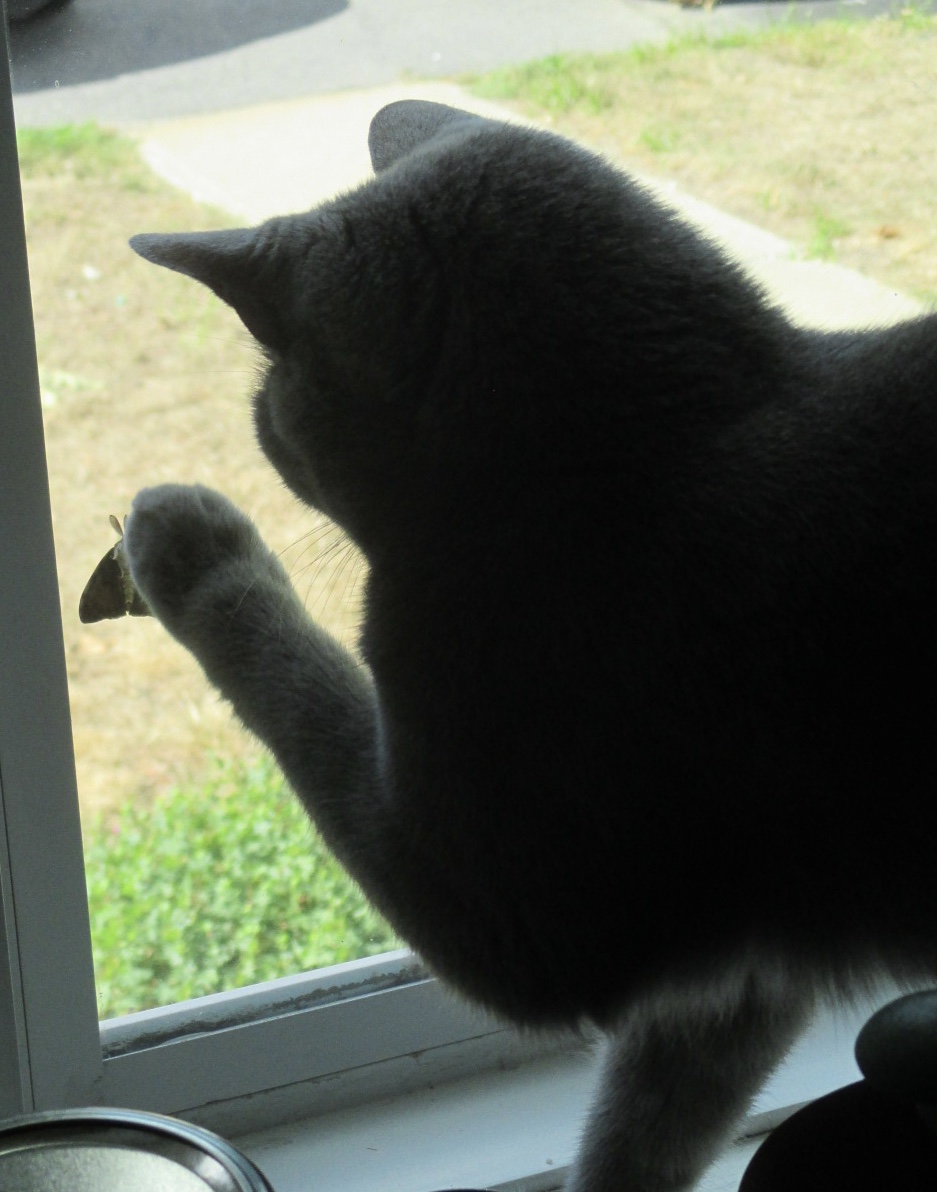
One morning this week, I watched as she tried to capture a moth. Her paw was right there batting it—once, twice, three times—slipping down the smooth glass of the window each time. The moth was still and unmoving, but moth and paw were not connecting. Despite her efforts to get the moth, my little cat was unable to capture it, and she couldn’t understand why.

The moth was sitting just on the other side of the window. But that didn’t stop the cat from the pursuit. She could see the moth. She wanted it. And she was sure she had a pretty good shot at it. She didn’t recognize the window as a barrier to her hunting skills.

I got to thinking about her attempts to hunt through the window, her ability to see what she wanted and go after it. And I considered how her actions compare to some of the actions in my own life. So often, it seems, I can see what I want—either literally or figuratively, but I can’t quite get there. There are unseen barriers, and my goal is elusive.

But one day, when I least expect it, I will open the door, and my cat will accidentally slip outside (she’s sneaky like that), or the moth will fly in. And in that brief moment, the barriers between fierce hunter and prey will melt away, and the cat will have access to what she wants. This same type of fortuitous moment might work out for me, as well. If I keep working, keep striving, keep pursuing my goals, a moment of opportunity may arise, and I, too, will have access to what I want.

Matches

DSC_0384

One of the skills that I have taught my children—perhaps the only one that will ever come in handy as they already use it fairly often—is the skill of searing the ends of rope, cord, ribbon, nylon, etc. I have taught them how to pass these ends and edges through a flame in order to “seal” them so they won’t fray. This is a skill I learned in an indoor/outdoor sewing class back in my high school days—one of the few useful skills I acquired in the six years spanning grades seven through 12.

The other day, C came into the kitchen with a length of black cord that was fraying. “I need the lighter,” he declared as he walked toward the crock where we keep it.

“Oh…” I hesitated. “We don’t have one that works. Your brother used it, and I meant to replace it.” I had put lighter on my shopping list countless times, but I never seemed to remember to actually buy one. The one we had was clearly empty and wouldn’t stay lit, but I hadn’t thrown it out. Somehow, I figured it would be useful (for what, I have no idea) until a new one appeared.

“So…?” he posed as a question, thinking I would fill in an answer for him. I continued typing on my laptop. “What am I supposed to do? I need to fix this.” He held out the cord for me to see, but I continued to work. By this point in my mothering career, I pretty much have eyes in the back of my head, the side of my head, the top of my head, and the bottom of my chin. I knew what he needed.

“We have matches,” I told him. He began searching the junk drawer in the kitchen, and he seemed to have found some because the next thing I knew, I heard him trying to light one. The first match didn’t stay lit long enough for him to sear all of his cord. The second one didn’t, either. He was on the third when I finally looked up from my work.

“How about if you light a candle?” I suggested. “Then you will have a constant flame, and you can work with that.”

Success! He was able to complete his task of searing the ends of three, maybe four, cords.

The next day, W walked into the kitchen with a length of paracord that he had wound into an impressive skein. “Nice!” I nodded my approval.

“I just need to seal these ends,” he said, holding them up for me to see.

“Um…. We don’t have a lighter that works,” I reported, feeling a strange sense of deja vu. “But we do have matches you can use.”

He dug through the drawer and pulled out the matches. He studied them for a minute. “How do these things work?” he asked, jokingly. As a Boy Scout, he has used matches once or twice.

“Hey, I can help you!” C said, coming to his brother’s rescue. “I’ve mastered this old-fashioned technology!”


Good Fence/Bad Fence

As poet Robert Frost writes, “Good fences make good neighbors.” In New England, there is much evidence of good fences in the miles of rock walls that amble over hills and through meadows in their forgotten quest to separate the farms of yesteryear. As I look at these walls, I can see the neighbors, each on his or her side of the wall, walking the line together piling stone on stone after each hard winter.

I, however, would like to argue that good neighbors exist regardless of the state of the fences that separate them.

As the resident of a townhouse, walls are generally all that separate me from my neighbors. Thankfully, my neighbors and I get along. At least I like to think we do….

Take my neighbor with whom I have an adjoining deck. For a long while, we had a lack-of-privacy fence between us. Granted, it was supposed to be a privacy fence, but it failed miserably at that job. In fact, the fence actually rotted and began to fall apart. For two-plus years, there was a large hole—at adult eye level—which allowed us to chat without looking around the fence by leaning on the railing. If I stepped out my door, I would often hear, “Howdy, Neighbor!” and a lengthy conversation would ensue through the hole in the fence.

The new privacy fence, rebuilt earlier this season, has just enough space between the slats to allow for partial view from one deck to the other. There certainly is no true “privacy.” As we often say, it’s good we like each other!

On the other side of our house, our former neighbors had two little girls. While our decks were not joined, we did have a more effective privacy fence separating us. But that didn’t stop the girls. If they heard us on our deck eating dinner, they would lean over the railing and engage us in entertaining conversation. It usually started something like this:

“Are you eating dinner?” one would ask. And when we replied with the affirmative, the conversation would continue. “What are you eating? Are you almost done? I have sand in my shoes from the sandbox. Wanna see it?” On a crazier night, one might announce from just behind the fence, “I’m naked. Is that embarrassing you?”

Perhaps it’s true that good fences make good neighbors. But bad fences make better neighbors. Honestly, who needs fences anyway? I suppose I might need a good fence if I had bad neighbors.

IMG_2258

[Image is a photo of our privacy fence, stealthily snapped out my back door so my neighbors wouldn’t think I was creepily stalking them. Clearly, “privacy” is not the strong point of this fence.]