Sharing

I have a new sweatshirt. It is grey and purple, fleecy and soft. And it is the perfect weight for winter we have been having. Not only was this sweatshirt on sale, I had a coupon and an extra discount for recently celebrating my birthday. All told, I believe the store paid me to take the sweatshirt off their hands.

Because it was a recent purchase, I wore it for the first time this weekend. It immediately got my daughter’s attention. “I like that shirt, Mom,” she told me, running her hand up my arm. “It’s so soft!”

“Thanks,” I replied. “It’s the same brand as the one you have, but it’s a different style.”

“I really like this one.” She paused, and I could see the wheels turning in her head. “Did you get me one, too?” she asked, smiling and batting her eyes for effect.

Of course, I thought. Because I always buy you things when I buy things… just to make it fair. But to her, I said, “Um, no. I didn’t think ‘matching your mother’ was on your fifteen-year-old bucket list.” I winked.

She shrugged her shoulders. “That’s okay. I’ll bet I can wear that one.” She turned, her hair flipping, and skipped up the stairs. And I realized that for the first time, she probably could wear this sweatshirt—my sweatshirt—and more importantly, that this is a major milestone for this kid.

Almost exactly a year ago, this child, who’s always run a little on the small side, was being tested to make sure that she wasn’t deficient in anything necessary for “normal” development. Even though she had always been off the bottom of the growth chart, the doctor just wanted to be sure. The blood tests and x-rays revealed that all is fine, but her bone age is two years lower than her chronological age.

Since that time, she has gained ten pounds and grown several inches. She eats non-stop, and she is always hungry. (I don’t know why no one ever talks about how much teenage girls can eat. If you get enough skinny dancers in your house, you may as well be feeding an army of teenage boys….)

While my daughter is still small for her age, she’s catching up. It wasn’t until she asked about my sweatshirt that I recognized my shirt is only one size larger than her own. She could easily wear it, and it would only be a little big. So for now, I’ll keep it in a safe (and hidden) place. But soon, she’ll be wearing it. I can share. And after all, I’m kind of flattered that my clothes fit her teenage sense of style.

Family business

I was in the grocery store the other day, and I wandered into the bread aisle where a mother was arguing with her teenager. She was telling him how disrespectful he had been of late. She was disappointed that he wasn’t taking more responsibility around the house. She wanted him to be more involved with the family and their activities. He never went anywhere with the family anymore, she whined. Why did he have to act this way? His counselor said he was making progress, but he was supposed to be more involved…. Why wasn’t he doing what his counselor said??

This conversation went on at great length as mom carried on about all the things that were wrong with her child and his behavior. She palmed the loaves of bread, weighing one against the other, as she told the boy how much of a disappointment he was to her. Her voice became louder, whinier, and though she didn’t actually yell at him, it might have been better if she had. But she was in the grocery store, after all.

I was embarrassed for this woman. I thought about quietly suggesting that she take her conversation elsewhere. The boy probably would have appreciated it. No doubt, he would have been mortified if he had known how many people now knew about his business—his family situation, his counseling, and his inability to live up to his mother’s expectations. The store was quite crowded, after all, and the bread aisle is always popular.

But the boy wasn’t actually there. In fact, I don’t know that she was talking to a boy at all. I don’t know that she was talking to a teenager, though her tone and demeanor gave me my biggest clues. The entire conversation took place on her cell phone.

For whatever reason, cell phones allow people to believe that their private conversations should be held in public. They haul out their cell phones when they feel the need to say something, and they don’t bother to look around to see who might overhear. Or who might be offended. And they don’t consider that not all conversations are appropriate for all forums.

In this case, Mom was complaining that her son was disrespectful, and I’m pretty sure I know where he learned that trait. I would guess I’m not the only one who figured that out.

So the next time you’re tempted to haul your private business into the grocery store in a loud and unfiltered cell phone conversation, look around to see who might overhear what you have to say… and blog about it later.

Calculations

One never knows what is going to happen at the dinner table in my house, nor how that information might be used in future conversations. We have discussions that range from the sublime to the absurd, and everything in between. And the conversations tend to wander from one end of that spectrum to the other—often multiple times over the course of the same meal.

On Friday night, the boys became engaged in a conversation that was both entertaining and thought provoking. Dinner was going along smoothly until one of them dropped some food on the floor and started pondering the edibility of the morsel in question.

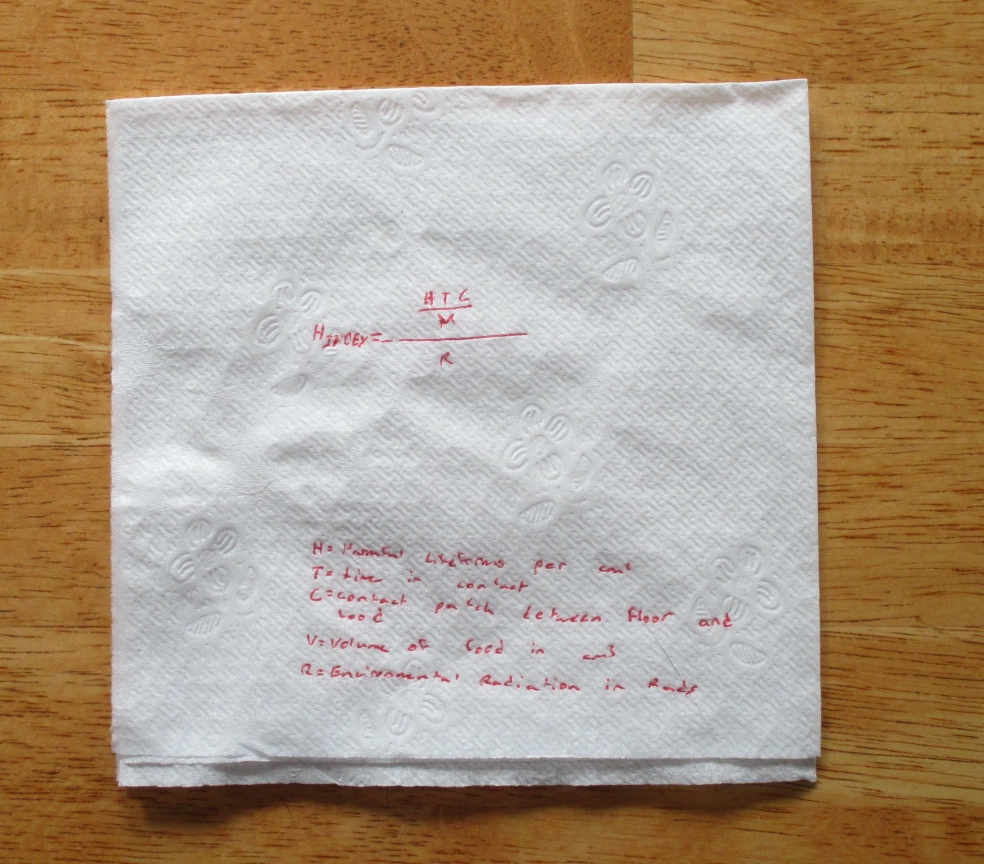
The next thing I knew, the older brother had pulled out his napkin, and was working through a formula to determine whether or not one should remove food from the floor and eat it. His napkin was the paper on which he was composing his formula—writing out the variables involved in making the necessary “calculations.”

The younger boy watched critically as his brother developed this idea, throwing in some of the factors he believed to be important. C had based his calculations on an “average bedroom floor,” using food on a plate and (basically) food in the cats’ litter box as his extreme conditions.

“Wait! Let me show you mine!” W said, grabbing the pen from C. The wheels in his head sped up, formulating, calculating. He developed a complicated equation in which one variable was “harmful life forms per square centimeter,” and another was “time in contact.” There were others, as well as a series of unknowns over other unknowns. They bantered back and forth as they considered whether they had covered all of the important elements.

Ultimately, the bite that fell on the floor made its way to the trash. Through it all, the boys were laughing and carrying on about various funny (i.e. “disgusting”) things that could happen to the food to affect edibility.

In my mind, I had to consider how this incident might have been different if I had been eating with two girls. The girls would have immediately picked up the food, thrown it out, and cleaned up the floor.

But in the interest of developing the boys’ talents at creating new formulas, I have some ideas. On Monday morning, I was texting my daughter—who spent the weekend with her father. I told her I missed her. She said she missed me more. “Tough to know,” I texted. “We can measure later.”

Perhaps the boys could write a formula for that.

IMG_1314 IMG_1315

Weight of Words

So here’s the thing…. I realized the other night that this phrase is the one I use when I start a conversation with my children, usually, a conversation that might have some controversy or weight attached to it. And it’s a construction I use without even thinking.

The other night, after working my primary job and prepping for the start of a new session in my virtual job, I sat down in the living room. “So here’s the thing…,” I started. I felt an instantaneous change in the room. Three teenagers momentarily paused their various activities and caught their breath. Marginal—but noticeable—discomfort hung in the air while they braced themselves for what was to come. I suddenly realized that they were expecting a deep discussion. And I realized that the phrase I had just spoken is my “go to” phrase for starting difficult conversations.

So here’s the thing… I need to take an additional job for a while, which means you guys need to step it up around the house.

So here’s the thing… the class you want to take conflicts with your activities, so we have to figure out if we can work around that.

But the other night, it wasn’t a deep conversation that I was planning to have. I was tired. So I sat down, and I started the conversation. Clearly, not as I should have. “So here’s the thing…” and suddenly, I had everyone’s nearly undivided attention, though no one looked up from his or her screen. “I’m not in the mood to cook dinner tonight, so I’m looking for volunteers….”

Granted, for teenagers, that could be devastating news. What? No dinner?? That could be a heavy topic. But it was not meant to be. It was meant to be a call for help. It was meant to mobilize the troops and call them to action. In the end, mobilization didn’t happen, and we cooked up some omelets, a quick option for a tired mom.

How I came to my conversation opener, I have no idea. It has always worked. But ultimately, this incident taught me something about my approach to conversations. I really don’t know why it was that after years of using this same phrase, I had the realization of its weight just the other night. However, the knowledge that So here’s the thing… elicits an immediate emotional response in my teens means that I will be more cautious in the future. Those words, that phrase should clearly be used with care, and reserved for the conversations that carry some weight.

Feast or famine

“There’s some Danish there you can have for breakfast,” I told the first child to the kitchen this morning.

“I saw it, but that’s not what I want. I’m going to have cereal,” my youngest said as he reached into the cabinet for a bowl. He opened the refrigerator and pulled out the milk.

“More than likely, no one will want the Danish. Your brother’s been looking for breakfast food all week. Now that we actually have something other than cereal, he’ll choose something else.” W smiled, knowing this was a real possibility. In fact, what my oldest has been seeking are the 26 muffins I didn’t buy him last week after our text exchange.

The text exchange went like this: I asked a simple question—a question about breakfast, asked via text because kids communicate via text anyway. I would have asked in person if I had been there. I would have waited to ask. But the fact was, I was at work and planned to stop at the grocery store on my way home. So I asked a reasonable question.

The answer was one of those moments when the true personality of the child emerged, unedited and unrestricted.

“If I go to the store on my way home, what do you want for breakfast?” was the question.

A few minutes later, the answer came: “A few cinnamon chip muffins (and by a few, I mean like a bunch because most likely I will eat one tomorrow and then try to consume multiple both weekend days and then I would want some for the following week and then also taking into account that other people would wish to consume some as well so maybe like 30 muffins).”

This response caught me off guard, but it shouldn’t have. I laughed out loud at the uncut version of a teenage super-appetite. I went home with eight muffins: four cinnamon chip, and four for my other teens to share.

Of course, the muffins were gone in seconds. Food doesn’t last when teenagers are around. Unless they are sick of it. Then it lasts too long. And they usually get sick of it just when I have purchased extra because it’s on sale. Cereal, chips, cookies… it doesn’t matter. The pattern is always the same. If we have enough to last more than a day, they realize they are sick of it. I believe this is where the saying “feast or famine” originated—from parents not only trying to keep enough food in the house, but food that their teenagers would actually eat.

In the end, C ate the Danish for his breakfast, though I’m sure he would have preferred muffins. Then again, if I’d had muffins, he would have preferred Danish.

Hoops and weapons

It has been snowing nearly invisible snow all day. This morning, at a time when the snow was briefly visible, my daughter had a minor panic. She had just bundled herself up to step out into the cold, hoisted her school back-pack onto her back, and she paused. She slumped and expelled the air from her lungs.

“I have a whole list of things I was supposed to bring in by today!” she informed me. “I need them for a project.” Her tone teetered on the edge of whine. It’s the end of the semester. Finals loom next week, and the teachers have been piling on the projects. We have more schoolwork, anxiety, and drama than any sane household can handle.

“Do you need the stuff today?” I nervously glanced at the clock, anticipating the imminent arrival of the school bus. “Can you get it together tonight?”

“I’m the leader of the group. I have to have it. Can I text you a list from the bus, and you can bring it in?” She gave me a hopeful look. Her brother was disappearing out the door for the bus.

“I’ll try. Will I be able to find everything?”

“I’ll tell you where it is when I text. Thank you!” she shouted as she ducked out the door, though I hadn’t promised anything. The door shut loudly, blocking the cold and the sounds of her feet shuffling down the rough concrete of our front steps.

It wasn’t long before the text came. A play sword, a rubber knife, a white sheet. Clearly, a project for English—The Odyssey—the white sheet for a toga and the weapons for the dangers of the journey. However, the rubber knife looked somewhat real, and from a distance, it could be mistaken for a real weapon. While I had intended to send the items in with my oldest when I dropped him off, I made a mental note to go in to the office to ask about it. These days, one can never be too careful.

When we arrived at the high school, I held up the bag and pointed to my son. “He has to take this to his sister, but there is a rubber knife in here. I thought I should check to make sure it’s okay.” I pulled out the knife and held it up for the secretary to see.

“Oh!” She studied the item and scowled. “I don’t know,” she said, and I bent the “blade” with my fingertip so she could see it was not real. She deferred to another secretary, who went off to check.

Meanwhile, the assistant principal came out of his office. I held up the knife for his scrutiny. “Is this okay for a student to have?” I asked, again bending the blade.

He looked at it. “Is it for a project?” he asked, and I nodded. “Hmm…” he tipped his head and pursed his lips as he inspected the knife. He shook his head ever so slightly, and I could see him conjuring images of all the ways a student could get in trouble with this completely harmless “weapon.”

“Tell you what,” I said, intercepting his thought process. “I’ll leave it with you. When she needs it, she can come and get it.” I smiled a hopeful smile.

“Perfect!” he responded, and he took charge of the knife.

It was only as I was leaving the school that I realized how deeply our school culture has changed in recent years. Change is for the better sometimes, but not always.

Hairless cats

“When you grow up, I’m going to buy you a hairless cat!” my daughter taunted her younger brother this morning, in a way that implied this was the ultimate curse.

My youngest, unfazed that he would be saddled with a non-cuddly pet at the hands of his sister, snickered and continued eating his breakfast. He didn’t even look up from his cereal.

“It’ll jump up on your lap, and you’ll want to pet it, but you won’t want to touch it,” my daughter continued. “It’ll rub up against you, wanting attention, but it’ll be like holding a wrinkly, newborn baby—a naked, PURRING baby!” Hmm… having held a newborn baby or two in my time, I can’t say that would be a terrible thing. But it wouldn’t actually be a baby….

“You’ll have to put on lotion to touch it!” I’m not sure if she meant on himself or on the cat….

Seriously. I have no idea where that last thought came from. I did once have a cat that pulled out all of his fur, a nervous habit, and I called the vet to see if he needed sunscreen. But lotion? Perhaps a hairless cat would get dry skin in the winter. Interesting. I am always fascinated by the direction conversations take in our house.

This particular conversation emerged from a series of disagreeable discussions that J and her older brother had engaged in since they met up at the breakfast table. Finally disgusted, she turned her attention to her younger brother to have some more jovial interaction. We had been talking about who was occupying the wrong seat at the breakfast table; how annoying the morning singing was; and a plethora of other seemingly meaningless topics when she announced that she was going to be a crazy cat lady when she grew up. Then, the hairless cat idea began to emerge.

While the morning had not been going well, this conversation—just as I was getting ready to walk out the door—turned my mood around. As I drove off to work, I was still giggling about the hairless cat, and the “punishment” she would bestow upon her brother when they were older….

Technology

1962 - the Jetsons-03 copyright - Hanna-Barbera from: https://www.flickr.com/photos/x-ray_delta_one/
1962 – the Jetsons-03 copyright – Hanna-Barbera
from: https://www.flickr.com/photos/x-ray_delta_one/

When I was a kid, I remember watching the Jetsons navigate their space-age world, and I would marvel at their futuristic (and highly improbable) technology. The family would zip around in flying vehicles, push buttons to complete simple tasks like raise the door and prepare their food, lift their feet when the robot maid was vacuuming, and even talk with their friends and family on their video telephone screen. My eyes were glued to the television, wondering what it might be like to have such amazing technology. Not once, while I was watching these cartoons, did I expect my own children would be holding video chats in my house.

Fast forward many years to Friday evening at my house.

Two of my teenagers are sprawled on the living room floor, the iPad propped up between them. (Ironically, my third teen is off the grid, camping in the woods….) They are watching funny videos, laughing, and chatting. They are telling jokes, and sharing favorite Internet sites. And they are discussing an economics assignment that is due by midnight. I can hear them talking about resources, analysis, and the performance of various companies.

Even though there are only two teens in my house, there is a friend with them. She is on the iPad via FaceTime. Early in their conversation, I had a brief chat with her about some treats I made that she particularly liked. Yes, the video chat technology that was thought to be science fiction back in my childhood is the reality of the world in which we live today.

These days, I never know who will appear in my living room. Friends and their pets are the usual visitors. My son’s teacher, teaching assistant, and classmates are also frequent visitors, now that he is a member of an online classroom. I always try to stay out of the room when the calls or classes are happening, as I am not a fan of video chatting; only every now and then will I take part in one of these conversations.

Despite my own reluctance to engage, FaceTime and video conferencing are wonderful tools, useful for many things. My children can talk to friends, hold study sessions, flirt with the objects of their affection, and spend lazy summer days with their step-sister, who resides hundreds of miles away. These tools are changing the face of education, employment, and many other areas. No longer do students need to be physically present to take part in a class. They can attend lectures from remote locations; they can hold virtual classes through chat rooms; and their classmates can hail from nearly anywhere in the world. I’ve had job interviews and held parent-teacher conferences via Skype. Video conferencing technology brings people together in ways never before possible.

Yes, in our world, my children have amazing technology at their fingertips, and it will continue to develop and change. It makes me wonder what might be next. While I don’t know what is coming, I am looking forward to the day I have my own robot maid!

Self advocacy

I have spent years trying to get my children to advocate for themselves. “Go tell Mrs. ___ that she gave you the wrong grade. She said your presentation was an A-, but she gave you a B; tell her you believe she put in the wrong grade.”

The answer was always, “No. It’s okay.”

Lately however, I have noticed that my oldest is beginning to take initiative in standing up for what he believes and what he wants. For example, last spring—at the end of his sophomore year—we noticed that he had an odd charge on his school account. When we inquired, we were told he had not returned a textbook at the end of his freshman year, but no one had bothered to tell us. (Most likely, they were hoping we wouldn’t notice until graduation, when we’d likely pay without debate).

“Mom, I know I returned that book. The teacher was distracted that day, and he probably forgot to write it down.”

“Well, you’ll have to go talk to him.” And so he did, with no result. He then went to the woman in charge of the book storage room. She repeated what we already knew; there was no evidence that he had turned in the book. She even went to the shelf and conducted a cursory glance-through. The book wasn’t there.

“Mom, she looked at the wrong books. I didn’t have the brown version of that text, but that’s where she looked. I had the green version.” He reappeared at her desk the next day.

“Are we to make this a daily meeting?” she asked him with more than a hint of sarcasm.

“Only until we find my textbook,” he shot back. (Most days, my kids could get in trouble for the sass they undoubtedly learned from their momma, but so far, they have not quite crossed that line….)

“Fine,” she sighed as she rose from her desk. “We’ll go look again. But it’s not there.” She tromped off to the storage room with my son in tow. After a quick look, he FOUND THE BOOK! Sadly, she did not apologize. But these are the encounters through which kids build the skills they need to navigate the world and advocate for themselves.

This past Monday, he came home from school and told me about a breakfast that was being hosted through his culinary program.

“It’s a little different than the other breakfasts,” he told me. “It’s for the mayor and some of the local senators. It starts at 8:00, so culinary 1 is doing prep, and culinary 2 is serving.”

“That’s too bad. So you don’t get to serve the mayor?”

“Chef said if we could get permission, we could stay. When we got back to school, we went to Mrs. B and asked her if we could stay. She gave us permission!” He smiled.

Yes, my son advocated for himself without any encouragement from me. He wanted something, and he was willing to put himself out there, knowing the answer might be no, but at least he would have asked. Maturity and experience are beginning to take hold. Then again, if you really want something, you’re willing to fight for it.

Injuries and Imagination

At sixteen, my son has experienced a work related injury. Of course, you might have to use your imagination to call tripping up the stairs on one’s oversized teenage feet a “work-related injury.” In this case, he was carrying a heavy container, which he proceeded to drop on his hand, thereby causing the injury.

When he first texted me from work, “I am injured. They are sending me home at 2. Please be here at 2,” I panicked, and immediately lost my appetite for the bagel chips on which I was munching.

I texted back, “Injured?” I received no reply. It was 1:15. My overactive imagination went to work. I conjured images of blood, burns, compound fractures, a concussion. My head held bloody pictures from horror movies and my worst nightmares. I felt sick to my stomach, and the partially digested bagel chips rose in my throat.

I took a deep breath. No, I convinced myself. If he were badly injured, they would send him home right away. I calmed my beating heart with a few more deep breaths, and I swallowed hard to send the lump of bagel chips back toward my stomach.

The minutes ticked by slowly, loudly, as I played and re-played the mommy panic in my head; I calmed myself, but quickly started the panic cycle over again.

When I finally arrived in the parking lot of his work, I texted. “Do I need to come in?”

“No,” came the reply. “I’ll be right out.” More long moments before the door opened and he emerged. His hand was wrapped in a towel; a plastic bag of ice resting on top dripped as he approached. His finger was covered in a band-aid that needed changing. He was walking, talking, and held the slightest hint of an embarrassed smile in his eyes.

I let out a breath and realized I had been holding it in since he texted me. My boy was in one piece. One. A walking, talking whole.

He got in the car, looked at me, and I didn’t even ask before he started in on his story. He tripped going up the stairs, dropped a heavy box on his hand, and the rest, as they say, is history. He told the supervisor he would stay, but she sent him home. He sustained a nasty bruise and some swelling, but he had full range of motion; as long as no one touched his hand, he was fine. I was more than happy to monitor the swelling and pain.

The following morning—the Monday after Christmas vacation—I woke him for school. I asked him how it felt, to find out if his hand hurt excessively, or if it had stiffened up overnight. If it had, I figured we would have it checked out. His response was the classic teenage response.

“It hurts, Mom. I think I’ll have to take another the week off from school….” Ha! That settles it: he’s fine!