Culinary Issues

My culinary kid admitted to something by accident last night. And now I know the truth.

He started the school year in his culinary program with the basics: knife skills, chopping and cutting, and moved on to stocks, soups, salads, and sandwiches. I asked him if he got to bring anything home. “No Mom. We package it and sell it in the café,” because yes, vocational schools have cafés where teachers, students, staff, etc. can buy lunch and ready made dinners. It’s a great idea, really. Except for the fact that the culinary students don’t get to take any food home to test on their parents.

Second semester, my son moved to baking, and he has been studying the various processes involved in baking. So far, I have heard about the banana bread, the blueberry crumb cake, and the rolls. For the last two weeks, I’ve been hearing about the rolls. When I (once again) asked him if he would be bringing any of his baked goods home for sampling, he said no. Then he said, “The blueberry crumb cake wasn’t very good, anyway.” Okay then.

Last night, we were talking at the dinner table, and he started to talk about the “sculpture” he made in the middle of the school lunch table from everyone’s trash, i.e. leftover packaging. (In our house, we have a long history of making things out of—um—recyclables. That’s just the way we roll…). “First, I had a milk carton, then another milk carton, then the big bag from the rolls I brought, then another milk carton, then the ‘mushroom’ I made from my lunch bag….”

Stop. Right. There. My mind got stuck on the big bag from the rolls I brought. I didn’t hear anything else that was part of the sculpture because my mind stopped at that phrase. I realized he brought rolls from culinary.

“I’m sorry. Did you say you brought rolls to school?”

He stopped talking and looked at me with a crooked half-grin, then quickly looked away. “Yeah,” he said, fidgeting in his chair. He turned back to his siblings and continued his story, trying his best to ignore the piercing stare I was throwing directly at him. “So anyway, I offered one to my—“

“And you gave them out to your friends? At school? Without bringing any home?” Clearly, I must have misheard him.

“Yeah, Mum.”

“Why didn’t you bring one home so I could try it?” After all, I’ve only been asking since September, I wanted to say.

“Because I only brought six,” he paused here while he attempted to concoct a reason. “And I had plans for them.” And he turned back to his siblings and started talking about the people who were lucky enough to get a roll. Freshly baked. From his culinary class.

“You know what, C?” I interrupted his story.

“What, Mom?”

“I’m going to bake some cookies tomorrow, and I’m not going to give you any.” He turned to me. I looked him right in the eyes, my stare intense and unwavering. “Because I have plans for them.” I winked and smiled.

So now he knows the truth.

Temperature Check

It has been a cold winter; there is no question about that. Even in the early days of March, the morning temperature still hovers around the 0° point. One day recently, I went into the kitchen at just about the crack of dawn and glanced at our indoor/outdoor thermometer. The outdoor temperature read -1°. This fact barely registered in my brain; the morning low had been nearly the same for days, maybe weeks.

I went about my early morning business packing lunches, filling water bottles, and overseeing the consumption of breakfast. My mind was not fully on the task at hand because I was pondering the day ahead. W came to the kitchen, puttered around for a minute longer than usual, and fixed himself breakfast. C stumbled down the stairs next. He stood in front of the open fridge for a moment, declared the space void of anything edible, and began packing his backpack.

Sandwiches were made, thermoses filled. I moved on to water bottles. J made her way down the stairs, popped a bagel in the toaster, and sleepily sat at the table. I pulled the pitcher of water from the fridge and began pouring it into the bottles.

“OH MY GOSH!” J exclaimed, startling us all. “Why is it so cold out?!”

Why the alarm? I wondered. Not registering that I had already checked the temperature, I looked at the windowsill. The thermometer read -17°. My mind ticked back through its stash of morning snapshots. Confusion tugged at the edges of my memory. It wasn’t that cold a few minutes ago. Was it? Had it really dropped so fast? What was going on? All of these thoughts slipped through my mind, one after the other, like a deck of cards being shuffled.

Overhearing the conversation, W came in to the kitchen from the living room. “I suppose I should change that back to Fahrenheit, huh?” he said. He picked up the thermometer and pressed the Celsius/Fahrenheit toggle button. He ducked his head to hide the mischief evident in his satisfied smirk as he made a quick retreat to the other room.

Yes, we always have to be on our toes in my house. You just never know who is up to mischief!

Invisibility

One day, when my children were fairly young, I discovered that I had the power of invisibility. While this discovery was totally unexpected, invisibility has been a useful trait over the years.

My children were preparing for bed one night. They were somewhere around the ages of four, six, and eight. I had set them to the task of getting into their jammies and brushing their teeth in preparation for bed.

I was exhausted, as I so often am at the end of the day. I went in my room to lie down for a minute—my own mommy “time out”—while I waited for them. I started to zone out, my mind drifted, though I remained attentive. I remember over-hearing their kid conversation. My oldest was talking about something that had happened on the school bus that day, and the manner in which he spoke was just a little different than when he spoke to me. The tone in his voice as he relayed the event to his sibling was one of authority. It was pure kid-to-kid conversation, and as the oldest, he knew the most.

I heard my name mentioned in the conversation. Then I heard little footsteps in the hall, stopping at the door to my room. My room was dark, but light shone in from the hallway.

“Mommy?” a tentative voice asked into the darkness. I was tired and almost asleep. I didn’t answer. The footsteps retreated. “Do you know where Mommy is?” the little voice asked her little brother.

“No,” brother responded.

“I can’t find her,” said the little voice. She had barely looked, but brother didn’t know that. “Will you come downstairs with me to look for her?” And two sets of footsteps padded down the stairs and around the first floor while I puzzled over the fact that she had stood in the doorway of my room and not seen me lying on the bed. I heard a far-off voice inquiring into the dark basement. And then the footsteps came back up to the second floor.

“Where is she?” the two little ones continued to look for me as they conversed about my whereabouts. Hand in hand, they walked into my dark bedroom and passed inches from the foot of the bed as they checked the bathroom—also dark. They turned around and walked out the door, still calling to me despite my presence just a hair’s breadth away. I smiled in fleeting satisfaction that I was somehow invisible.

However, the discussion right outside my door was growing emotional and slightly panicky as the children considered how I could possibly have disappeared. “Hey you two,” I piped up. “I’m right here. You walked right by me.” To myself, I marveled that I could be invisible while I was in plain sight.

These days, it’s not so easy to be invisible. But when I am, I have learned to use my invisibility carefully. Sometimes, I try hard to conjure this power with no success; other times it just happens. Driving the car—especially with a car full of kids—I tend toward invisibility. Other times, I might be invisible from a different room.

No matter where I am when this power overtakes me, I have come to realize that in my times of invisibility, I must remain quiet and listen in order to get the greatest benefit.

Essays

“I have to work on my history essay,” my son announces.

“Isn’t that due tomorrow?” I ask.

“Yes. But it won’t take long.” To me (a writing teacher), writing an essay seems like something that might take some time. This particular essay involves a bit of research in the gathering of sources, and while it’s not a lengthy piece, this particular teacher is a stickler, to say the least.

“What should my thesis be?” he asks me from the other room, as if I know the assignment and the points he will make. I think about how much easier it would be if he would venture into the kitchen where I am preparing dinner so we could discuss without yelling back and forth. And since I have been struggling with my own writer’s block, I am not feeling particularly adept to be giving advice on how to start writing.

“Think about the points are you going to make,” I say. When pressed, yes, I can hold a writing conference from a different room. “Those need to be part of your thesis. But you probably want to do your research first.”

“I’ll just start writing,” he declares, dismissing any input I might offer at this point in the process. Fine then. He did ask for my help, after all. I swallow hard as the teacher in me wells up, desperately wanting to comment about the research piece.

I go about my business making dinner and finishing up some evening chores. After about half an hour, I start to the basement to tend to the laundry. My son is staring off into space. “You need to focus or you’ll never get that done,” I say in passing.

“Mom…!” he says in his favorite tone of teenage incredulity. “I’m working on it!” He springs from the couch, iPad in hand, and starts following me. “You have to see this….” But I am already down the stairs in the laundry. “Mom, look.” He holds the iPad out for me to see, and three solid paragraphs fill the screen. I am impressed. “See?” he says. “I’ve got this.”

It isn’t long before he is finished, and he brings me the essay to read. Aside from some repetition in two of his points, which I mention, it’s not bad. We work on the thesis, and he returns to the living room to type and reformat. In a few minutes, he says, “I need help with my citations.”

After a brief discussion of whether or not we can work from the same room, we decide he needs the computer, and I need to cook dinner. So, from the kitchen I say, “You’re going to write the author’s last name followed by a comma, then the first name, period….”

“Mom!” my daughter interrupts. “You have that memorized?? That’s so wrong!” Maybe. But since I use it often—as in daily—the memorization came as a side effect.

“Hey Mom! My friend hasn’t even started his paper yet. He’s hoping for a snow day tomorrow!” C laughs.

“Hmm. He does know we had a snow day today, right? Is he planning to write the essay?”

“Who knows,” C says. “But mine’s done!” He pauses for a minute. “I just need a title. What should my title be?”

He struggled with the title longer than he did on writing the entire essay. Which just goes to show, sometimes the easy things can trip us up. Sometimes, we get caught up in the little things in life and end up with writer’s block. As for his friend? He’s still working on the essay. I think he’s stuck on the first sentence.


Calculations

One never knows what is going to happen at the dinner table in my house, nor how that information might be used in future conversations. We have discussions that range from the sublime to the absurd, and everything in between. And the conversations tend to wander from one end of that spectrum to the other—often multiple times over the course of the same meal.

On Friday night, the boys became engaged in a conversation that was both entertaining and thought provoking. Dinner was going along smoothly until one of them dropped some food on the floor and started pondering the edibility of the morsel in question.

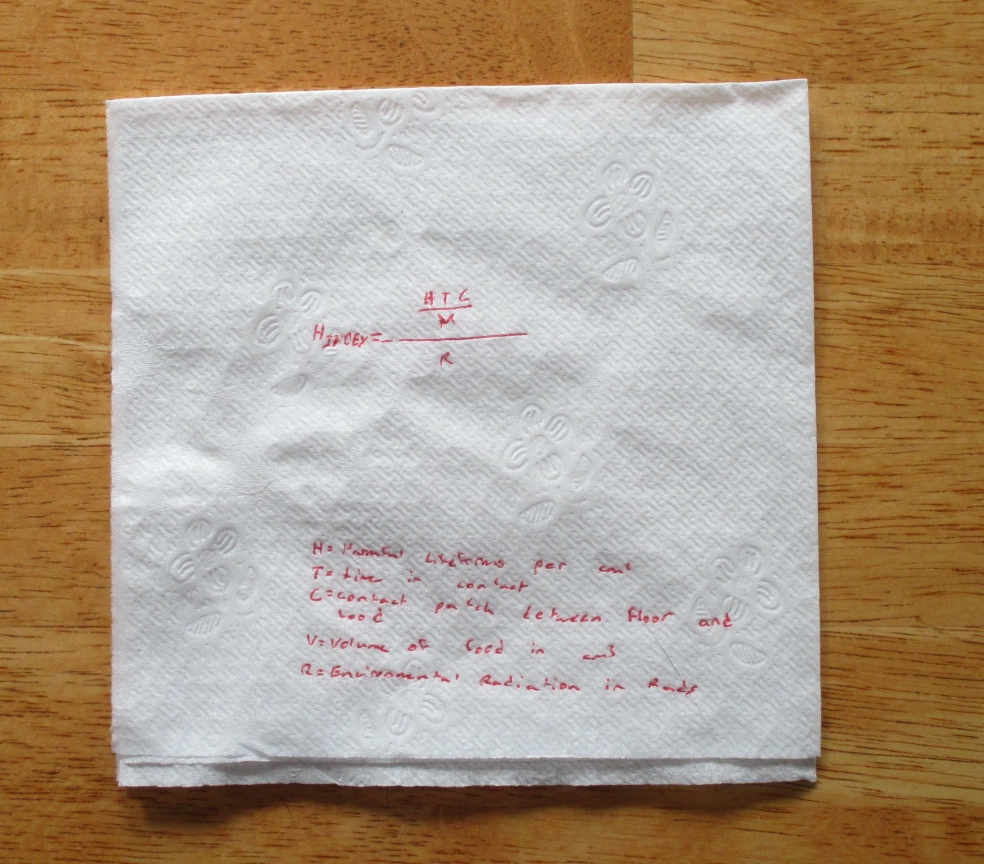
The next thing I knew, the older brother had pulled out his napkin, and was working through a formula to determine whether or not one should remove food from the floor and eat it. His napkin was the paper on which he was composing his formula—writing out the variables involved in making the necessary “calculations.”

The younger boy watched critically as his brother developed this idea, throwing in some of the factors he believed to be important. C had based his calculations on an “average bedroom floor,” using food on a plate and (basically) food in the cats’ litter box as his extreme conditions.

“Wait! Let me show you mine!” W said, grabbing the pen from C. The wheels in his head sped up, formulating, calculating. He developed a complicated equation in which one variable was “harmful life forms per square centimeter,” and another was “time in contact.” There were others, as well as a series of unknowns over other unknowns. They bantered back and forth as they considered whether they had covered all of the important elements.

Ultimately, the bite that fell on the floor made its way to the trash. Through it all, the boys were laughing and carrying on about various funny (i.e. “disgusting”) things that could happen to the food to affect edibility.

In my mind, I had to consider how this incident might have been different if I had been eating with two girls. The girls would have immediately picked up the food, thrown it out, and cleaned up the floor.

But in the interest of developing the boys’ talents at creating new formulas, I have some ideas. On Monday morning, I was texting my daughter—who spent the weekend with her father. I told her I missed her. She said she missed me more. “Tough to know,” I texted. “We can measure later.”

Perhaps the boys could write a formula for that.

IMG_1314 IMG_1315

Hairless cats

“When you grow up, I’m going to buy you a hairless cat!” my daughter taunted her younger brother this morning, in a way that implied this was the ultimate curse.

My youngest, unfazed that he would be saddled with a non-cuddly pet at the hands of his sister, snickered and continued eating his breakfast. He didn’t even look up from his cereal.

“It’ll jump up on your lap, and you’ll want to pet it, but you won’t want to touch it,” my daughter continued. “It’ll rub up against you, wanting attention, but it’ll be like holding a wrinkly, newborn baby—a naked, PURRING baby!” Hmm… having held a newborn baby or two in my time, I can’t say that would be a terrible thing. But it wouldn’t actually be a baby….

“You’ll have to put on lotion to touch it!” I’m not sure if she meant on himself or on the cat….

Seriously. I have no idea where that last thought came from. I did once have a cat that pulled out all of his fur, a nervous habit, and I called the vet to see if he needed sunscreen. But lotion? Perhaps a hairless cat would get dry skin in the winter. Interesting. I am always fascinated by the direction conversations take in our house.

This particular conversation emerged from a series of disagreeable discussions that J and her older brother had engaged in since they met up at the breakfast table. Finally disgusted, she turned her attention to her younger brother to have some more jovial interaction. We had been talking about who was occupying the wrong seat at the breakfast table; how annoying the morning singing was; and a plethora of other seemingly meaningless topics when she announced that she was going to be a crazy cat lady when she grew up. Then, the hairless cat idea began to emerge.

While the morning had not been going well, this conversation—just as I was getting ready to walk out the door—turned my mood around. As I drove off to work, I was still giggling about the hairless cat, and the “punishment” she would bestow upon her brother when they were older….

Real Estate

“Mom, can we grow some fresh herbs on the windowsill?” C—my culinary kid—asks me out of the blue. We live in a townhouse, and we have windows on only our north and south walls. We have one main window where plants will actually grow, our south-facing kitchen window, and thankfully, it is a picture window with a deep sill.

“Um, sorry,” comes the voice of W from the other room. “I’ve already reserved the windowsill for a science experiment.”

“Dude!” C replies (because for some unknown reason, boys always call each other “dude”). “You can’t reserve the windowsill!! What kind of ‘science experiment’ do you have planned that you can do in the kitchen anyway?” His attitude is typical of a 16 year old who knows everything, and it is designed to be off-putting to a younger brother. W doesn’t bother to respond. He knows he will be criticized and chastised for even thinking he could take over the windowsill. In fact, through his brother’s tone of voice, he already has been.

“You can’t claim the windowsill,” C continues on his rant. “All I want to do is grow some herbs. Herbs belong in the kitchen. We can use them for cooking… we can dry them… and, your science experiment… in the kitchen? Really?”

“Mom already said I could do my science experiment. On the windowsill.” W is quiet but firm in his response. Personally, while I remember him saying he wants to ionize soil to see if plants will grow better, I can’t remember any other experiment; so I am hoping that this is the one. The combination of the stress of single-handedly raising three teenagers and middle age is not always the most conducive to productive thought processes. Things get lost in my head more often than I would like to admit.

“W, remind me again which experiment you want to do? I remember several you mentioned recently,” and it’s true. There is always something brewing in the head of this kid. Newer, better, more effective ways to do whatever the task at hand. And unlike his Mama, he has no problem accessing his thoughts and ideas in his amazingly complex mind. Thankfully, I am right that he wants to test plants and soil.

“Why don’t you combine your projects?” I suggest. “We can see if herbs grow best in soil that is ionized as opposed to soil that isn’t.” I, of course, think this is the perfect solution to the problem, and one that will limit the clutter on my windowsill. My boys do not.

“I don’t want my herbs to be part of some science experiment! He can grow his own plants in his experimental soil!” Clearly, this discussion is going nowhere. At least nowhere positive.

“Well, that would be a way for you to both use the windowsill and to collaborate. Ionizing the soil isn’t going to hurt your herbs. It’s not like he’s using radiation or something hazardous.”

“No way, Mom!” C leaves the room, and W and I look at each other. I roll my eyes. It is going to take some convincing. Teens are tough that way. Once they know something (and by know, I mean yup, he’s the expert), it can be difficult to sway them otherwise. Experimental soil or not, it seems this is the most likely solution to the real estate issue.

Of course, there is another option. I could continue to hog the windowsill with my plants. I do, after all, pay the mortgage.