Projects

image

This summer, more than any other I can remember, my children have been off in different directions, pursuing their own interests. I have one who can drive, so he will frequently take the car and go off with his friends.

My daughter trained for, traveled to, and competed in a national competition in her chosen sport. She returned home only to sequester herself in her bedroom so she can complete her many hours of summer reading and projects for the courses she will be taking in the fall.

The youngest has spent the better part of the summer in the woods. He has been to camp; he has been camping; he has hiked more than one mountain; and he went off on a multi-day canoe trip. In between his adventures, he has been pursuing his other interests by finding ways to “tinker” and improve one aspect of our house or another.

When I returned from several days away with my daughter, I found a fifth bike in my shed, and all of the bikes leaning against each other. Since my shed provides tight quarters for four bikes and the small amount of junk that usually resides there, the fifth bike had to be crammed in.

“These bikes shouldn’t be leaning against each other like they are,” I told W. “The gears are going to get bent.”

“They’re not leaning on each other,” W replied as he walked to the door of the shed and peered in. “Oh. Oops. They must’ve fallen over.”

“Right. That would be my point.” I walked back up to the house, but the seed had been planted, and a plan was beginning to develop.

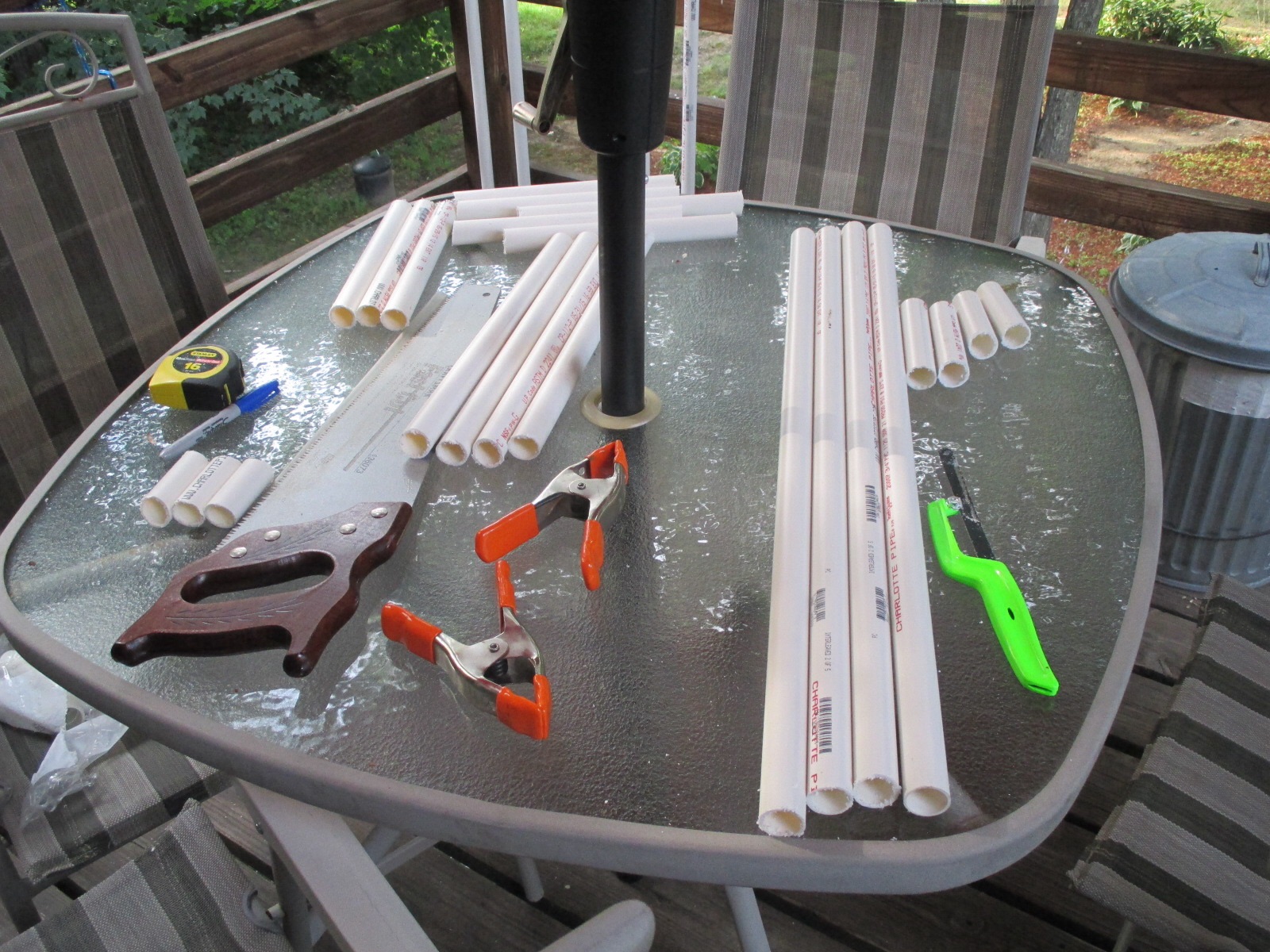
Two days later, I had several ten-foot lengths of PVC pipe, joints, and various hardware on my living room floor. Acquiring the materials was the first step of the project. But then the project leader left the house for a meeting to prepare for his next journey into the woods.

C, who had been out with a friend for the day, returned home around dinner time. He walked in the door and started to tell me about his day, and about his thoughts on the headaches he’d been having lately. He was walking into the bathroom while he was telling me this.

“This morning, I didn’t sleep late at all. I really don’t think that the headaches are from sleeping too—” His monologue stopped abruptly. He had apparently spied the “supplies” scattered on the floor of the living room. “Oh no,” he paused for effect. “What’s the new project?”

I burst out laughing. It seems there is always a project. Always “supplies” somewhere in the house. The supplies for the bigger projects end up in the living room for a time. The last time we had PVC pipe in the living room, there was a model “black hole” in the works for a school project.

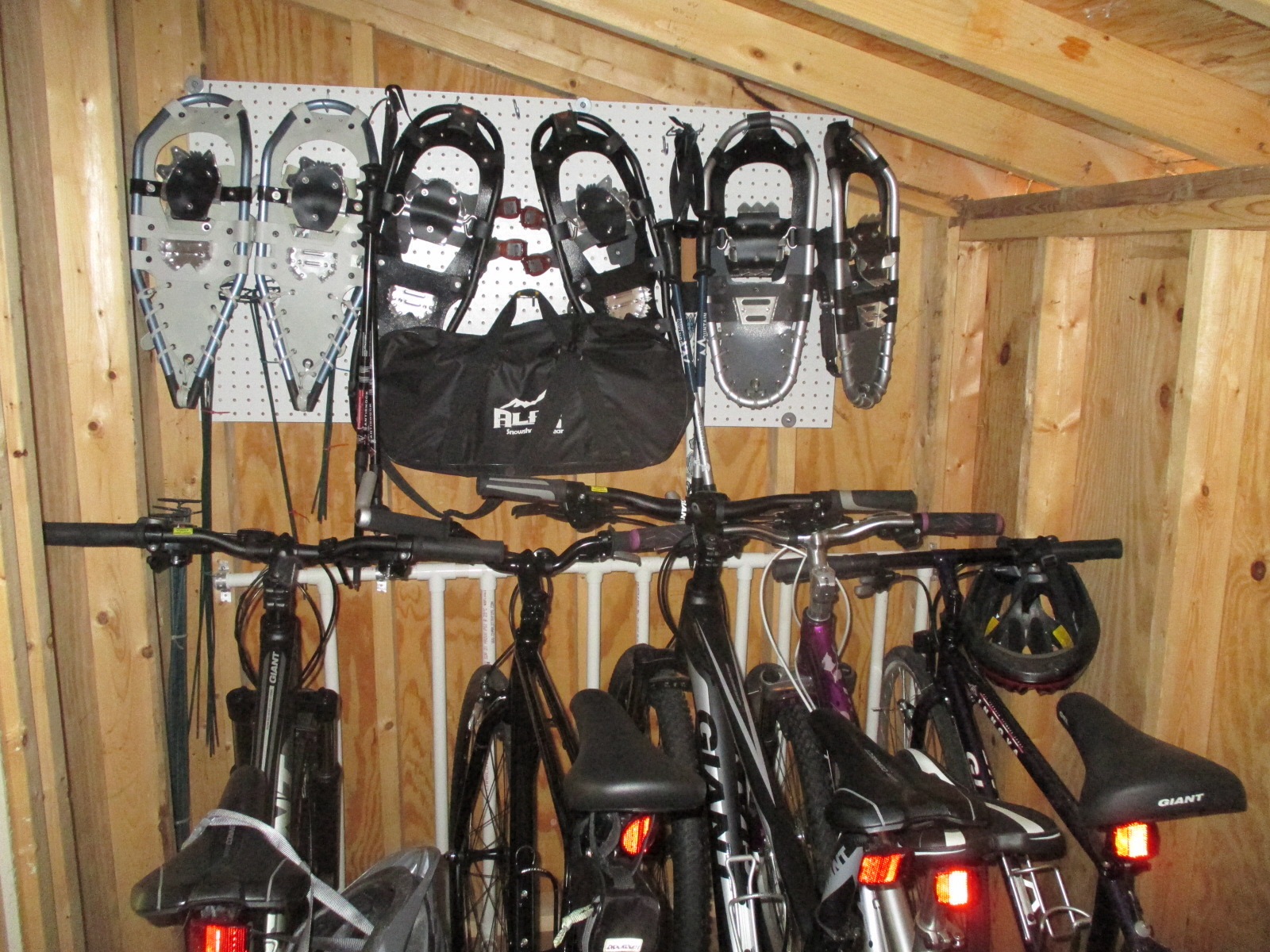
But this time, the project was for the family. Together, W and I sketched and planned; he measured the space, considered distances, and manipulated the plans to get them to work. He tried the “prototype,” and revised his design. He cut the pipe into appropriate lengths, and connected them all together. And now, we have a bike rack in our shed that keeps the bikes upright.

Isn’t it amazing what summer boredom can do?
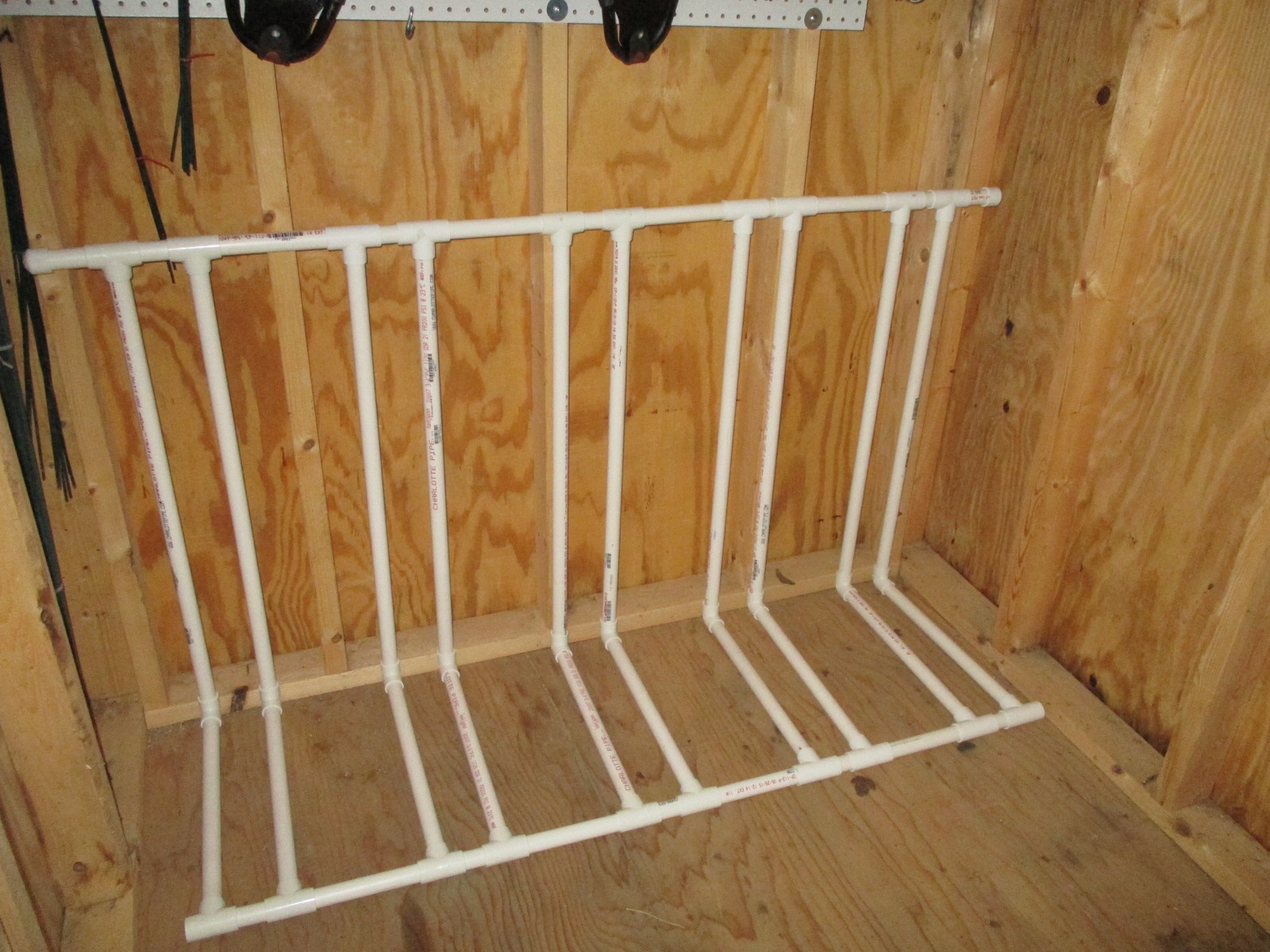
image   image

Wishes

Yesterday was a quiet day. I spent much of the day working, and J spent much of the day on the couch reading and messaging friends on her iPad. Her brothers were off doing their own thing; one was planning an overhaul of our shed while the other one had gone to the beach with a friend.

Several times, I tried to entice her to come out on the deck with me and read, but the fact that I was working was not terribly enticing. Instead, she took up some creative pursuits: a chalk mural in our parking area, sketching, origami.

Later, after the head of the day had cooled, I came downstairs from a refreshing shower. She was cleaning up small strips of paper from the floor in the living room. They were squished and rustling in her left hand. She held out her right hand as if to give me something.

“I don’t want your trash,” I told her, as I walked by. “Throw it out.”

“It’s not trash,” she said. “I have something for you.” Whatever “gift” she had was paper in her hand, white and rustling just like the trash.

“Throw it out,” I reiterated. “I know it’s trash.”

“No, Mom, it’s not trash. Just hold out your hand.” I sighed, weary and worn down. I held out my hand, fully expecting it to be filled with her paper scraps.

Two tiny folded paper stars fell into my hand. “Oh!” I exclaimed, drawing in my breath. I was surprised by their simple beauty, their tiny-ness, their perfect star-ness. “They’re beautiful! I love them!”

“They’re wishing stars.” She smiled. “The first ones didn’t come out at all, but I figured it out.”

Beautiful! And what could be better to fall into your open hand than two paper wishes?


IMG_1735

Baking

IMG_1578

I was making fresh strawberry scones the other morning.

I dumped a small pile of flour on a piece of waxed paper so I could flatten the dough and cut it into scone-sized triangles.

“Is that your bench flour?” C asked.

“My bench flour?” I looked at him, unsure of his reference. “You mean this pile here? Is that what you call it?”

“Yeah. And you save it when you’re done.” I spread the flour with my hand and plopped the dough onto the flour where it (hopefully) wouldn’t stick. I rolled it into a ball, worked it for a minute, then started to spread it out.

“You save it?” I asked, a bit incredulous, knowing what my ‘bench flour’ looks like when I’m done. In fact, as the dough stuck to my hands, I would rub little bits of dough off my fingers and into the ‘bench flour.’

“Why wouldn’t you save it?” C asked. “It’s just flour and little pieces of pie crust.”

“Well, not really….” I thought for a minute. “What if you are making chocolate scones? Then your ‘bench flour’ has little bits of chocolate dough in it. When you roll out your pie crust, it gets chocolate in it.”

“That’s half the fun,” C replied, mischief creeping into his tone. “It’s like a treasure hunt. ‘What will I find in my bench flour today? Oh look! A whole blueberry!!’”

“That’s gross,” I stated, but I laughed in response. “I think I’ll throw out my bench flour. Thanks.” Funny or not, there will be no “treasure” traveling between my baked goods.

But from here on, every time I eat something from a bakery, I will wish there were some things I did not know.

Nothing Good

One day this week, my daughter came downstairs for breakfast. She opened the fridge and looked inside. She stood there just a moment too long, surveying. She sighed, “There’s nothing good in here.” No, there is never anything good to eat in my house.

This is one thing I dread about school letting out for the summer. My children will check the refrigerator, the cabinet, wherever, sigh and declare, “There’s nothing good to eat.” In an hour or so, they will come back to stare into the fridge and repeat the process. They don’t seem to notice that I have not left the house and no one has entered. “There’s nothing good to eat,” is a complaint I hear daily.

Last night, I made a batch of blueberry muffins—a dozen muffins in all. I got up this morning to make lunches and get the kids out the door. By the time I sat down for breakfast, the muffins were gone.

Monday afternoon, I came home from an errand to find C, who had just arrived from school, sitting at the kitchen table downing a rather large bowl of pasta salad. Actually, it was the “Family Sized” bowl, and I know this because we were going to have it for dinner.

“What are you doing?” I asked, trying to temper my accusatory tone into curiosity. I didn’t want him to think that I was accusing him of doing something wrong when he had made a relatively healthy snack choice.

“Mom!” he nearly yelled, immediately defensive that I should walk in and catch him eating, of all things. “I eat four meals a day! My school lunch is at 10:30. You can’t even call that lunch.

“So this is one of your meals?” I questioned.

“Yeah. This is my lunch!” Well, it’s good to know my pasta salad wasn’t merely a snack, I suppose.

And during the warmer weather—like now—I try to keep some cut up fruit in the fridge. I cut up an average of two whole watermelons a week. I cut it into bite-sized pieces and put it in a bowl, so it will be cold and delicious and ready to eat. Every time I think I might snack on some watermelon, I go into the fridge and it’s not there. The empty bowl sits in the sink with only a bit of pink juice remaining in the bottom. One of the teens in the house has consumed the contents of said bowl, though he or she blames another. “I only ate some of it. C ate the rest!” or “J ate the last piece….”

Come to think of it, I’m beginning to understand why my kids say, “There is nothing good to eat!” I can’t find anything, either….

Warped

DSC_0688

It started at the dinner table, our discussion of warped things. W looked out the window into the settling dusk of evening. “And… it’s started raining again!”

“It’s raining?” I questioned, glancing out the window. It had been raining for two days, but the rain had stopped earlier in the afternoon, and I thought it was done. According to the weather forecaster, it was done, at any rate. Then again, the weather forecaster doesn’t have a great track record.

“Or tiny morsels of something are hitting our window,” W continued. “I can hear it.”

“Oh, that’s not rain,” I informed him. I’d been sitting at the kitchen table all day, and I had heard the noise he was referring to. “I washed the window last week, and for some reason, the sun-catcher is now tapping against the window.” I leaned in toward the window to study the sun-catcher. “I must not have put it back in exactly the perfect spot. Or may it’s warped….” The discussion wandered to how a window might be warped, until I brought it back to the sun-catcher.

I stood up to put some dishes in the sink. I looked at W. “I have a son who’s warped….” He turned to look at me, startled for half a second before the mischief smiled on his face.

“You do have a warped son, don’t you?” He glanced at C who was getting up to bring his plate to the sink. C was also smirking.

“Yes, you do,” he agreed, as he moved out of the kitchen for his next activity.

“You can totally say that, Mom,” W commented, “Because we’ll both think it’s the other one.” He watched C walk out the door, and he leaned toward me, speaking just a little quieter. “But I’d be right!”

I smiled in response, and W started the dishes.

A few minutes later, the warm water had begun to lull the crazy day out of him. He looked up from the suds that he had been spreading around a pan. “You know Mom, I’m not warped. I’m just bent.”

Yes, my friend, we’re all a little bent. That’s what keeps us from breaking.

Going nowhere

We were on vacation recently, staying in a place that has all sorts of fun things to keep active kids of most ages occupied and entertained. One of these attractions is a Fun Barn in which there is a bounce house, a ping-pong table, a climbing wall, and an area in which kids (um… and adults) can have nerf-ball battles. This area is caged in with netting and has hundreds of foam balls with several air powered shooters strategically placed around a climbing structure with a slide, making it easy for groups to have rousing battles. So we did.

It was after dinner on our last night. As four teenagers and two adults, we were able to have quite a battle before some younger children showed up, and we had to turn the energy down a notch. It was getting dark by then, so we decided to leave the Fun Barn to walk back to the lodge. It was chilly for the end of April, but the days were getting longer, the snow had finally (mostly) melted, and the flowers were starting to bloom. We could hear spring peepers off in the distance.

As we exited the Fun Barn, J wanted to go to the playground. It was getting dark, and the sign posted on the playground fence claimed the area closed at dusk. But a simple sign would not deter J. “Let’s just go see,” she said, running ahead with W to check out the playground. “The chain’s not up!” she reported of the yellow plastic chain used to discourage after hours playground use.

Gleefully, the two of them slipped through the gate and ran to the merry-go-round. Not a carousel merry-go-round, but a playground merry-go-round—the kind that most schools did away with years ago as children flew off when they spun too fast and couldn’t hold on. My two each grabbed a side and started running to get the merry-go-round moving.

“When I say THREE, jump on!” called W. “One, two, THREE!” They both landed with the muffled thud of rubber soles on metal platform. They hung their heads off the edge, hair flying up in the centrifugal force. They completed this exercise several times before their activity diminished to lying on the platform while the movement slowed, looking up at the branches of the tree above.

“Mom, can I have your camera?” J asked, and I handed it over. She started taking pictures from her spot on her back looking up at the sky. She spent several minutes clicking, checking the the screen, sighing and trying again.

What she didn’t realize was that it was too dark for pictures. And she also didn’t realize that what she wanted to capture was not the branches above her and the moon in the background. She wanted to capture the moment, the feeling of a beautiful spring night, vacation, and family time spent together. She wanted to capture the spinning, the breeze, the feeling of going nowhere, and the thrill of the ride.

IMG_1519

Liebster Award

liebster2

At the end of last week, Susan, at The Best Things in Life nominated me for a Liebster Award. I was thrilled, but before I accepted, I felt like I should achieve some crazy blogging milestone. So maybe I did not achieve a “crazy milestone,” but I posted my 50th post!

In the blogging world, 50 posts is not much—a drop in the perpetual post-bucket. However, for me, it feels pretty big. I put off blogging for a very long time because I was afraid that I would not be able to keep it up. I was afraid my hectic life would get in the way, and my blog would fall by the wayside with only 10 or 15 posts. While my posting has slowed down a bit since my spring teaching picked up at the beginning of February, I have still kept at it. I will get back to posting more regularly.

I took a look at the “Official Rules” for the Liebster Award —which seem to be ever changing and marginally “un”official. (The Liebster Award: The Official Rules). In looking at the rules, I realized that I had a little flexibility. And to me, flexibility means room to color outside the lines, something my creative self adores! But I will try to stay within the bounds of the rules as much as possible.

First of all, many thanks to Susan at The Best Things in Life for finding my blog in this jungle we call the Internet, and then nominating me for this award. Sometimes, finding the good stuff feels like magic, but other times, it seems like pure, dumb luck. As a blogger, I have to get better at the magic aspect of it.

Next, I will answer Susan’s questions:

  1. What state or country do you live in? The U.S.—New Hampshire.
  2. What is the best thing about where you live? Eventually, it stops snowing and spring arrives.
  3. What is your passion? Helping writers to develop their craft. Raising caring, happy children.
  4. How do you relax? Relax? Am I allowed to do that?
  5. Vanilla or chocolate? Um… is coffee an option?
  6. Favorite vacation spot? We have the most wonderful camp that we go to. It’s not really a “vacation spot” per se, but my children and I—and now some of our extended family and wonderful friends—have created some amazing memories there. Because it was the first “vacation spot” I was able to take my children to, it has become a very special place to us.
  7. Favorite band? Too many to mention—lots of bands and lots of solo artists.
  8. Why do you blog? I blog because I find it relaxing. I think that even though I am a little crazy creative and unique, there is much of who I am (to my kids, friends, students, co-workers, pets, etc.) that is part of the universal experience of humanity.
  9. What was the last book you read? I read a lot of YA literature. I just finished Miss Peregrine’s Home for Peculiar Children for a class I’m teaching.
  10. Weirdest thing you have ever eaten? Lamb’s brain. Served on the half-skull.

And now that I have answered these questions, I will nominate six bloggers—who may, or may not, choose to accept the Liebster award—and pose some questions for them to answer:

EpicGran

Renaissance Musings

Hypedad

Scribbles and Crumbs

Motherhood and all the rest

Bari Nan Cohen

Here are my questions:

  1. Where do you live?
  2. If I were a tourist in your area, what should I absolutely not miss?
  3. How long have you been blogging?
  4. Is there anything you have found surprising or unexpected about blogging?
  5. What are your blogging goals?
  6. In one sentence, tell me about your writing process.
  7. What is the most interesting place you have ever visited?
  8. What is your favorite book/series?
  9. Do you have any pets, and what types?
  10. What is your favorite book?
  11. What is your favorite movie?

I look forward to reading your responses!

Perspective

Every now and then, we catch a glimpse of our children’s lives through reflection on our own experiences, past and present. Recently, I had one of those moments… when my thoughts on my children’s attitudes suddenly clicked into place in a new and unexpected way. It was an “ah-ha” moment, of sorts.

Over the weekend, I was introducing my sister to some people who grew up one town over from our own hometown. Since it was a small town in a rural area, growing up in the next town implies that we shared a fair degree of history. We knew some of the same people, competed as rival schools in sports, hung out at some of the same places, frequented the only local movie theater, and shopped in the same stores.

As we briefly discussed the fact that my sister graduated from a different high school, my mind wandered back into the past. My sister and I had different teachers. And just like any school, a handful of teachers were known to be “difficult,” more in their behavior and attitudes toward students than in their educational expectations.

For the most part, I had teachers who were memorable in positive ways: they wanted to teach, and they genuinely liked working with students. However, there were exceptions. There were teachers for whom unflattering nicknames had been passed from one class to the next for near generations. And it was one of these teachers with just such a nickname that I stumbled over while I was taking my ‘mind journey’ down memory lane over the weekend.

And after stumbling, I sat sprawled on memory’s path, realizing that we hadn’t been very nice back in high school. And then, I was pulled to the present, to the words I had recently said to my son when he called one of his (male) teachers a diva. “You shouldn’t be disrespectful to your teachers, C. They have a tough job teaching you guys all the things you don’t think you want to know.”

Gulp!

There I was, stuck straddling a line. As a teacher myself, I would normally advocate for the teacher in this instance. Getting up in front of a classroom full of apathetic, sometimes ungrateful (insert year here: sophomores, seniors, you name it) day after day is not an easy task. It can be brutal.

Then again, being a kid in a class with a teacher who has forgotten what it is like to be a teenager—a teacher who hasn’t updated his or her approach to teaching since the age of the dinosaurs, and chooses not to (ever) smile—is not easy, either.

Suddenly, I realized that what I perceived as “disrespect” was really something of a rite of passage. As we work to figure out our relationship with the world and how to deal with people we don’t necessarily want to get along with, but need to get along with, we seek to find a comfortable place to fit them into our experiences. We use nicknames to diminish these people so they are slightly less intimidating and they fit more neatly into our experience. For teens, this can be the way they survive the classes that otherwise threaten to bore them, annoy them, or terrify them.

And straddling this line between kid and teacher is the constant battle I face as a parent. This is the battle that determines if I am successful or not. I am constantly faced with the need to remember what it was like to be in my children’s shoes—whether they are teenagers or toddlers, while still teaching the skills necessary for them to function in a world which requires an ever changing mix of diplomacy, sensitivity, and candor.

For the most part, my children are respectful and polite when they walk out my door and into the world. Perhaps then, they really are learning what they need to know to make their way in the world. Perhaps a little name-calling, in the right context, can help to put relationships in perspective.

Culinary Issues

My culinary kid admitted to something by accident last night. And now I know the truth.

He started the school year in his culinary program with the basics: knife skills, chopping and cutting, and moved on to stocks, soups, salads, and sandwiches. I asked him if he got to bring anything home. “No Mom. We package it and sell it in the café,” because yes, vocational schools have cafés where teachers, students, staff, etc. can buy lunch and ready made dinners. It’s a great idea, really. Except for the fact that the culinary students don’t get to take any food home to test on their parents.

Second semester, my son moved to baking, and he has been studying the various processes involved in baking. So far, I have heard about the banana bread, the blueberry crumb cake, and the rolls. For the last two weeks, I’ve been hearing about the rolls. When I (once again) asked him if he would be bringing any of his baked goods home for sampling, he said no. Then he said, “The blueberry crumb cake wasn’t very good, anyway.” Okay then.

Last night, we were talking at the dinner table, and he started to talk about the “sculpture” he made in the middle of the school lunch table from everyone’s trash, i.e. leftover packaging. (In our house, we have a long history of making things out of—um—recyclables. That’s just the way we roll…). “First, I had a milk carton, then another milk carton, then the big bag from the rolls I brought, then another milk carton, then the ‘mushroom’ I made from my lunch bag….”

Stop. Right. There. My mind got stuck on the big bag from the rolls I brought. I didn’t hear anything else that was part of the sculpture because my mind stopped at that phrase. I realized he brought rolls from culinary.

“I’m sorry. Did you say you brought rolls to school?”

He stopped talking and looked at me with a crooked half-grin, then quickly looked away. “Yeah,” he said, fidgeting in his chair. He turned back to his siblings and continued his story, trying his best to ignore the piercing stare I was throwing directly at him. “So anyway, I offered one to my—“

“And you gave them out to your friends? At school? Without bringing any home?” Clearly, I must have misheard him.

“Yeah, Mum.”

“Why didn’t you bring one home so I could try it?” After all, I’ve only been asking since September, I wanted to say.

“Because I only brought six,” he paused here while he attempted to concoct a reason. “And I had plans for them.” And he turned back to his siblings and started talking about the people who were lucky enough to get a roll. Freshly baked. From his culinary class.

“You know what, C?” I interrupted his story.

“What, Mom?”

“I’m going to bake some cookies tomorrow, and I’m not going to give you any.” He turned to me. I looked him right in the eyes, my stare intense and unwavering. “Because I have plans for them.” I winked and smiled.

So now he knows the truth.

The Frog

IMG_1411

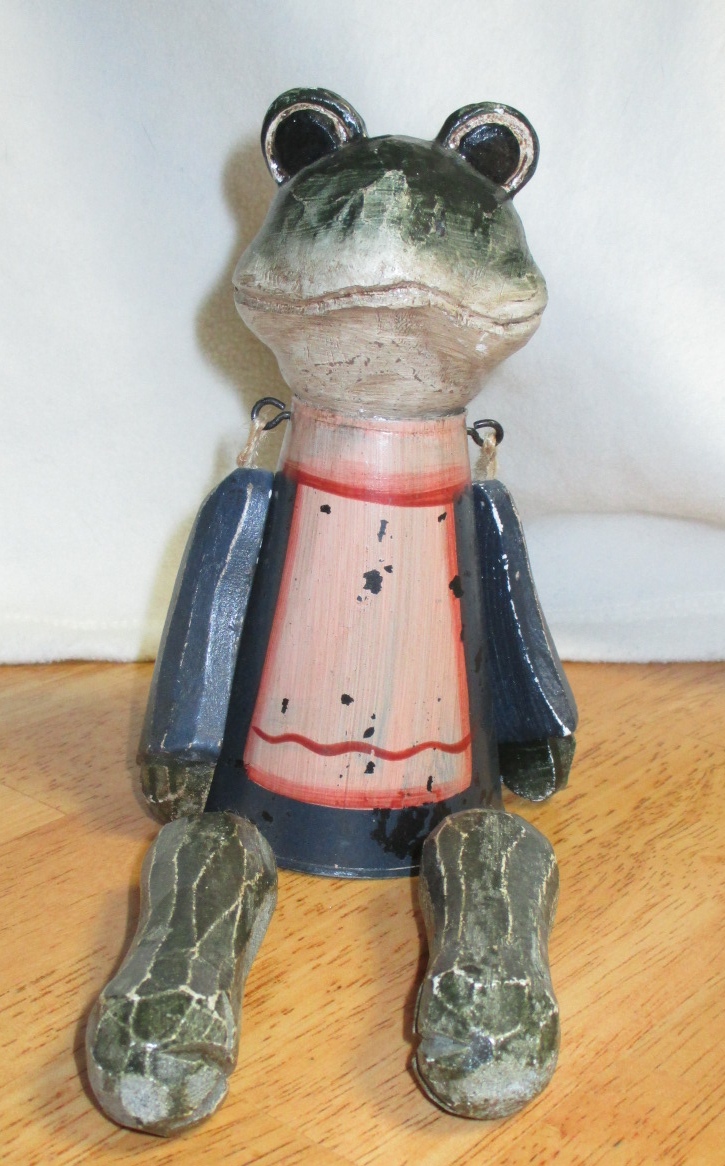
When I was younger, I had a collection of knickknack frogs. One of these—made of tin and wood with limbs that dangle from joints of twine and wire—was a gift that I received many years ago, and it has a simplicity to it that is reminiscent of an earlier era. As I have moved residences over the years, I’ve pared down my collection to my favorites. This particular frog remained as it reminded me of my past for reasons I can’t exactly pinpoint.

In the townhouse where I landed with my children after my divorce, the frog took up residence on a shelf that held some books and a few ornamental items. Seldom did I notice it sitting there in its decorative, take-up-space kind of way.

One day when my children were still fairly young, I found this very frog sitting in the middle of my propane heat stove, right next to a candle that I had placed there at the end of the most recent heating season. It was late spring, and warm enough out that the windows had been open with regularity. The sight of the frog startled me because I wasn’t expecting it to be there. How odd, I thought. I wonder who put that there? It seemed like a bold placement for such an object, and I picked it up and moved it back to its normal location on the shelf.

The next morning, I woke the children, and I took a quick trip to the basement laundry room to gather some clothes. As I passed through the living room, I stopped abruptly, startled when I spotted the frog, once again sitting proudly—albeit unexpectedly—on the heat stove. The children were upstairs waking and preparing for school. I glanced around the room, not really sure what I was looking for. The room was empty. I set the laundry basket on the floor, and returned the frog to his spot on the bookshelf.

I took a deep breath, shaking off my surprise, and I went about my morning preparations.

When I was ready for the day, I went downstairs to the kitchen. I opened the door to welcome the spring air, and went to the back of the house to open the back door. Mid-way through the living room, I froze. There, on the stove, was the frog, sitting right in the middle where he’d been twice, now three times. My heart pounded in my chest as I thought through the possibilities. I glanced around the room expecting the unexpected, only daring to move my head. I pondered going to the basement to look around, but I couldn’t do it. Not alone. I went to the kitchen phone and called my neighbor.

“I think there’s someone in my house,” I reported in a near whisper. “Can you come over?”

“I’ll be right there.” She arrived a minute later, wielding a kitchen knife.

“What are you going to do with that?” I asked her.

She looked down and shrugged, smiling weakly. “It’s better than nothing!” Together, we searched the house while I explained the unexplainable to her. We found nothing, but we got a good laugh. We concluded that one of the children was playing a trick on me. No one would fess up.

It wasn’t until several months later that my oldest finally admitted to moving the frog. He read in a book how to secretly move an object. Or something. I have to say, he got me good, and we will forever joke about it.

Since that experience, the mere sight of this little frog holds an unexpected emotional charge. When I happen to see it sitting (usually in its normal place) on the shelf, I have a momentary jump in heart-rate, as if its very glance in my direction has power beyond its inanimate self. Then I laugh at the memory.