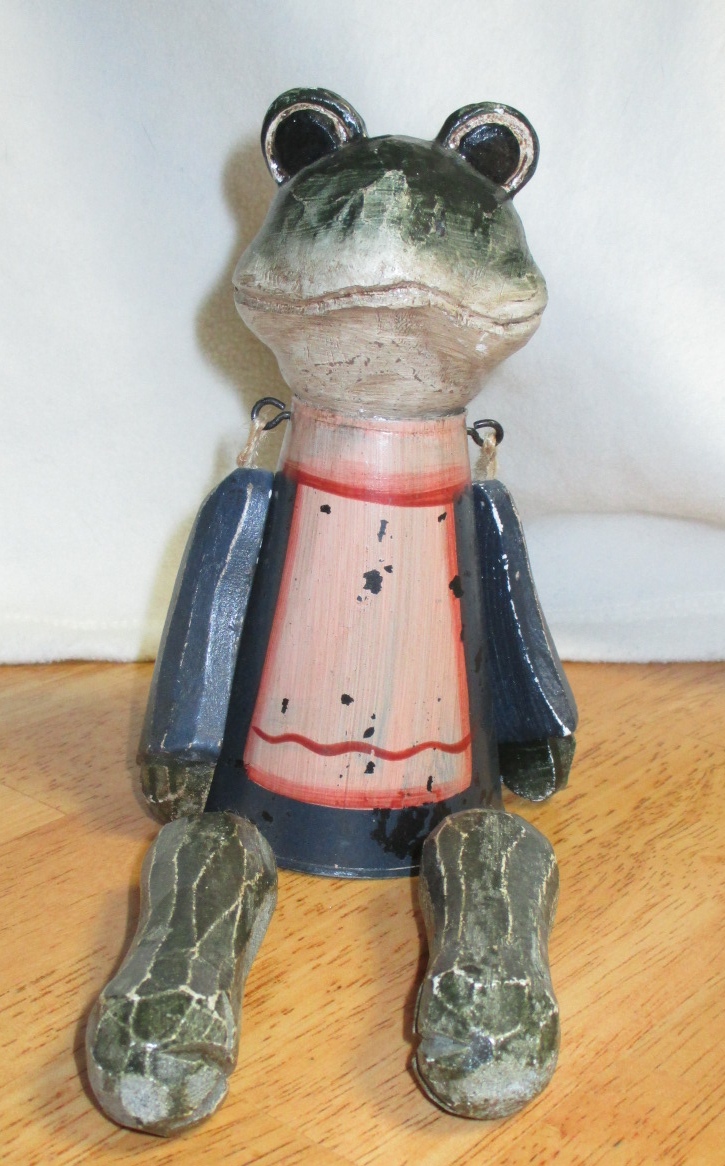
The Frog

IMG_1411

When I was younger, I had a collection of knickknack frogs. One of these—made of tin and wood with limbs that dangle from joints of twine and wire—was a gift that I received many years ago, and it has a simplicity to it that is reminiscent of an earlier era. As I have moved residences over the years, I’ve pared down my collection to my favorites. This particular frog remained as it reminded me of my past for reasons I can’t exactly pinpoint.

In the townhouse where I landed with my children after my divorce, the frog took up residence on a shelf that held some books and a few ornamental items. Seldom did I notice it sitting there in its decorative, take-up-space kind of way.

One day when my children were still fairly young, I found this very frog sitting in the middle of my propane heat stove, right next to a candle that I had placed there at the end of the most recent heating season. It was late spring, and warm enough out that the windows had been open with regularity. The sight of the frog startled me because I wasn’t expecting it to be there. How odd, I thought. I wonder who put that there? It seemed like a bold placement for such an object, and I picked it up and moved it back to its normal location on the shelf.

The next morning, I woke the children, and I took a quick trip to the basement laundry room to gather some clothes. As I passed through the living room, I stopped abruptly, startled when I spotted the frog, once again sitting proudly—albeit unexpectedly—on the heat stove. The children were upstairs waking and preparing for school. I glanced around the room, not really sure what I was looking for. The room was empty. I set the laundry basket on the floor, and returned the frog to his spot on the bookshelf.

I took a deep breath, shaking off my surprise, and I went about my morning preparations.

When I was ready for the day, I went downstairs to the kitchen. I opened the door to welcome the spring air, and went to the back of the house to open the back door. Mid-way through the living room, I froze. There, on the stove, was the frog, sitting right in the middle where he’d been twice, now three times. My heart pounded in my chest as I thought through the possibilities. I glanced around the room expecting the unexpected, only daring to move my head. I pondered going to the basement to look around, but I couldn’t do it. Not alone. I went to the kitchen phone and called my neighbor.

“I think there’s someone in my house,” I reported in a near whisper. “Can you come over?”

“I’ll be right there.” She arrived a minute later, wielding a kitchen knife.

“What are you going to do with that?” I asked her.

She looked down and shrugged, smiling weakly. “It’s better than nothing!” Together, we searched the house while I explained the unexplainable to her. We found nothing, but we got a good laugh. We concluded that one of the children was playing a trick on me. No one would fess up.

It wasn’t until several months later that my oldest finally admitted to moving the frog. He read in a book how to secretly move an object. Or something. I have to say, he got me good, and we will forever joke about it.

Since that experience, the mere sight of this little frog holds an unexpected emotional charge. When I happen to see it sitting (usually in its normal place) on the shelf, I have a momentary jump in heart-rate, as if its very glance in my direction has power beyond its inanimate self. Then I laugh at the memory.

Faux Pas

I was driving my daughter home from dance the other night, listening to the radio, and absently pulling on the material of my pant legs. We had been having a conversation about dance, play practice, school, and what was for dinner. A song came on the radio, and I started to sing.

Suddenly, my daughter looked down at my leg. “Are you wearing leggings?” she asked in that incredulous tone that teenagers use to indicate that their parents are doing something unbelievably ignorant.

I rubbed my leg, trying to remember which pants I was wearing, while continuing to keep my eye on the road. “No, they’re not leggings. They’re knit jeans.”

“Good! There are a lot of people who wear leggings who shouldn’t,” she continued, clearly not thinking through the implications of what she was saying. But her dialogue was effective. Immediately, visions of people who shouldn’t wear leggings entered my mind. Then I thought about her comment.

“I’m sorry…. Are you saying I shouldn’t wear leggings?” I asked.

“I didn’t mean you!” she responded, too quickly. She backed up. “I’m just saying that a lot of people wear leggings, and they shouldn’t wear them.”

“I have some leggings,” I admitted. “Is it bad for me to wear them? Is there something that says I shouldn’t wear leggings? Maybe I’m too … old?” I wasn’t trying to push her. I was just trying to figure out the teenage rules for what mothers should wear. I wouldn’t want to cross any invisible lines.

“Really, Mom?” That was it. No explanation. No further comment. Just, really?

“How about if I wear them tomorrow?” I pressed. “I have something that I could wear with them that would be completely appropriate.” I waited for her reply.

“No Mom.”

“So I can’t wear leggings?” I made sure my tone was now bordering on a teenage whine. “But they’re comfortable!”

She sighed a loud, disgusted sigh. “Not to work, Mom.”

Oh.

Yes, the fashion police now live in my house. The fashion police take notice of all adult wardrobe faux pas, and “they” are not afraid to intervene….

Temperature Check

It has been a cold winter; there is no question about that. Even in the early days of March, the morning temperature still hovers around the 0° point. One day recently, I went into the kitchen at just about the crack of dawn and glanced at our indoor/outdoor thermometer. The outdoor temperature read -1°. This fact barely registered in my brain; the morning low had been nearly the same for days, maybe weeks.

I went about my early morning business packing lunches, filling water bottles, and overseeing the consumption of breakfast. My mind was not fully on the task at hand because I was pondering the day ahead. W came to the kitchen, puttered around for a minute longer than usual, and fixed himself breakfast. C stumbled down the stairs next. He stood in front of the open fridge for a moment, declared the space void of anything edible, and began packing his backpack.

Sandwiches were made, thermoses filled. I moved on to water bottles. J made her way down the stairs, popped a bagel in the toaster, and sleepily sat at the table. I pulled the pitcher of water from the fridge and began pouring it into the bottles.

“OH MY GOSH!” J exclaimed, startling us all. “Why is it so cold out?!”

Why the alarm? I wondered. Not registering that I had already checked the temperature, I looked at the windowsill. The thermometer read -17°. My mind ticked back through its stash of morning snapshots. Confusion tugged at the edges of my memory. It wasn’t that cold a few minutes ago. Was it? Had it really dropped so fast? What was going on? All of these thoughts slipped through my mind, one after the other, like a deck of cards being shuffled.

Overhearing the conversation, W came in to the kitchen from the living room. “I suppose I should change that back to Fahrenheit, huh?” he said. He picked up the thermometer and pressed the Celsius/Fahrenheit toggle button. He ducked his head to hide the mischief evident in his satisfied smirk as he made a quick retreat to the other room.

Yes, we always have to be on our toes in my house. You just never know who is up to mischief!

Invisibility

One day, when my children were fairly young, I discovered that I had the power of invisibility. While this discovery was totally unexpected, invisibility has been a useful trait over the years.

My children were preparing for bed one night. They were somewhere around the ages of four, six, and eight. I had set them to the task of getting into their jammies and brushing their teeth in preparation for bed.

I was exhausted, as I so often am at the end of the day. I went in my room to lie down for a minute—my own mommy “time out”—while I waited for them. I started to zone out, my mind drifted, though I remained attentive. I remember over-hearing their kid conversation. My oldest was talking about something that had happened on the school bus that day, and the manner in which he spoke was just a little different than when he spoke to me. The tone in his voice as he relayed the event to his sibling was one of authority. It was pure kid-to-kid conversation, and as the oldest, he knew the most.

I heard my name mentioned in the conversation. Then I heard little footsteps in the hall, stopping at the door to my room. My room was dark, but light shone in from the hallway.

“Mommy?” a tentative voice asked into the darkness. I was tired and almost asleep. I didn’t answer. The footsteps retreated. “Do you know where Mommy is?” the little voice asked her little brother.

“No,” brother responded.

“I can’t find her,” said the little voice. She had barely looked, but brother didn’t know that. “Will you come downstairs with me to look for her?” And two sets of footsteps padded down the stairs and around the first floor while I puzzled over the fact that she had stood in the doorway of my room and not seen me lying on the bed. I heard a far-off voice inquiring into the dark basement. And then the footsteps came back up to the second floor.

“Where is she?” the two little ones continued to look for me as they conversed about my whereabouts. Hand in hand, they walked into my dark bedroom and passed inches from the foot of the bed as they checked the bathroom—also dark. They turned around and walked out the door, still calling to me despite my presence just a hair’s breadth away. I smiled in fleeting satisfaction that I was somehow invisible.

However, the discussion right outside my door was growing emotional and slightly panicky as the children considered how I could possibly have disappeared. “Hey you two,” I piped up. “I’m right here. You walked right by me.” To myself, I marveled that I could be invisible while I was in plain sight.

These days, it’s not so easy to be invisible. But when I am, I have learned to use my invisibility carefully. Sometimes, I try hard to conjure this power with no success; other times it just happens. Driving the car—especially with a car full of kids—I tend toward invisibility. Other times, I might be invisible from a different room.

No matter where I am when this power overtakes me, I have come to realize that in my times of invisibility, I must remain quiet and listen in order to get the greatest benefit.

Snow Wonder

IMG_1369

I went out the other evening to pick up my daughter from her team practice. It was snowing, though with the winter we’re having, I prefer not to acknowledge snow. I will admit, however, that it is beautiful when it is falling, even when the snow banks are already eight feet high and the grass may not reappear until July.

When I arrived in the parking lot, the carpool had not yet gotten back from the gym. I rolled down my window to talk to another mom, and her young son opened the back window and began playing with the snow that was gathering on the car. “What’s that?” I asked him.

“Snow,” he responded.

“No,” I shook my head. “There’s no more snow. That’s bugs. They’re spring bugs.”

“It’s snow,” he told me without a hint of question in his voice.

“It’s little tiny bugs. Lots and lots of them. Those bugs only come out in the spring.”

He shook his head. “No. It’s snow,” he said, and he rolled up the window. Clearly, he was done with my silliness, and he didn’t need me to change what he already knew.

My daughter arrived, and she immediately hung her head out the window to catch some big, juicy snowflakes on her tongue before we drove off. “Can you put on your high beams when we get to the back road?” she asked, settling back in to her seat. The snow was lazy, but steady as the car pulled out of the parking lot.

I smiled to myself. “I’ll try,” I told her, not making any promises. I never knew how the traffic would be, but the back road was usually not heavily traveled at this time of night.

When we turned onto the back road, she was disappointed to see there was a car ahead of us. I slowed down and the car pulled ahead and disappeared around a bend. I flipped on my high beams while I had a chance. The snow took on a life of its own, speeding toward our windshield like stars whizzing by a spaceship.

As we traveled down the road, the snow suddenly stopped; then a few feet later, it started back up again, like we had driven through a brief tunnel or a hole in the cloud.

An amazed exclamation of “Whoa!” escaped from my daughter. Her word, her tone of wonder, were perfectly synchronized with my own thoughts. The break in the snow was so unexpected, so incredible, so wonderful, “Whoa!” was a perfect reaction.

To share a moment of natural wonder with one of my children is always special. The fact that her outer reaction exactly mimicked my inner reaction let me know that somehow, as I have parented her through so many every day moments, I have taught her to appreciate the ordinary wonders in life.

Creative Mathematics *

“Jimmy wants to determine the height of the tree on the corner of his block. He knows that a fence by the tree is 4 feet tall. At 3 pm, he measures the shadow of the fence to be 2.5 feet tall. Then he measures the shadow of the tree to be 11.3 feet. What is the height of the tree?” I hear from the other room. Homework is going on, and from her tone, I can tell my daughter is disgusted by the question being asked of her in geometry. “Ugh!” she says to no one in particular.

I remember this type of word problem as the bane of my existence in high school. “It’s 27.2,” I call to her, omitting the unit (because really, does it matter?). I am fully confident that I am not even close.

“What?” she says, a hopefulness in her tone that indicates she believes I might actually be supplying her with the right answer.

“I said, the answer is 27.2. I just did it in my head. Impressive, isn’t it?” I walk into the living room and smile at her. All three children are staring at me like I have three heads, maybe four. “What?” I look at them innocently. “I made it up. It’s called ‘creative mathematics.’ It’s a new thing I just invented.”

“Oh!” My daughter jumps up, completely on board with the new class I have just discovered. It would be kind of like creative writing, but on a math scale. “Where do I sign up? I could totally get into that class!”

Me too… and probably, many other people I know would also appreciate it. Word problems would be awesome! The question would no longer say, Calculate the height of the tree. It would now ask, How tall do you want the tree to be? Or maybe you could simply decide how tall you need the tree to be to suit your purposes. Of course, you would have to give the reasons to support your answer.

Creative mathematics would have nothing to do with calculations. It would be about problem solving and creating your world with the specifications that you find necessary. Plausible or not, you would be allowed to reimagine your world to suit your needs.

Granted, just like creative writing, creative mathematics would not fit every situation. For example, if you were putting new counters in your kitchen, you would need an accurate measurement rather than simply deciding how big you wanted your counter to be. However, such a mathematical option would allow the creative among us to enjoy math and take a break from the many long years of calculating the right answer and showing the work we did to get there.

In life—even in situations like medicine—there are very few “right” answers. Creative mathematics would honor that fact and encourage effective problem solving. Yes, in mathematical calculation, students would still be expected to find the right answer. But in creative mathematics… the sky’s the limit.

* this post is dedicated to the best math teacher I have never had. Once upon a time, a long time ago, she spent hours in daily telephone tutelage to move my sorry math-challenged self through high school calculus.

Essays

“I have to work on my history essay,” my son announces.

“Isn’t that due tomorrow?” I ask.

“Yes. But it won’t take long.” To me (a writing teacher), writing an essay seems like something that might take some time. This particular essay involves a bit of research in the gathering of sources, and while it’s not a lengthy piece, this particular teacher is a stickler, to say the least.

“What should my thesis be?” he asks me from the other room, as if I know the assignment and the points he will make. I think about how much easier it would be if he would venture into the kitchen where I am preparing dinner so we could discuss without yelling back and forth. And since I have been struggling with my own writer’s block, I am not feeling particularly adept to be giving advice on how to start writing.

“Think about the points are you going to make,” I say. When pressed, yes, I can hold a writing conference from a different room. “Those need to be part of your thesis. But you probably want to do your research first.”

“I’ll just start writing,” he declares, dismissing any input I might offer at this point in the process. Fine then. He did ask for my help, after all. I swallow hard as the teacher in me wells up, desperately wanting to comment about the research piece.

I go about my business making dinner and finishing up some evening chores. After about half an hour, I start to the basement to tend to the laundry. My son is staring off into space. “You need to focus or you’ll never get that done,” I say in passing.

“Mom…!” he says in his favorite tone of teenage incredulity. “I’m working on it!” He springs from the couch, iPad in hand, and starts following me. “You have to see this….” But I am already down the stairs in the laundry. “Mom, look.” He holds the iPad out for me to see, and three solid paragraphs fill the screen. I am impressed. “See?” he says. “I’ve got this.”

It isn’t long before he is finished, and he brings me the essay to read. Aside from some repetition in two of his points, which I mention, it’s not bad. We work on the thesis, and he returns to the living room to type and reformat. In a few minutes, he says, “I need help with my citations.”

After a brief discussion of whether or not we can work from the same room, we decide he needs the computer, and I need to cook dinner. So, from the kitchen I say, “You’re going to write the author’s last name followed by a comma, then the first name, period….”

“Mom!” my daughter interrupts. “You have that memorized?? That’s so wrong!” Maybe. But since I use it often—as in daily—the memorization came as a side effect.

“Hey Mom! My friend hasn’t even started his paper yet. He’s hoping for a snow day tomorrow!” C laughs.

“Hmm. He does know we had a snow day today, right? Is he planning to write the essay?”

“Who knows,” C says. “But mine’s done!” He pauses for a minute. “I just need a title. What should my title be?”

He struggled with the title longer than he did on writing the entire essay. Which just goes to show, sometimes the easy things can trip us up. Sometimes, we get caught up in the little things in life and end up with writer’s block. As for his friend? He’s still working on the essay. I think he’s stuck on the first sentence.


Memory foam

This weekend, I took my daughter to get some new sneakers for the P. E. class she will have through the new semester. We went to a store not far from our house where they were having a buy one pair, get the 2nd for 50% off. She found some sneakers she liked, and began the search for her size, 6.5.

I don’t really need shoes, but I tried some on, just for kicks. I started with a 7.5, which was large, so I moved to a 7. While I found the memory foam insole quite appealing, the shoe was a bit big and gappy on my foot. (Since I’ve had children, my feet have shrunk. Most women say the opposite is true, which proves that I am an anomaly). Needless to say, we left the store with only my daughter’s new sneakers.

On the drive home, she asked me why I didn’t buy any shoes. “50% off, Mom. You could have gotten some shoes for yourself.”

“But I don’t really need shoes,” I told her. “I tried some, but the 7 was a little big, and the 6.5 probably would have been too small.”

“Wait…” she paused while she thought about what I had just said. “If you can wear a 6.5 shoe, that means I can wear your shoes!” She said this as if she were making a great announcement. “You could have gotten some new shoes, and I could wear them!”

All the more reason not to buy some shoes, I thought, but instead, I quickly built upon her newfound realization. “And that also means that I could wear your new sneakers!”

“But you wouldn’t,” she stated with matter-of-fact certainty.

“Why not? I like the shoes you just picked out. They’re a nice color.”

“Mo-o-o-m!” she drew out in that teen tone that borders on a whine, but isn’t quite. “That’s gross.”

“What’s gross? It’s gross for me to wear your shoes, but not for you to wear mine? How is that different?”

“Well,” she began in her best voice of authority. “When you wear my shoes, you will mash down the memory foam, and it won’t be any good any more.”

“Wow. Did you just call me fat?” I teased. “Really? I don’t weigh that much more than you.”

“Mom, I weigh 76 pounds…”

“84,” I corrected. “Nice try, but that’s not the way memory foam works. It doesn’t remember who was in the shoes last. It’s called memory foam because it remembers… well…. Okay, I don’t really know. But I won’t ‘break’ it just because I wear your shoes.”

By this point, we were both laughing. Back when the kids were little, I used to be able to make up the details I didn’t know, and they didn’t question it. Today, that’s not so easy.

Truly, I have no idea how memory foam works, but I know that “memory foam” is not a good name for it. There is no “memory” of who used it and how they used it. But I do know this: if you’re going to try to reason with a teenager, you should probably know what you’re talking about! (Unlike me….)

Periodic Table

We were discussing the periodic table at dinner last night because … well, doesn’t everyone discuss the elements at dinner? It was just the boys and me at the table—J was off doing whatever thespians do on opening night. The conversation started with, “Let’s see how many elements we can name that start with the letter….” It might have been a fun game when I was in high school and actually remembered the elements; but I’m resourceful, so I was making them up.

I made up elements that included the names of our cats (Potonium). I made up elements after some random foods (Maltedmilkballium). And I made some with names that were just plain silly (Phantomite), but elemental, nonetheless.

The boys were getting bored with my silliness (interesting role reversal), so they decided to switch it up. “Let’s name the elements in order,” W challenged his brother. “Hydrogen.”

“Helium!” I shot in before anyone else could. I knew it was the only one I had a chance of getting right.

“Lithium,” C added to the game.

“Beryllium,” W continued, and they both seemed to wait for me to jump in. Nope. I got nothing.

“Boron,” C guessed.

“If you took regular chem, this would be a piece of cake,” I told him. He looked offended. “No,” I back-pedaled. “You would have had to memorize the periodic table. I memorized it when I took chemistry.” Of course, I only took two years of science in high school because there was ART, after all.

“Yeah Mom, but that was back when the periodic table only had five elements,” W informed me. Ow.

Yes, to my children, I am “old,” and they love to tease me about it. And someday, they will be “old” to their children, as well. It’s the circle of life. One day, when W is talking about the periodic table of elements at his dinner table, the circle of life will come full circle, and I will be the one laughing.

Snow Days

1956692_10201528127188600_1607549408_o

When I was a child, snow days (days off from school because of a ‘snow event’) were announced in the early morning hours. If we happened to awaken by 6 am, we could lie in bed listening to the muffled silence that only comes when the world outside is blanketed with a thick, smothering layer of fresh snow. We would strain our ears, listening with all our might for the sound that would be distant, but audible nonetheless. If Mom came in to wake us, our deep listening would prove to be in vain.

The sound we listened for was the blaring of the horn on the firehouse, half a mile away. This was the same horn that would blow to alert us when there was a fire in town (and probably would have sounded for other emergencies, as well); the number of whistles let us know the location of the fire. For an announcement of no school, the signal was 22—two horn blasts with a brief pause before two more horn blasts. A longer pause then followed before the signal was repeated. If we heard that signal—one that seemed so far away, but so close and exciting—we would silently cheer, turn off our alarms, and go back to sleep.

These days, snow days have fallen victim to our constantly advancing technology. No more lying in wait; we are alerted of snow days via recorded cell phone call: “The following is an important message from the local school district…” the voice begins. Often, the calls come in at 5:30 in the morning. But for the big storms, the “sure thing” snow days, we are alerted the evening before, or sometimes even the previous afternoon. Since weather forecasting has become more accurate over the years (well, it often doesn’t seem so, but it has…), there seems to be more advanced warning that a storm really is going to be “epic.” Hence, more warning that it might be wise to cancel school.

Now, the announcement is closer than ever—an in your home and “in your face” type of close. No more wondering if you are going to hear the notice… or if you might merely be imagining the sound in the far off distance. It is clear your phone is ringing, and the message it carries is unmistakable. Now, the children can sleep in, and the morning doesn’t carry the same air of mystery and excitement.

I vividly remember those cold, dark mornings of waiting and listening as an integral part of my childhood winters. I wonder sometimes, if my children are missing out on an important rite of passage. But then I realize that there will be other things they will remember (and miss) when they grow up and have their own children.