Food heist

IMG_1761

One day, out of the blue, my daughter said to me, “I am not going to be a good mother because I would never be able to give up a good sandwich for one of my kids.”

Well then.

Giving up food items started is something I have done on many occasions. I can very distinctly remember summer mornings ten or so years ago when I would get up early and enjoy a moment of quiet reflection with a cup of coffee. Then I would make myself breakfast.

In the summer, one of my favorite breakfasts consists of a bowl of fresh fruit with vanilla yogurt. Usually, I start with watermelon, add strawberries, blueberries, grapes, and sometimes raspberries or peaches, depending on what is in the fridge. When I am done washing and cutting the fruit, and my bowl is an array of bright and fresh color, I add a dollop of yogurt, usually vanilla.

When the children were little, inevitably, just as I sat at the table and pulled up an article on the computer, a little person would appear next to me, jammie-clad and rubbing sleep from its eyes. The child would ponder my breakfast briefly before stating, “That looks good,” or the tougher, “Can I have some?” And my bowl would be usurped, slid across the table to the spot in front of another seat, and the child in question would consume the entire bowl while I created a new breakfast for myself.

While this was a common scene at the breakfast table, over the years, it has not been limited to the morning meal. My children descended from a long line of hunter/gatherers, and they can sniff out a good sandwich from two floors away. Nowadays though, I am more likely to point the kids in the direction of the ingredients than to pass them my own food.

So when my daughter says she doesn’t want to give up a good sandwich, I know where her thought originated. Being on the receiving end of the process is great, but the other end… maybe not.

Even still, I’m pretty sure my daughter will make an excellent mother one day. The truth of the matter is that if the sandwich [fruit bowl, etc.] is good enough, I’m not giving it up, either!


Camp Mail

Sending letters to camp is not what it used to be. When I was a kid, my mother would send us off to camp, and each day, while she sat at home doing nothing (because what else does a mother do when her children are not home?), she would take out a pad of stationery and write a note about her day and inconsequential things that had happened. I remember the first time my sister went to camp, Mom asked me if I wanted to write her a letter. But then she cautioned, “Don’t write anything that will make her homesick.” I was eight and had no idea what would make my sister homesick. So I drew an elaborate picture, wrote that the cat had sniffed a blueberry, and I signed my name. We still laugh about that letter….

On Sunday, I dropped my son at camp for a week. Now, what with e-mmediate-mail, it’s quicker to drop the letters off with the child’s camp counselor, or in this case, Scout leader. Of course, W’s Scout leaders have worked hard to earn a reputation for handing out mail (the entire week’s worth) on the day parents are coming for pick up. I decided to circumvent that problem, and give the letters directly to W to read on the correct day(s). I labeled the letters with post-its and packed them in a Ziploc bag (the bag will prevent him from reading mail on the wrong day or reading all of the letters at once, of course).

Being seasoned camp-ers, we know all the warnings: Don’t send food, candy, electronics, or any bad news such as news that the dog died. And so…. Because we are cat people, every year, I send a letter to camp informing the child in question that the dog has expired.

On Sunday morning, I sat down at the kitchen table to compose five letters to be read over the coming five days. As the story in the letters began to unfold, I snickered to myself, unable to contain my amusement. W was walking through the kitchen. Knowing I was writing camp mail, he stopped and rolled his eyes. “Mom, what are you writing?”

“You’ll see!” I giggled in response.

Over the next few days, my son will read about our adventures in Paris, eating breakfast with a view of the Eiffel Tower; snorkeling off the coast of Australia; and walking the Great Wall of China. Believe it or not, we were able to walk the entire length of the Wall in one day—between our day in Australia and our trip home in time to pick him up.

On Thursday, my son will read that the dog accompanied us on our trek on the Great Wall, and did a fantastic job! He will read that the dog is doing well, though resting, after his intensive exercise. Sadly, on Friday W will learn that the trek was too much for our pup, and he expired overnight.

Yes, we had a grand adventure while my son was at camp—at least in my over-active imagination. And my son got to read about it from the comfort of his tent.

None of my kids can say camp mail isn’t entertaining!

Settings

One of my least favorite chores is buying groceries. I don’t really know why it’s my least favorite, other than it takes time out of my schedule; I have to physically touch every object I buy multiple times (way too many, in my book); and it’s EXPENSIVE (and getting even more so by the second). Nowadays, I tend to get groceries on my way home from work, which delays my arrival home AND our family dinner.

When my children were younger, we all went to the grocery store together much more often than we do now. Occasionally, when I had only a few items and I was feeling particularly adventurous, we would use the “self-scan” registers. One time, when C was about 10 or 11, he ran ahead of me into the self-scan lane, and hit the button on the screen indicating that we wanted our checkout experience to be in Spanish. Um… what?

First of all, it is important to understand that throughout junior high, high school and college, I took French. Back then, we didn’t have exposure to foreign languages before we hit 7th grade, and at that point, we had to choose our career language—the language we would take through high school. Nobody ever switched. Thus, I know English and French (and a little bit of Greek from a two-month exchange trip back in the dark ages). No Spanish. None.

I stared at the screen with no idea what to do. How do you fix the language setting when you can’t understand the language in which the machine is prompting you? Ugh! Out of frustration, I moved to another register and let that one time out and reset itself. And I made a mental note not to let C beat me to the self-scan registers anymore.

Yesterday, a new laptop arrived in the mail for C. He was in the living room running through the set up procedures, and I could hear him reading the options aloud. “Set language….” And BAM! Just like that, I was transported back to that day in the supermarket. I could see the sly smile he gave me that day, just like it happened yesterday.

“Set it to Spanish, C!” I called to the living room. “Just like you used to do to me in the grocery store!”

He snickered. “Yeah. Wouldn’t that be fun?”

Yes, I thought, my own sly smile brightening my face. It would be kinda fun, wouldn’t it?

Going nowhere

We were on vacation recently, staying in a place that has all sorts of fun things to keep active kids of most ages occupied and entertained. One of these attractions is a Fun Barn in which there is a bounce house, a ping-pong table, a climbing wall, and an area in which kids (um… and adults) can have nerf-ball battles. This area is caged in with netting and has hundreds of foam balls with several air powered shooters strategically placed around a climbing structure with a slide, making it easy for groups to have rousing battles. So we did.

It was after dinner on our last night. As four teenagers and two adults, we were able to have quite a battle before some younger children showed up, and we had to turn the energy down a notch. It was getting dark by then, so we decided to leave the Fun Barn to walk back to the lodge. It was chilly for the end of April, but the days were getting longer, the snow had finally (mostly) melted, and the flowers were starting to bloom. We could hear spring peepers off in the distance.

As we exited the Fun Barn, J wanted to go to the playground. It was getting dark, and the sign posted on the playground fence claimed the area closed at dusk. But a simple sign would not deter J. “Let’s just go see,” she said, running ahead with W to check out the playground. “The chain’s not up!” she reported of the yellow plastic chain used to discourage after hours playground use.

Gleefully, the two of them slipped through the gate and ran to the merry-go-round. Not a carousel merry-go-round, but a playground merry-go-round—the kind that most schools did away with years ago as children flew off when they spun too fast and couldn’t hold on. My two each grabbed a side and started running to get the merry-go-round moving.

“When I say THREE, jump on!” called W. “One, two, THREE!” They both landed with the muffled thud of rubber soles on metal platform. They hung their heads off the edge, hair flying up in the centrifugal force. They completed this exercise several times before their activity diminished to lying on the platform while the movement slowed, looking up at the branches of the tree above.

“Mom, can I have your camera?” J asked, and I handed it over. She started taking pictures from her spot on her back looking up at the sky. She spent several minutes clicking, checking the the screen, sighing and trying again.

What she didn’t realize was that it was too dark for pictures. And she also didn’t realize that what she wanted to capture was not the branches above her and the moon in the background. She wanted to capture the moment, the feeling of a beautiful spring night, vacation, and family time spent together. She wanted to capture the spinning, the breeze, the feeling of going nowhere, and the thrill of the ride.

IMG_1519

Temptation

“I think I’m going to have a few peanut butter eggs,” C announced as he finished his dinner and pushed his chair away from the table. I had picked up a bag of chocolate covered peanut butter eggs from the clearance bin on a quick trip through the grocery store in the days after Easter. It was a temptation my sugar-addict couldn’t resist.

A few peanut butter eggs,” I repeated. “Exactly how many is ‘a few’?” He smiled in response, but made no reference to an exact number. Earlier, when I arrived home from work, I had noticed several wrappers from this very same treat in the trash. So I asked, “Didn’t you already have some when you got home from school?”

He raised one eyebrow, a talent he learned at a young age from his grandmother. “M-a-y-be…” he drew out the word, so as to throw in some uncertainty. It wasn’t working because… well, I had seen the wrappers in the trash.

“I think you’ve had enough,” I told him. I used to say, I think you’ve had enough sugar for one day, but that was when he was waist high and zipped around the house like a bouncy ball if he even so much as smelled sugar.

He feigned a look of shock. “Enough? There is never enough.” He shook his head as he made his way to the pantry cabinet. He reached in and took an egg. He held it up to his cheek, and he raised his eyebrows – Please?

And then his face shifted as it took on a hint of mischief. His expression mimicked one I’d first seen when he was a mere toddler. That day, I had given him some food in a glass bowl with the statement, “Be careful. This is a big boy bowl.” He had watched my face, calculating my response, as he pushed the bowl off his high chair tray onto the ceramic tile. This time, the consequence was minimal as he playfully ripped open the wrapper of the peanut butter egg. A satisfied look overtook his face as if to say, Now what are you going to do? I laughed.

In the end, he ate the candy egg. But just one. Our “argument” was all in fun, and was well worth it to see that mischievous expression again—the one that so easily transported me right back to his (much) younger days when he was still a toddler in the high chair.

IMG_1449

Perspective

Every now and then, we catch a glimpse of our children’s lives through reflection on our own experiences, past and present. Recently, I had one of those moments… when my thoughts on my children’s attitudes suddenly clicked into place in a new and unexpected way. It was an “ah-ha” moment, of sorts.

Over the weekend, I was introducing my sister to some people who grew up one town over from our own hometown. Since it was a small town in a rural area, growing up in the next town implies that we shared a fair degree of history. We knew some of the same people, competed as rival schools in sports, hung out at some of the same places, frequented the only local movie theater, and shopped in the same stores.

As we briefly discussed the fact that my sister graduated from a different high school, my mind wandered back into the past. My sister and I had different teachers. And just like any school, a handful of teachers were known to be “difficult,” more in their behavior and attitudes toward students than in their educational expectations.

For the most part, I had teachers who were memorable in positive ways: they wanted to teach, and they genuinely liked working with students. However, there were exceptions. There were teachers for whom unflattering nicknames had been passed from one class to the next for near generations. And it was one of these teachers with just such a nickname that I stumbled over while I was taking my ‘mind journey’ down memory lane over the weekend.

And after stumbling, I sat sprawled on memory’s path, realizing that we hadn’t been very nice back in high school. And then, I was pulled to the present, to the words I had recently said to my son when he called one of his (male) teachers a diva. “You shouldn’t be disrespectful to your teachers, C. They have a tough job teaching you guys all the things you don’t think you want to know.”

Gulp!

There I was, stuck straddling a line. As a teacher myself, I would normally advocate for the teacher in this instance. Getting up in front of a classroom full of apathetic, sometimes ungrateful (insert year here: sophomores, seniors, you name it) day after day is not an easy task. It can be brutal.

Then again, being a kid in a class with a teacher who has forgotten what it is like to be a teenager—a teacher who hasn’t updated his or her approach to teaching since the age of the dinosaurs, and chooses not to (ever) smile—is not easy, either.

Suddenly, I realized that what I perceived as “disrespect” was really something of a rite of passage. As we work to figure out our relationship with the world and how to deal with people we don’t necessarily want to get along with, but need to get along with, we seek to find a comfortable place to fit them into our experiences. We use nicknames to diminish these people so they are slightly less intimidating and they fit more neatly into our experience. For teens, this can be the way they survive the classes that otherwise threaten to bore them, annoy them, or terrify them.

And straddling this line between kid and teacher is the constant battle I face as a parent. This is the battle that determines if I am successful or not. I am constantly faced with the need to remember what it was like to be in my children’s shoes—whether they are teenagers or toddlers, while still teaching the skills necessary for them to function in a world which requires an ever changing mix of diplomacy, sensitivity, and candor.

For the most part, my children are respectful and polite when they walk out my door and into the world. Perhaps then, they really are learning what they need to know to make their way in the world. Perhaps a little name-calling, in the right context, can help to put relationships in perspective.

The Frog

IMG_1411

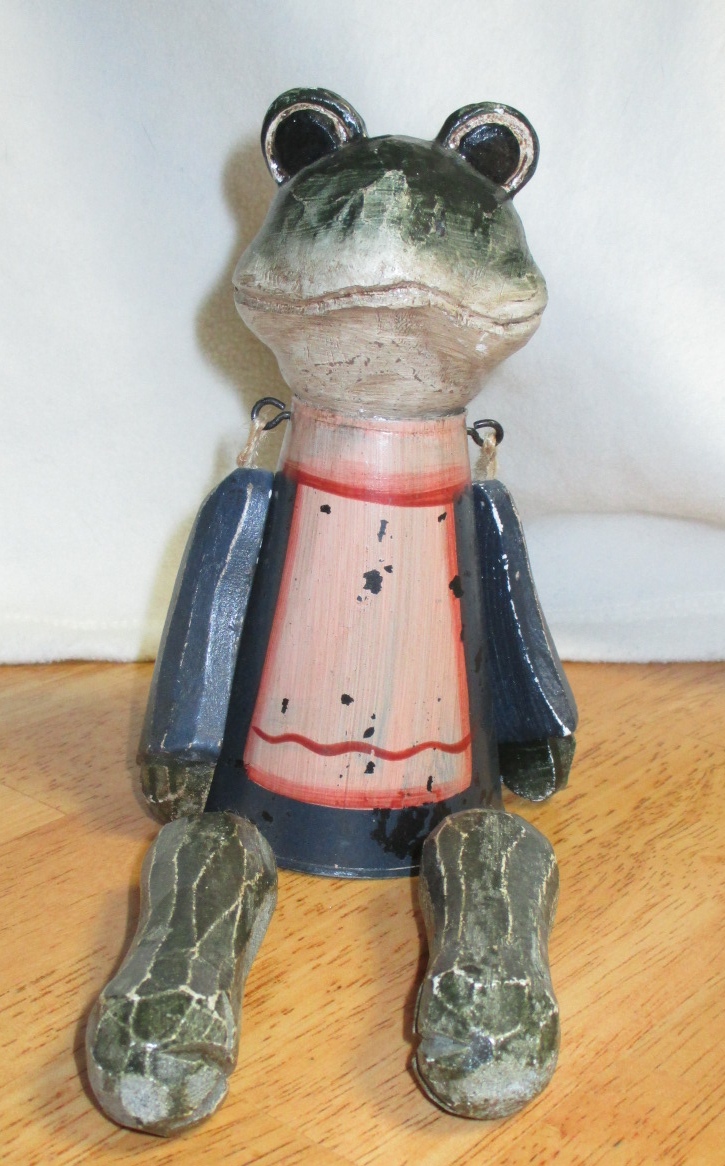
When I was younger, I had a collection of knickknack frogs. One of these—made of tin and wood with limbs that dangle from joints of twine and wire—was a gift that I received many years ago, and it has a simplicity to it that is reminiscent of an earlier era. As I have moved residences over the years, I’ve pared down my collection to my favorites. This particular frog remained as it reminded me of my past for reasons I can’t exactly pinpoint.

In the townhouse where I landed with my children after my divorce, the frog took up residence on a shelf that held some books and a few ornamental items. Seldom did I notice it sitting there in its decorative, take-up-space kind of way.

One day when my children were still fairly young, I found this very frog sitting in the middle of my propane heat stove, right next to a candle that I had placed there at the end of the most recent heating season. It was late spring, and warm enough out that the windows had been open with regularity. The sight of the frog startled me because I wasn’t expecting it to be there. How odd, I thought. I wonder who put that there? It seemed like a bold placement for such an object, and I picked it up and moved it back to its normal location on the shelf.

The next morning, I woke the children, and I took a quick trip to the basement laundry room to gather some clothes. As I passed through the living room, I stopped abruptly, startled when I spotted the frog, once again sitting proudly—albeit unexpectedly—on the heat stove. The children were upstairs waking and preparing for school. I glanced around the room, not really sure what I was looking for. The room was empty. I set the laundry basket on the floor, and returned the frog to his spot on the bookshelf.

I took a deep breath, shaking off my surprise, and I went about my morning preparations.

When I was ready for the day, I went downstairs to the kitchen. I opened the door to welcome the spring air, and went to the back of the house to open the back door. Mid-way through the living room, I froze. There, on the stove, was the frog, sitting right in the middle where he’d been twice, now three times. My heart pounded in my chest as I thought through the possibilities. I glanced around the room expecting the unexpected, only daring to move my head. I pondered going to the basement to look around, but I couldn’t do it. Not alone. I went to the kitchen phone and called my neighbor.

“I think there’s someone in my house,” I reported in a near whisper. “Can you come over?”

“I’ll be right there.” She arrived a minute later, wielding a kitchen knife.

“What are you going to do with that?” I asked her.

She looked down and shrugged, smiling weakly. “It’s better than nothing!” Together, we searched the house while I explained the unexplainable to her. We found nothing, but we got a good laugh. We concluded that one of the children was playing a trick on me. No one would fess up.

It wasn’t until several months later that my oldest finally admitted to moving the frog. He read in a book how to secretly move an object. Or something. I have to say, he got me good, and we will forever joke about it.

Since that experience, the mere sight of this little frog holds an unexpected emotional charge. When I happen to see it sitting (usually in its normal place) on the shelf, I have a momentary jump in heart-rate, as if its very glance in my direction has power beyond its inanimate self. Then I laugh at the memory.

Invisibility

One day, when my children were fairly young, I discovered that I had the power of invisibility. While this discovery was totally unexpected, invisibility has been a useful trait over the years.

My children were preparing for bed one night. They were somewhere around the ages of four, six, and eight. I had set them to the task of getting into their jammies and brushing their teeth in preparation for bed.

I was exhausted, as I so often am at the end of the day. I went in my room to lie down for a minute—my own mommy “time out”—while I waited for them. I started to zone out, my mind drifted, though I remained attentive. I remember over-hearing their kid conversation. My oldest was talking about something that had happened on the school bus that day, and the manner in which he spoke was just a little different than when he spoke to me. The tone in his voice as he relayed the event to his sibling was one of authority. It was pure kid-to-kid conversation, and as the oldest, he knew the most.

I heard my name mentioned in the conversation. Then I heard little footsteps in the hall, stopping at the door to my room. My room was dark, but light shone in from the hallway.

“Mommy?” a tentative voice asked into the darkness. I was tired and almost asleep. I didn’t answer. The footsteps retreated. “Do you know where Mommy is?” the little voice asked her little brother.

“No,” brother responded.

“I can’t find her,” said the little voice. She had barely looked, but brother didn’t know that. “Will you come downstairs with me to look for her?” And two sets of footsteps padded down the stairs and around the first floor while I puzzled over the fact that she had stood in the doorway of my room and not seen me lying on the bed. I heard a far-off voice inquiring into the dark basement. And then the footsteps came back up to the second floor.

“Where is she?” the two little ones continued to look for me as they conversed about my whereabouts. Hand in hand, they walked into my dark bedroom and passed inches from the foot of the bed as they checked the bathroom—also dark. They turned around and walked out the door, still calling to me despite my presence just a hair’s breadth away. I smiled in fleeting satisfaction that I was somehow invisible.

However, the discussion right outside my door was growing emotional and slightly panicky as the children considered how I could possibly have disappeared. “Hey you two,” I piped up. “I’m right here. You walked right by me.” To myself, I marveled that I could be invisible while I was in plain sight.

These days, it’s not so easy to be invisible. But when I am, I have learned to use my invisibility carefully. Sometimes, I try hard to conjure this power with no success; other times it just happens. Driving the car—especially with a car full of kids—I tend toward invisibility. Other times, I might be invisible from a different room.

No matter where I am when this power overtakes me, I have come to realize that in my times of invisibility, I must remain quiet and listen in order to get the greatest benefit.

Snow Days

1956692_10201528127188600_1607549408_o

When I was a child, snow days (days off from school because of a ‘snow event’) were announced in the early morning hours. If we happened to awaken by 6 am, we could lie in bed listening to the muffled silence that only comes when the world outside is blanketed with a thick, smothering layer of fresh snow. We would strain our ears, listening with all our might for the sound that would be distant, but audible nonetheless. If Mom came in to wake us, our deep listening would prove to be in vain.

The sound we listened for was the blaring of the horn on the firehouse, half a mile away. This was the same horn that would blow to alert us when there was a fire in town (and probably would have sounded for other emergencies, as well); the number of whistles let us know the location of the fire. For an announcement of no school, the signal was 22—two horn blasts with a brief pause before two more horn blasts. A longer pause then followed before the signal was repeated. If we heard that signal—one that seemed so far away, but so close and exciting—we would silently cheer, turn off our alarms, and go back to sleep.

These days, snow days have fallen victim to our constantly advancing technology. No more lying in wait; we are alerted of snow days via recorded cell phone call: “The following is an important message from the local school district…” the voice begins. Often, the calls come in at 5:30 in the morning. But for the big storms, the “sure thing” snow days, we are alerted the evening before, or sometimes even the previous afternoon. Since weather forecasting has become more accurate over the years (well, it often doesn’t seem so, but it has…), there seems to be more advanced warning that a storm really is going to be “epic.” Hence, more warning that it might be wise to cancel school.

Now, the announcement is closer than ever—an in your home and “in your face” type of close. No more wondering if you are going to hear the notice… or if you might merely be imagining the sound in the far off distance. It is clear your phone is ringing, and the message it carries is unmistakable. Now, the children can sleep in, and the morning doesn’t carry the same air of mystery and excitement.

I vividly remember those cold, dark mornings of waiting and listening as an integral part of my childhood winters. I wonder sometimes, if my children are missing out on an important rite of passage. But then I realize that there will be other things they will remember (and miss) when they grow up and have their own children.

Technology

1962 - the Jetsons-03 copyright - Hanna-Barbera from: https://www.flickr.com/photos/x-ray_delta_one/
1962 – the Jetsons-03 copyright – Hanna-Barbera
from: https://www.flickr.com/photos/x-ray_delta_one/

When I was a kid, I remember watching the Jetsons navigate their space-age world, and I would marvel at their futuristic (and highly improbable) technology. The family would zip around in flying vehicles, push buttons to complete simple tasks like raise the door and prepare their food, lift their feet when the robot maid was vacuuming, and even talk with their friends and family on their video telephone screen. My eyes were glued to the television, wondering what it might be like to have such amazing technology. Not once, while I was watching these cartoons, did I expect my own children would be holding video chats in my house.

Fast forward many years to Friday evening at my house.

Two of my teenagers are sprawled on the living room floor, the iPad propped up between them. (Ironically, my third teen is off the grid, camping in the woods….) They are watching funny videos, laughing, and chatting. They are telling jokes, and sharing favorite Internet sites. And they are discussing an economics assignment that is due by midnight. I can hear them talking about resources, analysis, and the performance of various companies.

Even though there are only two teens in my house, there is a friend with them. She is on the iPad via FaceTime. Early in their conversation, I had a brief chat with her about some treats I made that she particularly liked. Yes, the video chat technology that was thought to be science fiction back in my childhood is the reality of the world in which we live today.

These days, I never know who will appear in my living room. Friends and their pets are the usual visitors. My son’s teacher, teaching assistant, and classmates are also frequent visitors, now that he is a member of an online classroom. I always try to stay out of the room when the calls or classes are happening, as I am not a fan of video chatting; only every now and then will I take part in one of these conversations.

Despite my own reluctance to engage, FaceTime and video conferencing are wonderful tools, useful for many things. My children can talk to friends, hold study sessions, flirt with the objects of their affection, and spend lazy summer days with their step-sister, who resides hundreds of miles away. These tools are changing the face of education, employment, and many other areas. No longer do students need to be physically present to take part in a class. They can attend lectures from remote locations; they can hold virtual classes through chat rooms; and their classmates can hail from nearly anywhere in the world. I’ve had job interviews and held parent-teacher conferences via Skype. Video conferencing technology brings people together in ways never before possible.

Yes, in our world, my children have amazing technology at their fingertips, and it will continue to develop and change. It makes me wonder what might be next. While I don’t know what is coming, I am looking forward to the day I have my own robot maid!