Exit Poll

IMG_2058

My fourteen year old is in that stage where he doesn’t really want to talk to anyone, especially people he doesn’t know well. Suggest he talk to a teacher about an assignment? Um, no thanks. Ask him to call a store to find out their hours? No way!

So imagine my surprise when he recently started racing to the phone to answer political calls. He picks up the phone, and if he senses there is a real person on the line, he says, “Hullo?” If there is only a recording, he stands still, listening to the message until he gets bored.

If someone is talking to him, asking him questions, he generally acts as though he is trying to back away from the phone. The receiver is held a bit away from his face as he tips his head in the other direction. The conversation usually has a number of statements of, “I don’t know.” Sometimes, he looks to me for guidance, but recently, he has started acting as if he has the answers the caller is seeking.

This evening, the phone rang. No surprise, it was dinnertime. Everyone else in the house was ignoring the phone when W said, “I’ll get it!” and walked to the phone on the wall. “Morristown, New Jersey,” he read from the caller id as he picked up the receiver. “Hullo?” he said in the deep voice that I no longer recognize as belonging to my youngest child.

There was the customary pause as the caller made a pitch about something or other. And then the questioning began. W responded with a perfectly poised, “Well, I am not really sure.”

He listened some more. “I don’t know,” he said into the receiver. The caller, it seemed, was persistent in his pursuit of answers. Finally, I heard W say, “I’m not eligible to vote.”

I was close enough to the receiver to hear the far off voice of the caller respond, “I understand. Thank you for your time.” And he hung up.

W looked at me and smiled. “He asked me who I voted for, so I told him I wasn’t eligible to vote.” I just shook my head and rolled my eyes.

Clearly, the caller did not understand, as he said he did. If he truly understood, he would not have been trying to find out the vote cast by a fourteen-year-old boy.
Radioactive

IMG_1494

Last night was leftover night at Mom’s Table (i.e. my kitchen). Even better from my perspective, it was do-it-yourself leftover night. Basically, do-it-yourself leftover night entails the hungry participant going through the contents of the refrigerator, locating something to eat, and heating it up. Or settling for cereal–that is always an option. Leftover night always occurs when the fridge is full of the remnants of some pretty good meals.

Take last night, for instance. We had a nice selection of food to appeal to even the hungriest of teenagers: chicken drumsticks, Swedish meatballs, pasta, pizza….

W rifled through the fridge and made his selection: chicken drumsticks. “How long should I put these two chicken legs in the microwave for?” he asked me, and I gave him my best estimation. A later taste-test revealed that my estimation wasn’t long enough, so he put them back in the microwave to heat longer.

“Careful when you eat those,” I told him. “The bones heat up first.”

“Yes,” he agreed. “And that’s exactly why—if you are in a nuclear disaster and you are eating an animal—you should avoid the meat closest to the bone. It has the most radioactivity.”

Well now.

I stared at him, my face—no doubt—perplexed as I processed this statement. Finally, I said, “Good to know.” Because truly, I had no other words. And someday, I might be in a nuclear disaster and have to kill my own food to eat…?

How in the world this kid knows the things he knows is beyond me. But he is always able to spew out interesting information at exactly the right moment. If I ever find myself in a nuclear disaster (or any random survival situation, really), I hope that I have this kid nearby!

Self Improvement

IMG_1934

The other night, I had to take a quick run to Target. As I was putting up our Christmas tree, I realized the string of lights that I use around the trunk wasn’t working (yes, I put lights around the trunk before I put on the rest of the lights. I believe it adds depth or some such nonsense…). I didn’t have extra bulbs (or patience) to work through all of the lights on the dark end of the string in order to figure out what was wrong. And since W has been after me to get LED lights, this was going to be my first tentative step in his direction….

“I wanna come!” J announced.

“Okay,” I replied, but then I backtracked. “Wait. Didn’t you say you have a lot of homework?” I’ll admit it would have been more fun (albeit more expensive) to peruse the aisles of Target with my daughter in tow than to do so alone.

“Yes…” she drew out the word just a smidge too long. “But I can still get it done.”

I glanced at my watch. It was nearly 8:00 on Sunday night. “No, I don’t think that’s a good idea.”

“Aw…” she pouted for effect, trying to get me to change my mind. I threw a stern look in her direction. “Fine!” She turned to go back to her room. “But can you get me some hair scissors?”

“What?”

“Some hair scissors,” she repeated, as if I had difficulty understanding her language. (And I will admit that sometimes, I just might. But not this time…).

“Um, no.” Since she has a scheduled hair appointment this week, I certainly wasn’t going to buy her scissors with which she could create a disaster, or even attempt one. Perhaps she had forgotten about the time—the day before W’s baptism—that C took a pair of scissors to her hair. Right. In. The. Front. But I digress….

“I’m not going to ruin it,” she read my mind. “Just trim some of the …” she paused. “Extra.” She waved her hand toward some little flippy pieces that wouldn’t be there if her mother was willing to make her hair appointments monthly rather than bi-monthly. And pay for said extra hair appointments.

“No.” My cynical response left no room for question. Or comment. She grunted in half humorous teenage disgust and retreated to her room.

She didn’t really think I was going to buy her hair scissors. At least I don’t think she did…. Did she?

Thanksgiving Research

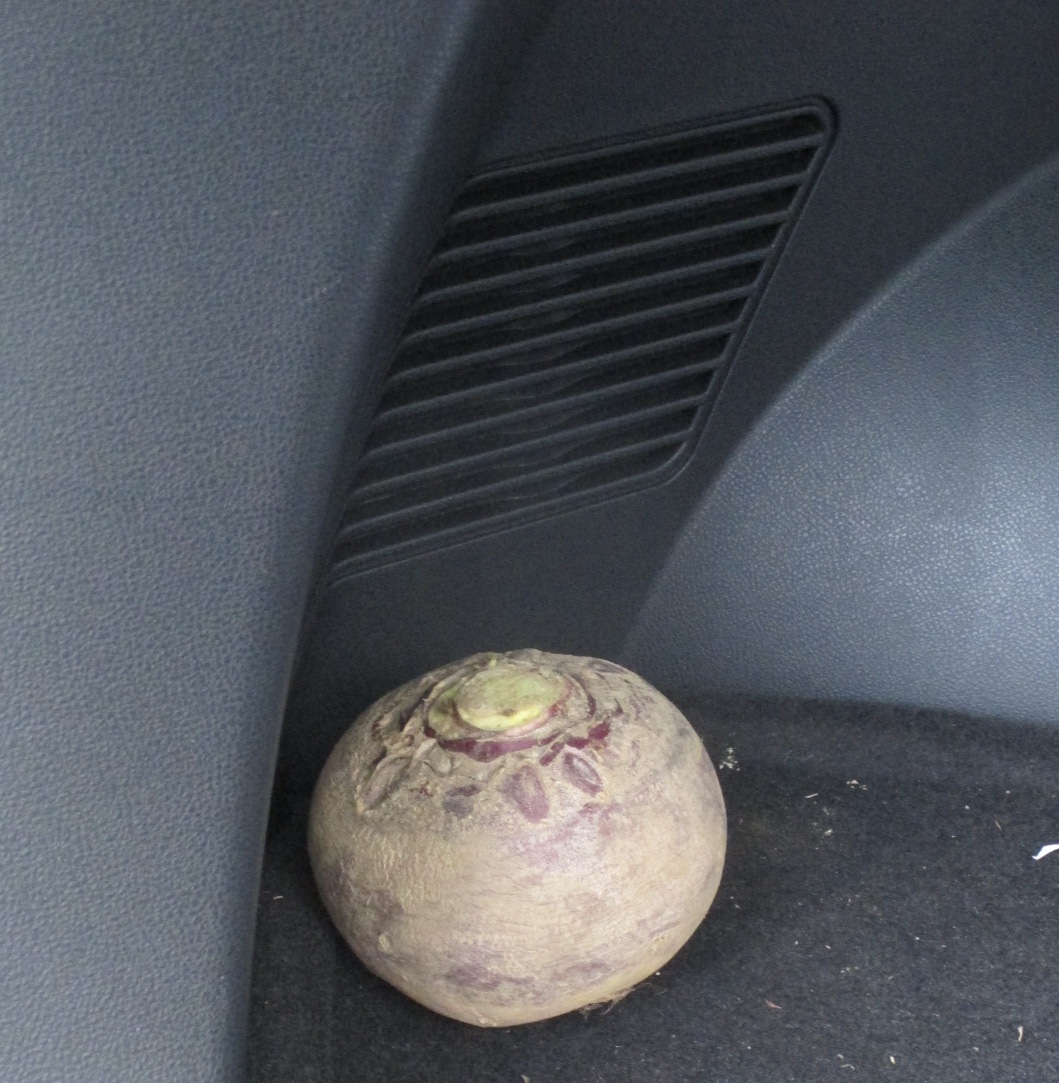
Last night after Thanksgiving dinner, my aunt offered me a turnip from a bag she had in the trunk of her car. At first, I said no, but then I changed my mind and decided to take one. After all, she had extra, I like turnip, and I am currently working with a limited diet. I took one and stashed it in the trunk of my own car. The cool nights, I figured, would keep it fresh until I could cook it this weekend.

This afternoon, I took my children to a local shop that we enjoy visiting. The shop has all kinds of fun toys, games, gadgets, greeting cards, decorations, etc. We did a little holiday shopping, and I came away with a bag of goodies. We decided we would walk the main shopping district of this small town, but I wanted to put my bag in the car first. I opened the back, not even thinking.

C’s brow wrinkled in surprise. “What’s that?” he pointed to the corner of the trunk, and I immediately remembered that I had placed the turnip in that spot last night.

IMG_1931

I laughed. “That’s a turnip. Looks like jicama, doesn’t it?” I asked him. When my aunt had given it to me last night, I realized the similar appearances between the two roots. I think C, who has recently discovered jicama, was hopeful that I had purchased (and hidden) this in my car trunk.

The similarities did prompt me to do some quick research on whether jicama and turnip are related. I was surprised to learn that jicama is actually a legume, and the root is the only edible part of the plant; the rest, it seems, is poisonous, and contains a chemical used in pesticides. Turnip, on the other hand, is a root vegetable, and even the greens are edible. Despite the similar appearance, these two roots are not related.

The things you can learn when you think your car is a good place to store a turnip for a day or two…. And now you know, too!

Roadblocks

download-1

Last week, my son was chosen to attend a conference at a local university. While he was happy to be chosen and excited about attending the conference (and missing school), this was the first time that he would have to navigate an unknown route on his own.

His concern began the week before. “I need to know how to get to the university,” he told me. (My children do not have smart phones or a GPS. We rely on old fashioned maps in our house. Actually, that’s not completely true. Mapquest is my navigation system of choice in most instances).

“I can tell you how to get there,” I told him. “Or you can look it up.”

“How do I do that?” he asked, triggering a twang of annoyance in my head. I cannot even begin to tell you how much this question irks me.

“Really?” I responded. “You can spend hours on the Internet, and you don’t know how to find directions?” I sighed as I realized he has not needed directions before now. I had a brief memory of my father’s irritation with me when, at 18, I didn’t know my way to a venue over an hour from our home. It was a place we visited every summer, but the drive through farmland, over twisty back roads always induced an intense case of day-dreamy-ness in me. Because I wasn’t driving, I didn’t have to pay attention to the route. “I’ll help you find the directions, but I’m not going to do it for you. It’ll be a good exercise.” And that was the end of the discussion and the immediate effort, but not of his worries.

The day before the event, he once again expressed his concern that he did not know the way. “I’ll Google it and show you,” I told him, but I had a scheduled meeting, and he didn’t want to move from the activity of the moment. So I closed my computer and left for my meeting.

When I returned, he was packing up his gear for the next day. “Can you help me with the directions?” He looked up and smiled a sheepish smile.

“I tried to show you before I left. Go pull it up on the computer, and I’ll go over it with you.” And so it was that he was finally able to get directions. We scanned the map together, and I pointed out the route, the trouble spots, and gave him tips for navigating the morning rush hour traffic. He printed out the directions and a map of the area, tucking them into the bag he would bring with him.

The next morning, he left on schedule. He had allowed twice the time it would take for the drive. Fifteen minutes after he left, my phone rang. It was him. “What’s up?” I answered.

“So… River Road is closed.”

“What do you mean ‘closed’? Is there a detour?”

“I don’t think so. There’s just a barricade and a guy telling people not to go that way.”

“Where are you now?” I asked him as I sat down at my computer. “Give me a minute to bring up a map.”

“I’m pulled over on the side of the road.” He paused. “From the map, it looks like I can get there if I take School Street all the way out.”

I surveyed the map on my screen. “I think that will work,” I told him. “Can you get to School Street from where you are?”

“I should be able to. There are several roads that lead over there.” He hung up, and in another fifteen minutes, he sent me a text to let me know that he had reached his destination.

He thought he was prepared for the day when he left home, but there are things we don’t plan for on our journey. Sometimes, unexpected things come up—detours, roadblocks, wrong turns. All we can do is prepare the best we possibly can and be flexible. Because he had printed out the map and tucked it into his bag, he was able to recalculate his route and make it to his destination with time to spare.

Snacks (2)

It is a rare occasion when I arrive home from work and have both the time and the motivation to make a real meal for dinner. I am good at whipping up something quick—spaghetti, chicken parmesan, tacos, etc. But making a full, more complicated dinner takes time and energy that I don’t usually have when I get home from work.

So last week, I planned ahead. I made pasta salad on Sunday for a potluck, and I doubled the recipe so we could have it for dinner on Monday, the most hectic day of our week. Pasta salad, ham, and broccoli—a simple, quick dinner.

As we sat down to eat, C looked at the food. “This is what I had for lunch.”

“This is what I had for a snack,” J piped up.

“You had this for a snack?” I asked. Then I looked at C. “I packed you a sandwich for lunch,” I responded. “You didn’t have pasta salad.”

“Yes I did,” he retorted. “You packed me a snack. I eat lunch when I get home from school.”

“What?” I studied his face. He was serious. “Wait… you eat a full meal when you get home from school?”

“Yeah, Mom. We eat so early at school, that’s just my snack. I eat lunch when I get home.”

“Every day?” I asked him.

“Yeah, pretty much.”

Well, that might explain where all the food has been disappearing to….

Social Media

This post was written for Writing 101, Day 5: Respond to a quote…

Just as we teach our children how to ride a bike, we need to teach them how to navigate social media and make the right moves that will help them. The physical world is similar to the virtual world in many cases. It’s about being aware. We can prevent many debacles if we’re educated.”     —Amy Jo Martin


The great thing about social media is that it is (for the most part) public. We can see what others are posting, saying, doing, thinking. Social media allows us to navigate a different world—to create a persona, if you will, of how we see ourselves or would like to be seen. Because it is so public, it provides great lessons for parents who are willing to trot out their ‘friends’ as examples, both good and bad.

A few years back, a young acquaintance of ours made an impulsive tweet in a moment of adolescent thoughtlessness. Hundreds of miles away, his tweet was picked up by people paid by our federal government to monitor such things, and he ended up squarely in the center of their radar. By the time he arrived at his first class of the school day, the local police were there to meet him. His parents were called, and ultimately, he was asked to quietly withdraw himself from the school—a private institution—and finish his senior year elsewhere.

What parent wouldn’t use this incident as an example for his or her children? Granted, this is an extreme example, but nothing that ends up on the Internet is private. Or unmonitored. Or irretrievable. If SnapChat postings actually did “disappear,” the terms and conditions wouldn’t ask users to agree to allow them to store all posts forever. But who reads the terms and conditions, right?

Every now and then, I see things on the Facebook sites or blog posts of the adult crowd. “I don’t think she should have shared that,” I grumble to my children. “Her children might not be on Facebook, but their friends and their friends’ parents are….” I wonder sometimes if people consider the ramifications of the things they post.

As C prepares for college, he is going out into a different world—his own world, away my watchful eye, where he has to make his own decisions and create his own identity and purpose. What I don’t want is for him to suddenly find that his Facebook, Tumblr, Instagram, or whatever are under scrutiny and not be prepared for that. This is the world in which we live, Friends. If you are putting yourself on the Internet for people to see, you very well may fall under scrutiny. That scrutiny may mean that you are held as an example within the private world of your “friends,” or it may have much bigger implications.

This lesson is one that each of us—teen or adult—will benefit from keeping in the forefront of our minds as we venture ever further into the virtual world.

Shared adventure

DSC_1109

I sent my children out on a mission. Armed with my camera, and all the colors of the fall season for inspiration, they went for a walk around the neighborhood so my daughter could take pictures for my son’s yearbook photo.

This plan is one that has was hatched over the summer, when I decided to save some money by not hiring a professional photographer to take C’s senior pictures. We discussed it in August, but C wanted to wait until the trees turned and the colors were bright. And he kept putting it off, claiming that his sister was never ready. J, meanwhile, claimed that C just had to say the word. It was not a promising start to the project, and I found myself second-guessing my decision.

As often happens, we procrastinated down to the wire. The pictures were due this week, and we had to factor activity schedules with days of “picture perfect” weather. And so it was Wednesday, leaving us very little time for a retake, should it be necessary.

After school, texts flew as plans came together, friends were contacted, and last minute details were taken care of. I let the kids figure out the logistics, the process, the timing. I gave them their mission, and I stepped out of the picture.

When I entered the house later that day, three kids were in the living room, laughing and chatting as they viewed the pictures on the computer. Click, click, giggle. Click, click, “Oh! Flag that!” Click, “Stop! Go back!” They flip through the photos, one by one. All of them. All 248 of them.

248 photos! (In my day, that would have been 10+ rolls of film; countless hours in the darkroom….) My daughter had catalogued the entire excursion in a photographic essay, of sorts, documenting the journey from our front door to the top of the street, and back again. Buried in among all of these photographs were the three choice moments when they stopped to focus on the mission I gave them—the sit-and-pose pictures. In total, we had seven photos in the running for the yearbook. But we had countless others that had captured a moment, a journey, a memory.

I sent my children out on a mission, but they came back armed with memories of an adventure. Sometimes, I am amazed at what happens when I remove myself from the picture. Mission (more than) accomplished!

DSC_0938     DSC_0942

(all images provided by the creative eye of J)

Superheroes

IMG_1824

The senior English classes at our high school are working on their college essays, which is both brilliant and problematic. It is brilliant because the students will get these essays written and perfected under the instruction of their teacher; it is problematic because my son is not prepared with a topic. He thought he had another month or two to think. He has nothing to write about. Not. A. Thing.

According to this kid, there is nothing that has happened to him that is essay-worthy. And “college-essay-worthy” at that. There are no experiences that define him. I can’t even get a story from him, and I am a woman who believes everyone has a unique and interesting story.

I sat him down, and I talked to him (actually, I followed him around the house to brainstorm with him, but I digress…). We discussed the trips he has taken, the activities in which he is involved, the club he is starting at school, his culinary program, his “broken” family of origin. Still, we came up empty. Nothing.

Each day, I would hear his rants about the essay, his lack of topic, his teacher and her nagging until I finally threw out anything I could think of. “Why don’t you write about your trip to Hawaii?” I suggested.

“Mom,” the sarcasm oozed thick and heavy. “No one wants to hear about my trip to Hawaii.”

“Well, how about when you almost fell in the volcano?” I continued.

“I didn’t almost fall into a volcano—”

“And your father risked his life to save you,” I interrupted.

“My father would never risk his…,” his voice trailed off. “You know, Mom, you might be on to something!” I could almost see the light bulb go off in his head. “I can write about the time my father died trying to save me!”

Um…. That wasn’t quite what I had in mind, but that was the direction he took my suggestion. “You can’t really make up your college essay,” I informed him. “They want to know who you are, what defines you.”

“But Mom,” his excitement was evident on his face. “What better essay to write if I’m going to school for creative writing? I’m going to tell my teacher that this is my topic for my essay!” He disappeared into the living room.

I sighed. I had grasped at straws, handing him one without thinking it through in the way a high school senior might. There is a lesson to be learned here … I’m just not sure what it is.

One lesson I know for sure. Every kid wants to believe that his parents might have a touch of superhero… that his parents would do anything to save him, should the need arise. I believe we all need to believe in parental superheroism.

But for parents who are not very “parental,” who think only of themselves (year after year, in situation after situation) and their children know there is not even a speck of superhero, well… they might just find themselves starring in an essay featuring a poorly placed volcano.

A Letter on Navigating Adolescence…

Posted in response to Writing 101, Day 9: Reinvent the letter format.

Dear Teen,

I see you sitting quietly on the edge of the action, deciding whether you will jump in and get involved or not. You are observing the situation, sizing up the participants, and gauging whether or not you will take part. I see the uncertainty you are feeling as you approach new situations and new people, wondering what will happen if you insert yourself into this activity and this group. As you sit here, you are deciding the likelihood of your success, defining what that success might look like, and determining whether you will be rejected if you don’t succeed…and if it matters.

I see your struggle because I have been around teenagers for the vast majority of my life. I have been a teacher, coach, mentor, dorm parent. These days, I am even a parent to my own teenagers. Eons ago, before the Internet and cell phones and MP3 players, I was a teenager. And despite how old I may seem, from my perspective, it wasn’t that long ago.

Adolescence is a bumpy ride. You may hear that these are the best years of your life, but don’t believe it for a second; these years are tough! Some of your friendships may grow stronger, but some will dissolve. Through the conflicts you have with friends now, you will learn to recognize the people who will be there for you through thick and thin—the friends you will support and who will support you through even the toughest of times, the ones you will want to keep close by always. These years can have a huge impact on the person you will become and the sensitivities you will have. I see the tolerance you have developed when you accept the people around you, regardless of how they are different from yourself. You have watched how mean other people can be, and you have recognized that not everyone is thoughtful, considerate, and accepting of others.

You are caring and sensitive and polite, and you are stronger than you believe. These traits are important. They will help you to navigate life and make your mark. And you will leave a beautiful mark in the footprints you leave behind.

Consequently, I would urge you to make good decisions and live like you don’t care what other people think. In the grand scheme of things, the opinions of others don’t matter. What matters in your life are your own opinions and those of the people closest to you. Be nice, be creative, be loving, but most importantly, be brave enough to stand out. Remember… fitting in is over-rated.

So jump in there and be a participant. These people are having fun, and you are likely to have fun, as well. Perhaps you’ll make a new friend. Perhaps you’ll discover a new activity you love. You never know until you try! Life is short—get involved and live it to the fullest.

May you always know that any time you need it, you have support right here!

Love,

Mom