Community

On Monday, I had a conversation with my college freshmen about community and responsibility. This conversation came after we had viewed a documentary on extreme poverty—living on a dollar a day—and attended a presentation by one of the young men who was involved with the project. Despite the poverty in the community, the families were very close as they worked together to help each other and make a better life for themselves. Our class discussion revolved around the responsibility each person has and how our responsibility extends from family to neighbors to the larger global community.

On Tuesday morning, I was driving to work. I had just pulled onto the entrance ramp for the highway when everyone around me suddenly began to slow and then they stopped. I looked to the highway on my left just in time to see a car flip over and land on its roof in the median. I pulled over and put my car in park. I sat for a minute catching my breath and working to calm my nerves as I watched several people get out of their cars and run to the flipped car to check on the driver. Before long, all traffic had stopped in both directions.

[I will say, I stayed in my car. Unfortunately, while I remain calm under pressure and can deal with emergencies, I do not deal well with injury/blood/death/etc. These things cause me to grow faint and shaky, pass out and become completely useless to anyone who might need help. Knowing our limits—it’s an important part of self-awareness.]

Four or five people gathered around the car and helped the driver out and to her feet. They walked her gingerly away from the car, and went back to check that the car was empty of other passengers. At this point, I decided the situation was under control, and I slowly made my way around several stopped cars and drove to work.

There are times when I think we are on our own in this country. The sense of community and our responsibility to others gets lost in the craziness of everyday life. And yet, this incident was an example of the many ways we come together to help others in need. We are all here together, and when we most need help, others generally show up, We have a responsibility to our community—both locally and globally—and if we take the time to look around, we will see ways in which we might just make a difference.

Compassion

It’s a complicated world we live in, and it’s important that we stop dancing around some of the bigger issues that threaten our safety and our society.

Today, I received a lengthy and detailed email from some overarching authority at one of the institutions for which I work. This email discussed how to recognize and assist individuals in Distress, with a capital D. “Distress” was then broken down further into several categories: general distress, victims of sexual misconduct, those at risk of suicide or self-harm, and those who may be dangerous.

This last one—oh yikes! But true, even though it seems to hit a bit too close to home as we begin to dissect yet another mass shooting. I listen to the news as the sheriff says, “No one expects this…” even though we are all coming to expect this. I hear an official on ABCNews instruct, “We all should think about what we would do in this situation…” and I know that any plan I could make would be lost in the terror of the situation.

But for those of us who daily deal with vulnerable individuals on a personal level, it is important that we are familiar with the warning signs of Distress. It is important to know what hurt looks like; how pain manifests; and when anger crosses into danger. So I read through the email, and I will read it again to commit the details to memory.

To all of my family, friends, students, neighbors, acquaintances, past and present; to all the people I know only in passing… if you are in Distress, I am here, and I am listening. If you need to talk, I will hear you. If you need a shoulder to cry on, mine are strong and broad. If you need a hug, my arms are open. If you need to sit in the corner and cry without judgment, I will sit with you. If you need encouragement, I will cheer you on. If you need prayers, I will offer them up.

I know I am not alone in the offer of help. The world is full of caring, kind, compassionate individuals who will listen and be present. They are willing to lend a hand, give a hug, connect over coffee, offer words of encouragement, or say just the right thing to make you smile. If you need something, we are here. Please… speak up and let someone know. If we all work together, perhaps we can make this world a little friendlier, a bit softer, and just a touch less complicated.

Encouragement

On a recent college visit, I was escorting my daughter across campus to the dining hall where she would meet up with the student who would be her “day host” for a class visit. As we walked, we passed by a post on which was taped a hand-written sign that said, “It gets better. I promise.”

I was struck by this sign because the truth is that life is a series of peaks and valleys and everything in between. When things are bad, they generally get better. We fight; we work; we pray; we cry; time goes by; and things get better. But a college student with less life experience may not realize this to be the case, especially when students are often told, “College is the best four years of your life.”

Newsflash: College is NOT the best four years of your life.

In fact, on that same college visit, I met with a professor, who was my professor when I was in college—about a gazillion or so years ago. Now, I haven’t seen this woman in a very long time. She looked at me and she said, “You look just like you did when you were twenty. But might I say, you look happier.” Her words prompted me to conduct an instant internal inventory that revealed that yes, I am happier than I was in college.

I tried to express my thoughts, “College… well, high school and college, really… they were tough times. Lots of social pressure and trying to figure out my identity and what I wanted from life.” And then we got to talking about kids today, the pressures they face, and the complications of social media in all its superficial glory. Truly, it was tough enough to grow up back in the seventies and eighties without the pressures brought on by social media. Is it any wonder so many young people nowadays suffer from anxiety, depression, and a whole host of other mental illnesses?

On my way back to the parking lot, I stopped and took a picture of the sign I had seen earlier. This sign is a message to all of us that whatever we’re going through… this too, shall pass.

And perhaps there will be one person who walks by this sign, and these words of encouragement might just make a world of difference. Whatever it is, it will get better. I promise.

Me Too

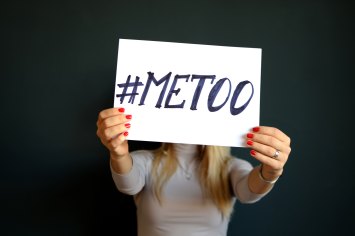
As the #metoo posts began to populate my Facebook timeline last weekend, I grew deeply disturbed at how widespread the problems of sexual harassment, sexual abuse, gender discrimination, etc. have been. How has our society continued to perpetuate the objectification of women without question? Yet, despite the fact that every one of my woman friends was posting #metoo, I couldn’t bring myself to post on my status, and it took me some time to figure out why not.

Even many years later, in each case without exception, I can still tell you exactly why I was at fault—for one reason or other—for the times I was a victim of abuse or harassment. If I had done something differently, if I had been more careful… these situations would not have happened. It seems that when the lines of appropriate and inappropriate are blurred from the time a girl is young, that girl accepts blurred lines as the manner in which the world is set up.

When I was 17, I was walking through the town square in a country far away. It was early afternoon—siesta time—and the square was nearly deserted. I should have been back to my host home earlier, and I was trying to get back as quickly as I could. I was walking quickly on a path that ran diagonally through the center of the square. As I passed an older man, he grabbed my thigh as if he had a right to touch me however he wanted. My heart and pace quickened, and I did not look back. I was young, alone, and scared, walking the fence between two cultures, unable to speak the local language. I should not have been out during siesta when the streets were quiet and everyone else was settling in at home. I had been out with a friend and time slipped away from us. It was a risky move, and the unwanted advance—it clearly could have been prevented if I had returned earlier.

In my early 20s, one of my student charges was popping popcorn and tripped a breaker in the dorm where I served as hall parent. It was after evening study hall, and I had to request help from a campus security guard to fix it. I followed him to the breaker box—in a dark room—where he lit our path with a flashlight. Until he had other ideas and switched off the flashlight. It was my fault for following him into a dark room and trusting him to light the way.

Again in my 20s, I was told that an entire office of male workers would discuss my backside as they watched me in the parking lot from a nearby window. First of all, do men not have anything better to do? Second, what did one man expect when he came to me to tell me that—with a creepy smile on his face? And third, why were there no self-checking men in the group who were willing to step forward and stop the others from objectifying a young woman? Was I not supposed to venture into the parking lot where they could see me?

I have faced unwanted advances, harassment, and discrimination from peers, coworkers, teachers, doctors, bosses, and strangers on the street, and thanks to #metoo, I know I am not alone. It is a process that begins when girls are young, and continues through adulthood. We become so accustomed to this behavior from the other half of the population that we begin to accept it without question, often blaming ourselves for not being strong enough, for wearing the wrong clothes, for being in the wrong place, or for trusting when we shouldn’t.

What I find disturbing is not only that we allow this harassment—this clear display of man’s power over woman—to perpetuate, but we make women feel responsible for the abuse. You shouldn’t have dressed that way. How many of us have heard those words? You shouldn’t have walked that way or You shouldn’t have been in that place.

No, I am not to blame in these situations. Men are to blame. Men who feel it is their right to objectify women and treat them as pieces and parts rather than as whole, intelligent, amazing, complicated, and competent human beings. And the silent men are to blame. Men who sit by listening to other men talk about women this way and watching other men treat women this way. Because if you sit idly by and say nothing, you are part of the problem.

It is time that women gather together, draw on our collective power, and release it out into the society as a loud and resounding NO! It is time that men stand up to other men and stop tolerating the “locker room talk” simply because it was once an accepted part of male culture. These people you are discussing…? These are mothers, daughters, sisters, and aunts. What if it was your mother or your daughter that was being discussed? These people—these women—they should be your people.

We have tolerated this behavior for far too long. It’s time we create a different world, a better world, for our daughters and their daughters, and all the daughters to come. It’s time expect better and end the cycle of #metoo.

{Image credit: Unsplash.com/Mihai Surdu}

Raising Teens

A month or so ago, a local teenager made a reckless decision and the decision had dire consequences. The story was on the news and all over social media, and the accompanying images were horrific. On social media, the responses to the story were brutal.

“Serves him right!”

“Where are the parents?”

“I have a 15 year old, and I always know where my teen is.”

I experienced such a visceral response to these comments that made it difficult for me to write anything for a time. Some time has passed, but this story still claims a large chunk of my emotional energy. There are a couple of points on which I remain stuck.

First of all, what’s up with the bullying among adults? Is it any wonder that we have bullying issues in our schools? When children see their parents making comments like these, they must begin to believe this is the way to respond to other people. And with the exponential growth of social media, there is no question that children see what their parents post—even their responses to news stories. After all, the parent’s name is attached to the comment, so anonymity… it’s not really a thing in an online community.

Perhaps these comments are born out of the need to uphold one’s own superiority, but it seems we have become so competitive that we have lost sight of compassion. The I am better than you mentality has taken over society, and we are unable to reach out to those who are suffering without claiming some imaginary trophy and keeping score. Bullying starts at home. It starts with adults who see no problem with posting brutal responses to tragic stories because they need to feel that they are better than others—just as a school-yard bully would do; they need to claim the position as better parents, better guardians of their teens, more efficient workers, etc. This competition is so destructive to society.

This situation reminded me of another horrible accident a year or so ago in which five teenagers were killed in a head-on collision on the highway. It was late at night and they were driving home from a concert. A man with a mental illness and a commitment to destruction of everything around him was driving the wrong way on the highway after a failed mental health visit to the ER. Now, if you have ever encountered a wrong-way driver on the highway in the dead of night, you understand how extremely disorienting it can be. You will likely not even realize what is happening until the other driver has passed, at which point you slam on the brakes and think, “Wait, what just happened??” If I’d been on that road that night, I wouldn’t have stood a chance just as these kids didn’t stand a chance. Yet, in the comments of this news story, responders blamed the parents for letting their teenagers attend a concert. I’m not sure when it became irresponsible to allow a teenager to attend a concert, but I digress.

As for the commenter who always knows where her teenager is…. I can pretty much guarantee that she does not. I have worked with teenagers for thirty plus years, I have three teenagers of my own, and I (sometimes) understand how teenagers think. It’s not necessarily that they disobey, but rather, they omit. History and literature are rife with examples: Rapunzel, Romeo and Juliet… these parents thought they knew what their teens were doing, as well. But in truth, try as we might, we don’t always know where our teens are and what they are doing. Maybe it’s okay not to always know. In fact, maybe it’s healthy to give our teens an increasing amount of space to make their own choices and decisions as they grow and mature. How are kids supposed to learn responsibility and how to face tough decisions if they are not given the room to do so?

Over the years, I have worked with some practically independent kiddos, and I have worked with others who still need a good deal of guidance; I have taught A students and F students; I have worked with wonderful young leaders and painfully shy followers. And I have seen everything in between. All of the teens I have worked with over so many years have one thing in common: they all have a still-maturing teenage brain that is not fully able to think through all of the consequences of a decision, and therefore, they are prone to making the occasional bad decision. It is through these questionable decisions that teens grown and learn how to make better decisions.

Maybe we could all work together to encourage our teens—and all the teens we come in contact with—to make smart decisions. And maybe we could work together toward healthier reactions and less judgment. If our first response is to have compassion rather than to chastise, we might be able to build some mighty bridges and educate our children in the process. After all, our children learn far more from our actions than they do from our words.

{Image is a photo taken by my daughter}

Simple Things

This week, it happened again….

One morning, early in the week, I was finishing up lunches and water bottles, preparing to send my kids out the door for their day at school. I usually add a few pieces of fruit to my water and my daughter’s, so we will have a hint of flavor as we stay hydrated throughout the day. I find if I put it in the bottom of the bottle before I add the ice, it stays out of the way.

Right now in New England, we are moving past our summer fruits. The berries and soft orchard fruits—like peaches—are not as readily available. Pineapple, various melons, and citrus fruits will become our go-to choices for the winter. On this particular morning, it was a few leftover strawberries combined with orange slices—a pretty tasty combination.

The minute I made the first cut into the orange peel, the zest sprayed out, filling the kitchen with its strong, distinct scent. This scent is one that speaks unmistakably of winter and holidays to me. On this morning, the smell brought me instantly to thoughts of Dad—the neatest orange peeler ever—and my childhood home; every year, just before the holidays, my parents buy oranges from a local high school citrus sale.

And suddenly, I began to wonder who might help Mom with the sorting and moving of her oranges this year—the boxes are bulky and heavy. And the grief came flooding in like a tsunami.

From that one simple act of cutting an orange, the week continued with moments of grief both intense and ephemeral. And on Friday, I walked out the door of my office building on a hazy, humid, and partly sunny day to a rainbow in the sky directly in front of me. It hadn’t rained, and the sun was struggling to shine brightly through the haze. And yet, there it was, a beautiful swath through the sky.

This grief thing… it can be a thorny path. But I’m becoming increasingly convinced that grief is not something to be overcome. Maybe, tucked in among the thorns, we find the beauty of the roses.

{Photo of oranges by Mateus Bassan on Unsplash}

Sibling Challenge

Through years of parenting and even more years of working with teenagers, I have gained a certain perspective on teen shenanigans. When this weekend started out with a “friendly competition,” I knew things were not headed in a positive direction.

We were getting ready to leave for a weekend away, and we were rushing around to take care of the few final tasks that had to be completed before our departure. We needed to dispose of the garbage and load the car. My youngest agreed to “take a quick run” to the condo dumpster. But instead of walking, he thought he would ride his bike.

Now, anyone with more than one teenage boy knows that nothing is real—or fun—unless it is made into a competition of some sort. In this case, “a quick run” became the point of competition.

“I’ll get down there and back before PiE gets here,” my son announced. “But instead of walking, I’ll take my bike.” His bike was lying in the front yard waiting to be loaded onto the bike-rack.

“I’m gonna time you!” challenged his older brother. “I’ll start the timer as soon as you get outside.”

“NO!” I told them, sternly. “We are going away, and if you race to the dumpster, you’re liable to end up hurt. I don’t want to be taking you to the ER before we leave. Or spending the weekend at the hospital, thank you very much.”

“Oh, I’ll be fine,” W pronounced as he continued out the door, grabbing the garbage on his way.

“Don’t race!” I hollered after him, but my command fell on deaf ears as he strapped on his helmet and took off at break-neck speed, his brother’s challenges urging him on. “Ugh!” I groaned in his wake as C focused on the stop-watch on his iPod.

It was only seconds before C was running out the door to check W’s progress, fully expecting to see his little brother disappearing in the distance. He stood outside for a minute, yelling after W, and then he came back into the kitchen, laughing. “He fell,” he informed me. “He was standing at the bottom of the hill saying, ‘Mom was right!’” Of course, these kids joke around so much, I didn’t fully believe him.

But sure enough, when W returned to the house, he had an odd combination of scrapes and cuts—his left elbow and his right thigh and ankle. While his injuries didn’t require medical attention, they did slow him down (just a bit) during our weekend adventures.

The lesson learned, “Mom was right,” could be priceless. But this lesson will fade as quickly as the pain of the road rash, and he will have to be reminded, once again, that sometimes Mom can see into the future and can predict how things will end. Some lessons need to be learned again and again in order for them to eventually… maybe… stick.

Changes

I am pretty sure my father would have secretly loved to have a son. I say secretly because when you have two daughters, you can’t really express a fact like that. “Oh darn. I really wanted a son!” But if he’d had a son, he would have been very happy.

However, my dad always made sure that my sister and I knew how to make simple repairs and improvements around the house. When he embarked on a project, he would often recruit us to “help,” which allowed him to impart wisdom and instructions as well as dos and don’ts of home repair.

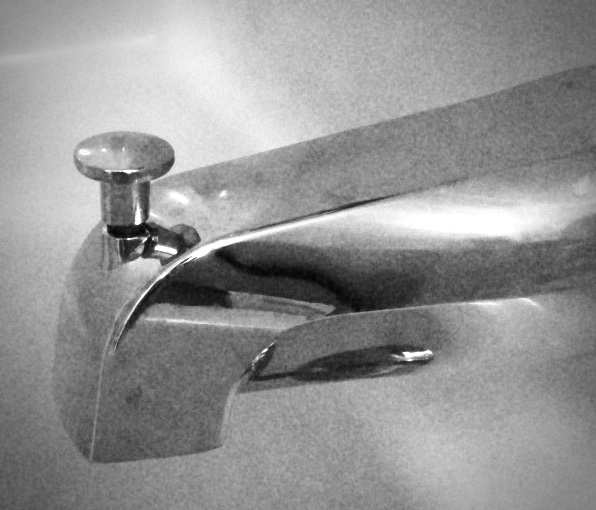
When my children left for a recent trip to Florida, I knew this solitary time was my opportunity to re-caulk the tub in their bathroom. There is no denying the fact that I know how to have a good time when my kids are away. Really, the only time the tub is not in use for several hours a day is when they are away, and anyone who has ever caulked [successfully], knows the tub and its various components need to be good and dry before the new caulk is placed.

When I settled in to remove the old caulk, I decided I would do a better job if I could just remove the tub spout to better clean off all of the tiny remnants (or large gobs) of caulk that had made their way under the fixture. But how to remove the fixture? It seemed to twist, but just in case, I consulted YouTube. There, I found a tutorial on how to remove (and replace) an old tub spout. Replace had not occurred to me, but a new tub spout would be just the thing to make the tub shimmer!

I took a trip to the local home improvement store where I found the parts I needed. At the checkout, the cashier looked from my purchase to the old spout that I had brought along just in case I needed a visual example. “That’s a good idea,” she said, pointing to the old spout. “To bring that along.” She paused for a moment, and then she said, “Are you doing this all on your own?” I nodded.

“I wish I was brave enough to take on that kind of project,” she commented. “That’s impressive.”

Not really. I must say, I was trained by a good man to recognize that many projects are not as overwhelming as they might appear. In truth, it’s not a big undertaking to change a tub faucet. The big undertakings I leave to professionals.

Back at home, I finished my project. It was straightforward without any frustrations, and I must say, it looks pretty good. Typically, when I finish a project like this, I would call Dad. “I just changed my tub spout,” I would tell him, and his first response was always the same.

“Did you?” he would respond with a hint of pride in his voice and then we would talk about what I had fixed and how the project had gone.

This time, I can’t call Dad to share my success. But I’m pretty sure he’s smiling with that same hint of pride up in Heaven. Because love… it doesn’t end. It only changes form

Fine

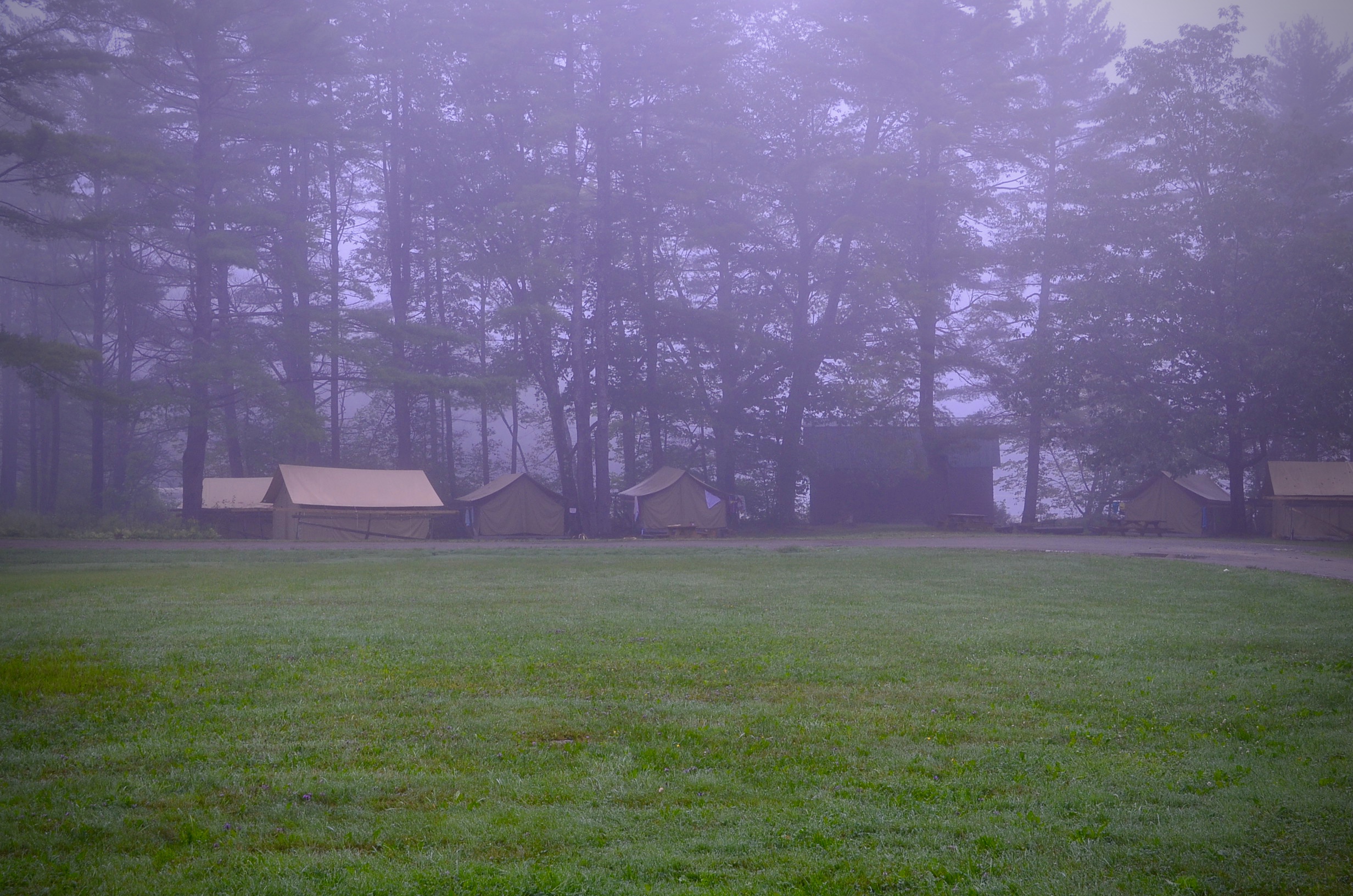
“This is the camp nurse,” I heard through the phone in the shallow end of Friday morning’s sleep. This was the third call I’d received that morning and the one that truly woke me up. I’ll admit I was sleeping late, but in my defense, I am recovering from surgery—and minor or not, it’s a perfect excuse to savor extra time behind the hazy veil of sleep where there are no demands on my time and energy.

“Your son is fine,” she continued. No, I thought. If my son was fine, there would be no reason for you to call me. I have been around the sun more than once, he’s my third kid, and I understand if the camp/school/health center nurse is calling me, all is not fine. I held my breath as I sat up too quickly, waiting for her next words.

Low-grade fever, sore throat, general achiness, she outlined my son’s not-so-fine physical state. A virus, it seemed, or possible strep. “Since he works in the kitchen…” she stopped and let me fill in the rest of the sentence. Yes, he would need to be seen by the doctor.

As an educator, I completely understand. But in the back of my mind there is the nagging lack of fairness that even though it’s fine for the campers to get my son sick, it’s not as fine for my son to get the campers sick. I drove to camp earlier than expected to take my son to the doctor where he was pronounced fine, as I suspected. Well… there is no doubt he has a virus, but thankfully, no strep.

In fact, on the way back from the doctor, we remembered that last year, when he was a CIT, he had the same symptoms at almost exactly the same point in the summer,  so we’ve dubbed it “camp crud.” Next year, when I get a call from the camp nurse during week five, I’ll know to say, “Oh, it’s just camp crud. He’s fine!”

Aimless

Lately, I have been aimless, so I have decided to post an aimless, wandering blog post. Perhaps doing so will help to spur something interesting in my brain, something that is so deeply hidden that only wandering over it will help to pull it out of the weeds. In the past week, I have started numerous posts, but none has stuck. I have been entertaining myself with television and surfing the Internet, and my blog has suffered.

In truth, I have not been totally aimless. I have been completing my work—on schedule, I might add—despite the extenuating circumstances of my life. I am grateful that my online summer work allows for a relaxed work environment while still providing a paycheck.

This evening, I eavesdropped on a conversation of my children discussing the boxes in which they receive gifts. “What are those shoes?” one teen asked another, who quickly explained that that was just the box the gift was in.

He replied, “If everything you ever got was what belonged in the box, you’d have a lot of weird stuff.” I had to laugh as he proceeded to list the items my children would receive: Girl Scout Cookies, DHC Skincare products, dance shoes….

And then my cats became fascinated with the summer beetles and moths that were drawn to the outside light by the front door. I could hear the click of their claws as they batted at the bugs through the glass of the storm door. When I went to check on them (and close the door) I found some impressive two inch bugs making their way up the door. It’s good they stayed outside.

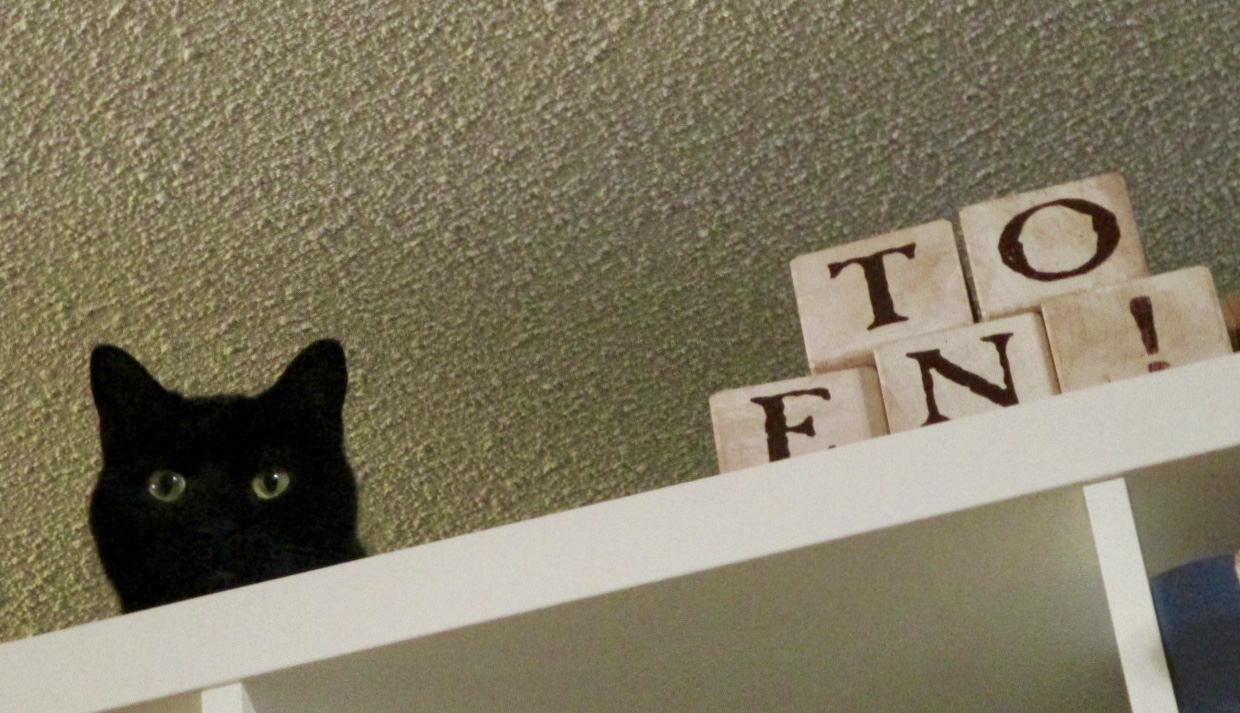
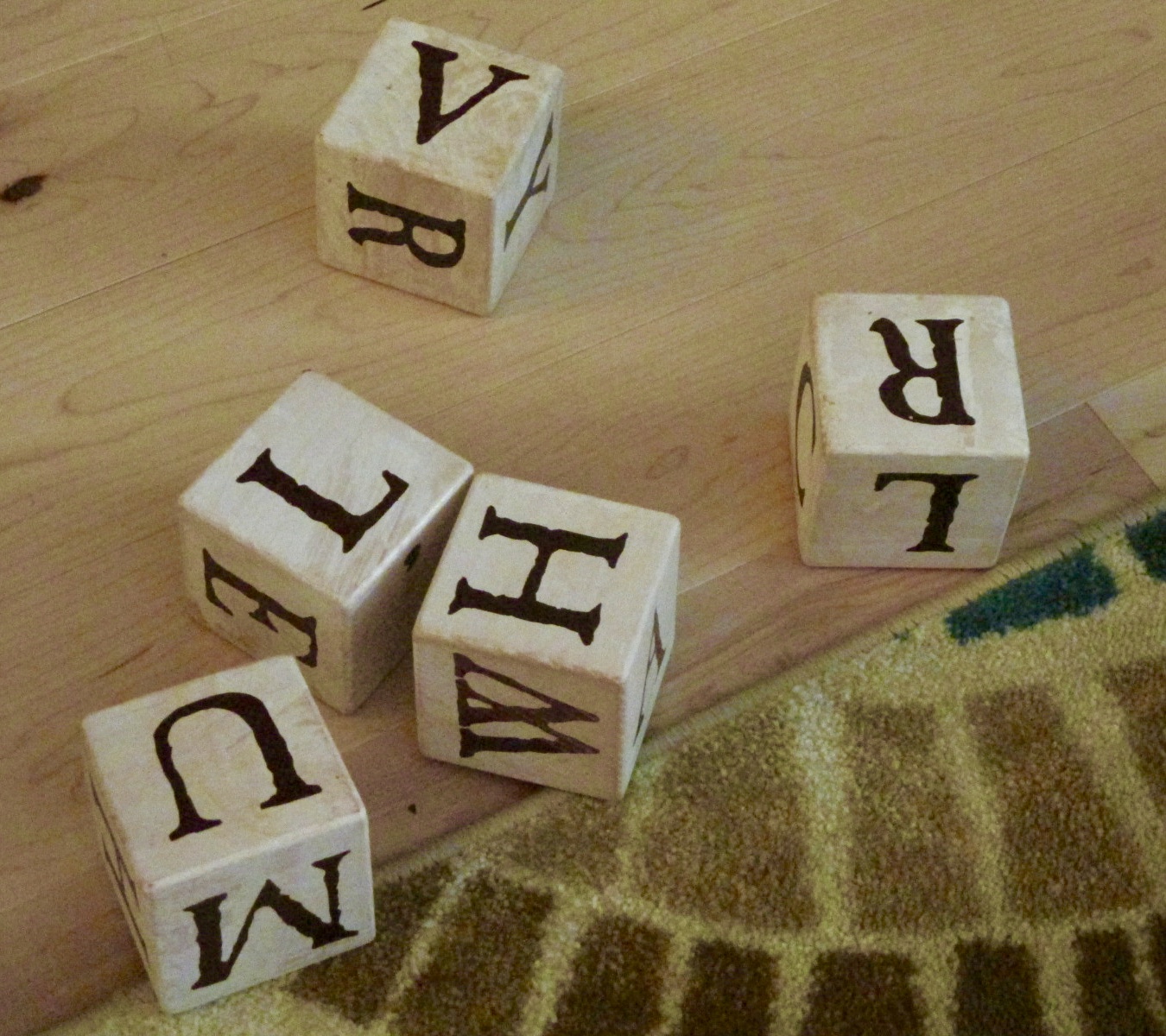
And finally, I will report that the message of my message blocks was finally… well … changed. Even though I wrote about changing the message back on May 31, it never happened. Now, I won’t say that the kids left the message completely alone. There were some small changes made to the spelling, the orientation of the letters, etc. There were comments made about the fact that the message remained unchanged, even after I had blogged about changing it. But no one could quite bear to rearrange the letters. In the end, it was appropriate that the cat—who sleeps on the shelf—pushed the message onto the floor. Dad was a fan of cats and would’ve loved this one. She has quite a purr-sonality! Maybe we’ll put the blocks away for awhile… at least until the cat can keep her paws off them.

Or maybe not.