Self advocacy

I have spent years trying to get my children to advocate for themselves. “Go tell Mrs. ___ that she gave you the wrong grade. She said your presentation was an A-, but she gave you a B; tell her you believe she put in the wrong grade.”

The answer was always, “No. It’s okay.”

Lately however, I have noticed that my oldest is beginning to take initiative in standing up for what he believes and what he wants. For example, last spring—at the end of his sophomore year—we noticed that he had an odd charge on his school account. When we inquired, we were told he had not returned a textbook at the end of his freshman year, but no one had bothered to tell us. (Most likely, they were hoping we wouldn’t notice until graduation, when we’d likely pay without debate).

“Mom, I know I returned that book. The teacher was distracted that day, and he probably forgot to write it down.”

“Well, you’ll have to go talk to him.” And so he did, with no result. He then went to the woman in charge of the book storage room. She repeated what we already knew; there was no evidence that he had turned in the book. She even went to the shelf and conducted a cursory glance-through. The book wasn’t there.

“Mom, she looked at the wrong books. I didn’t have the brown version of that text, but that’s where she looked. I had the green version.” He reappeared at her desk the next day.

“Are we to make this a daily meeting?” she asked him with more than a hint of sarcasm.

“Only until we find my textbook,” he shot back. (Most days, my kids could get in trouble for the sass they undoubtedly learned from their momma, but so far, they have not quite crossed that line….)

“Fine,” she sighed as she rose from her desk. “We’ll go look again. But it’s not there.” She tromped off to the storage room with my son in tow. After a quick look, he FOUND THE BOOK! Sadly, she did not apologize. But these are the encounters through which kids build the skills they need to navigate the world and advocate for themselves.

This past Monday, he came home from school and told me about a breakfast that was being hosted through his culinary program.

“It’s a little different than the other breakfasts,” he told me. “It’s for the mayor and some of the local senators. It starts at 8:00, so culinary 1 is doing prep, and culinary 2 is serving.”

“That’s too bad. So you don’t get to serve the mayor?”

“Chef said if we could get permission, we could stay. When we got back to school, we went to Mrs. B and asked her if we could stay. She gave us permission!” He smiled.

Yes, my son advocated for himself without any encouragement from me. He wanted something, and he was willing to put himself out there, knowing the answer might be no, but at least he would have asked. Maturity and experience are beginning to take hold. Then again, if you really want something, you’re willing to fight for it.

Injuries and Imagination

At sixteen, my son has experienced a work related injury. Of course, you might have to use your imagination to call tripping up the stairs on one’s oversized teenage feet a “work-related injury.” In this case, he was carrying a heavy container, which he proceeded to drop on his hand, thereby causing the injury.

When he first texted me from work, “I am injured. They are sending me home at 2. Please be here at 2,” I panicked, and immediately lost my appetite for the bagel chips on which I was munching.

I texted back, “Injured?” I received no reply. It was 1:15. My overactive imagination went to work. I conjured images of blood, burns, compound fractures, a concussion. My head held bloody pictures from horror movies and my worst nightmares. I felt sick to my stomach, and the partially digested bagel chips rose in my throat.

I took a deep breath. No, I convinced myself. If he were badly injured, they would send him home right away. I calmed my beating heart with a few more deep breaths, and I swallowed hard to send the lump of bagel chips back toward my stomach.

The minutes ticked by slowly, loudly, as I played and re-played the mommy panic in my head; I calmed myself, but quickly started the panic cycle over again.

When I finally arrived in the parking lot of his work, I texted. “Do I need to come in?”

“No,” came the reply. “I’ll be right out.” More long moments before the door opened and he emerged. His hand was wrapped in a towel; a plastic bag of ice resting on top dripped as he approached. His finger was covered in a band-aid that needed changing. He was walking, talking, and held the slightest hint of an embarrassed smile in his eyes.

I let out a breath and realized I had been holding it in since he texted me. My boy was in one piece. One. A walking, talking whole.

He got in the car, looked at me, and I didn’t even ask before he started in on his story. He tripped going up the stairs, dropped a heavy box on his hand, and the rest, as they say, is history. He told the supervisor he would stay, but she sent him home. He sustained a nasty bruise and some swelling, but he had full range of motion; as long as no one touched his hand, he was fine. I was more than happy to monitor the swelling and pain.

The following morning—the Monday after Christmas vacation—I woke him for school. I asked him how it felt, to find out if his hand hurt excessively, or if it had stiffened up overnight. If it had, I figured we would have it checked out. His response was the classic teenage response.

“It hurts, Mom. I think I’ll have to take another the week off from school….” Ha! That settles it: he’s fine!

Meals

The idea of “meals” takes on a whole new meaning when there are teenagers in the house. When my children were younger, we would eat three meals a day with the possibility of small snacks in between. Nowadays, meals all blend together with no real distinction. Snacks are simply a way to extend a meal and keep eating when it is not “meal time,” per se. My children seem to eat one meal a day, and it lasts all day.

The meal that I find most interesting is the Midnight Meal. It seems my children—one in particular—can’t make it through the night without a Midnight Meal. When I was a kid, we referred to this late night need to eat as a “midnight snack,” but I can honestly say I never took part in this practice myself. I remember being hungry at midnight, but the hunger was never enough to propel me out of bed, down the stairs, and into the kitchen where I could raid the refrigerator.

The “midnight snack” has morphed into a bowl of cereal, then another, and perhaps a third. A yogurt will supplement this small snack, and maybe some crackers. Oh wait! Is that a leftover BURGER I see?? Cold cuts!! Any food available is fair game for a hungry teenager at midnight.

Nope, it’s no longer a “snack” in my house. It is a veritable feeding frenzy, the panic that sets in as a teenager is about to go to bed, but realizes that bedtime means the possibility of hours without food. At that point, a teen can’t bear the thought of being away from the kitchen for more than a few minutes. It is this panic that leads to the Midnight Meal.

Interestingly, the quest for the Midnight Meal usually begins as soon as I say, “Hey, it’s time for bed.” By this time, it is already later than a kid should go to bed, but that doesn’t stop the hungry teen. The teen is hungry simply because it is bedtime. Which confirms my theory about a feeding frenzy.

If I went to bed with that much food in my stomach, I would not be able to sleep. But a teenager has merely to walk up the stairs to his/her room, and the majority of the food has been digested, the calories burned off. This super-charged metabolism gives me very little time to lock down what little food remains in order to save enough for the next day’s breakfast….

Tips

IMG_1298

Over many years, and through many mistakes, I have learned to check pockets before I throw clothing in the washing machine. It all started years ago, when my children would tuck crayons, tissues, toys, and trinkets into their pockets for safe keeping. The first crayon that went through the laundry was purple. A pair of boys’ tan cargo pants received the brunt of the damage. But since the crayon was in with a load of light clothes, it wasn’t difficult to spot streaky purple scars on shirts, underwear, socks, and even a pillowcase.

From then on, I tried to be much better about checking pockets. But all it takes is one day of dead-tired chores for me to slip up. And slip up, I did. This time, it was an orange crayon. Orange seems to be a grittier, stay-in-place kind of color. The orange crayon ruined one pair of (again) tan cargo pants when it disintegrated and stuck in the pocket like glue. Oh, and it bled through, so there really was no chance of wearing the pants again.

The next time I checked pockets too quickly, a few years later, I missed a lip balm. Lip balm melts very nicely down to nearly nothing in the heat of the dryer. There was just enough left to permanently leave an oily mark on everything it touched. Several more items were ruined.

Since these incidents, I have gotten much better at checking pockets. Often, I find spare change that I have dubbed “laundry tips.” Usually, I find a penny or a dime or a quarter here and there. Sometimes I might retrieve a dollar or two folded up into a tiny square, or to my disappointment, a baggie full of cracker crumbs (these I don’t eat…).

The stakes are higher nowadays, with flash drives and cell phones stored in pockets and sometimes forgotten. One of these items left in a pocket and run through the washer could cause some serious data loss, and as I mentioned, occasionally I am dead tired. So I have added an incentive for my offspring to check their own pockets: Anything I find while doing the laundry is mine to keep if I choose. While laundry tipping is often an involuntary activity, it always results from the voluntary refusal to check one’s own pockets before throwing clothing in the hamper.

Of course, sometimes they catch their mistakes before I can benefit. The other day, I was working in the kitchen when W walked in and started up the stairs. “I should probably go remove the ‘tip’ from my laundry,” he said as he passed. He had thrown his pants in the hamper with a pocket full of Christmas money. To my estimates, it would have been my best “tip” to date!

My loss, but clearly, the message is starting to sink in.

Resolutions

IMG_1289

The tradition of making New Year’s resolutions is almost as interesting as the tradition of breaking them a few weeks down the road. Somehow, we think that just because the calendar turns to a new month that ends in a new number, we should somehow change. We believe if we make significant changes in our behavior that our lives and our year will be different and better.

On New Years Day, we take on the challenge to change our lives all at once. We decide to lose weight, to work out, to eat healthier, and to live happier by reaching out to the less fortunate and changing our attitude. Really? And we wonder why we give up a week (or two… or four…) in.

Life change is an on-going process. It’s called growth, and growth is something that is constant and continuing until the day we die, regardless of our contribution to the process. While we have the option to make choices to help steer our growth in a positive direction, it is never advisable to make changes in all aspects of life at once. Unless we want to fail. If one truly wants to lose weight or get in shape or be more altruistic, one would do so regardless of whether the calendar changed.

In 2014, my greatest growth came not from changes I made, but from my choice to grow from the situations in which I found myself. Through these situations, I experienced one of the most important epiphanies of my life as a single parent, and consequently, I was able to release one of the long-standing stresses I have had. This growth is not something I could have predicted on January 1st, but will change my approach to similar situations in the future.

My resolution for 2015 is one that was originally made 17 years ago, and is one that I am still working on. Before my son was born, I resolved to be the best mom I could be, and I am forever working on this resolution as I define and redefine what it means to be “the best mom I can be.” My definition is different for teenagers than it was for toddlers, and what they need from me also transforms and evolves. My life as a single mom poses challenges that are neither constant nor predictable. But by striving to be the best that I can be in the situations that arise, I am making a promise—to myself and to my children—that I will be a presence that they can rely on and a role model that they might choose to follow.

And so I continue to work toward my goal on my journey as a parent. But I know I must do so one day at a time. January 1 represents a new day, 24 hours in which I can work on my goal to be the best I can be.

Oddities #2

As the mom of a brood of hungry teens, I tend to buy various favorite food items when they are on sale. Bagels fall into this category because they freeze well for a short period of time. I buy them, slice them, and pop them in the freezer for consumption over the next couple of weeks.

For some reason, it seems my children never finish one bag before they start another bag. I have, at times, had two or more bags with half a bagel kicking around in the freezer. After all, we all know that if you want a whole bagel, the top and bottom must both come from the same bagel, right? Teen rule #1 about consuming bagels: Do not ever split up a bagel to make a new whole.

Interestingly, the single bagel halves in my freezer tend to be the bottom half. In one way, that is not surprising. The bagel bottoms would likely be the last in the bag. The surprising thing is that I have found up to three bagel bottoms lingering in my freezer while a new bag is being consumed.

To discover the reasoning behind this oddity, I went straight to the source. “Would you rather eat the top of a bagel or the bottom?” I asked my youngest. He thought for a minute.

“The bottom,” he responded, so I asked him why. “It tastes better.” Hmm. If it is all the same bagel, does one piece “taste better” than the other? This thought is an interesting one, but does not explain the reasoning for the plethora of bagel bottoms in my freezer.

I moved on to my next test subject, who was cleaning her room. Since this activity is one I try not to interrupt, I made it quick. “Would you prefer to eat the bottom of the bagel or the top?”

“It depends on what kind of bagel it is. If it’s a sesame bagel, I’d rather eat the top because it has all the sesame seeds. If it’s a plain bagel, I like the bottom.”

The response of my oldest? “I eat them both,” …and everything else in sight, I’ve learned.

My research was, therefore, inconclusive. There is no reason that I should have three bagel bottoms loitering in my freezer. According to my children, they eat both tops and bottoms equally. Which leads me back to the question of when a container is empty. If half a bagel remains, but the eater wants a whole bagel, is the bag considered “empty”? This will likely remain another of the great mysteries of raising teens.

Snowmen

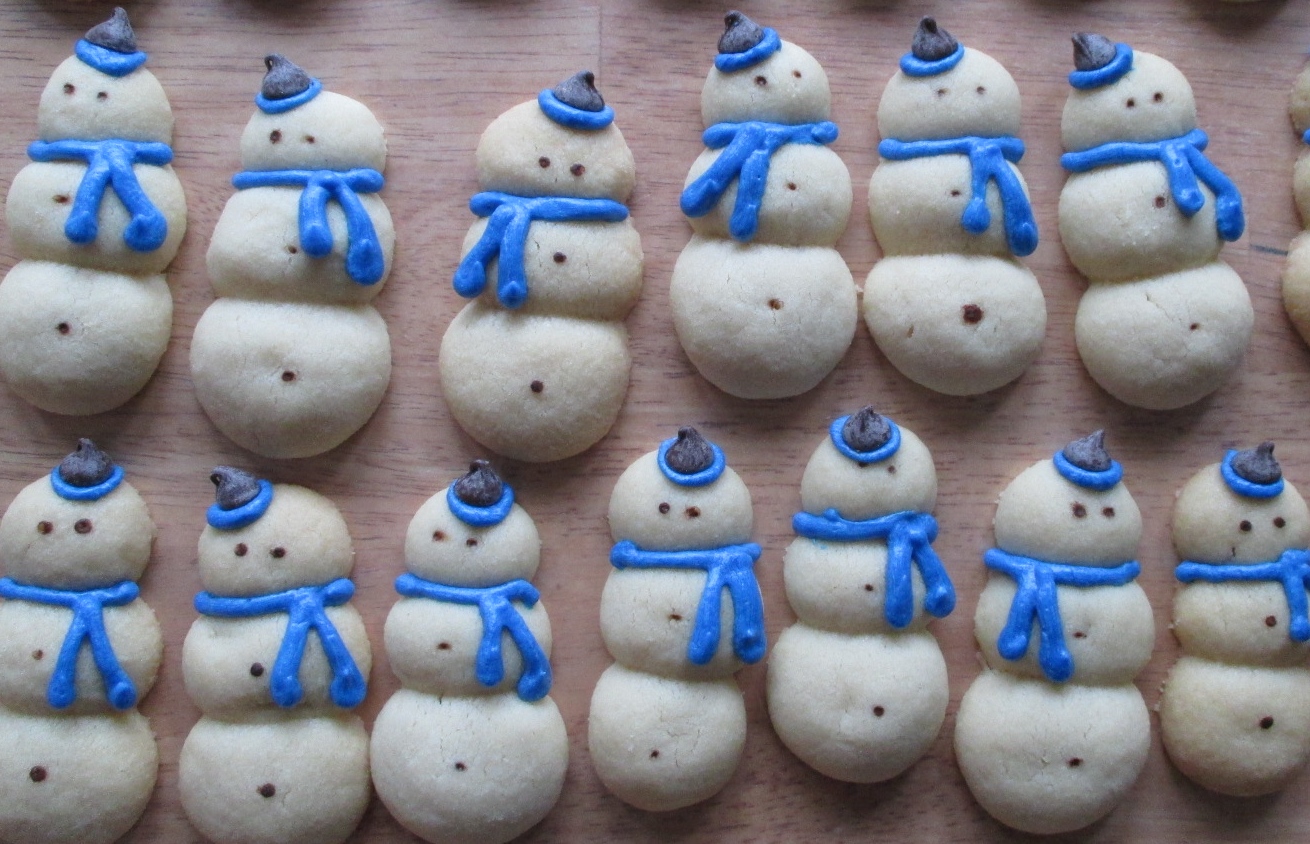
Each year at this time, an army of snowman cookies arrives at my house. Uh, wait… let me start over.

Each year at this time, through a great deal of effort on my part, an army of snowmen arrives at my house. This year, I tried to gain support for the cause. On Sunday morning, I looked at W sitting on the couch surfing the Internet on the iPad. “Hey W,” I watched him intently. He looked up. “Do you like to make little balls out of clay?” I asked with a tone that implied I had something exciting in store for him.

He looked at me with a raised eyebrow before he sighed with a hint of disgust. “Do you want help with your snowmen?” Yep, he was on to me. Every year, I try the same tactic.

I nodded too fast, like an excited puppy. “Yeah! You wanna help?”

“Not really,” he replied as he returned to the iPad. I went to the kitchen, hauled out the bowl full of dough, and began to roll it into balls. Tiny balls. Actually, three different sizes per snowman. These cookies are labor intensive, but they are the local favorite—in my house, in my neighborhood, and among my family. The fact that they have been a favorite is why I have continued to make them. Every year. For seventeen years.

It wasn’t long before I had an army of little snowmen on my kitchen table. And taste-testers hovering. My daughter had her first bite. “I think we should keep them all this year. We give away too many.” This thought was one that would never fly with my neighbor who believes I make these cookies specifically for her and then withhold all but a small number.

I turned to Facebook with this thought. To my neighbor I posted, “My taste-tester just tried a snowman and says we need to keep them all this year.” The reply: a resounding “NO!” and the annual “war of the snowmen” had begun.

At least daily, I receive a text, Facebook message, phone call, or an in-person assault. “Where are my snowmen?!” And daily, I have to deliver the difficult news that they are still naked, they have to stick together for their “army” training, or they have not yet said good-bye to their friends. (Really, I’m stalling while I make other cookies to “fluff up” the plate). Soon, my neighbor on the other side adds her two cents in anticipation of receipt of her yummy snowmen.

These little snowmen have evolved over the years. Initially, they were simply a part of my cookie tradition. But through the annual battle, these cookies have taken on a life of their own. They add extra fun to the holidays in my neighborhood, and they bring us together each year. I imagine I will continue to make them for another seventeen years. And I wonder how the tradition will evolve from here.

IMG_1248


Packages

My youngest and I were discussing a package that I recently ordered—not a present for anyone, but a necessary item to make some presents that I will be giving. Because I never think of it quite early enough, stores generally run out of the item by this point in the season. So I went online and found what I was looking for; and I ordered some. If I’m lucky, the package will be here before Christmas. “Maybe the package will arrive today?” W said thoughtfully.

“I’d be surprised. I don’t think it has even been shipped yet.”

His expression brightened in thought, and I could see his mind churning. “What if the government discovered the ability to teleport things, and they only shared the technology with the USPS and UPS?” Yeah… because that’s going to happen. But imagination is an amazing thing, isn’t it?

“So your packages just appear at your house? Like… Boom! There’s my package!?” I pantomimed a surprised look as I glanced at the kitchen floor.

He laughed. “Yep, like that.”

“Darn! I just tripped over my package. I wish those people would stop delivering things to the middle of my kitchen when I’m not expecting it!” I dramatized tripping over a package that appeared via this new delivery method.

“What if you ordered something heavy, and it landed on the cat?” He cringed for effect.

“Ooh, that would not be good! Hopefully, the cat could run away fast enough.”

“Especially if you ordered something really big!” he added.

“Yikes!” I responded, thinking back to a time when something very big was mistakenly delivered to my house. I had to call UPS to come pick it up because it wouldn’t even fit through my front door. I briefly wondered if they would be able to teleport a pick-up as well as a delivery….

“Imagine if you ordered a car, and it landed right on your kitchen table!” W said, and we both laughed. I imagine that would be the end of my house, not just my kitchen table.

And with a little imagination, I now know how thankful I am that the government does not (yet) have this technology!

Dark

Each weekday morning, when I drive my son to school at the ungodly hour of just-the-other-side-of-dawn, we see people engaged in their early morning activity. Early in the school year, there was the woman who walked her dog not far from our house. She wore clothes the color of dusk as she walked her dusky shadow of a dog along the line on the road that separates the travel lane from the shoulder. One day, as she and her dog were crossing the street, their shapes emerged from the darkness just in time for me to swerve to avoid them.

Farther along on our trip, there was the man who walked to work in the early morning murkiness. His walk was brisk, and he bent slightly under the weight of a small backpack. As the temperature dropped, his pace began to quicken, and he always walked with his back to the traffic, unaware of the dangers. When it was raining or snowing or foggy in the pre-dawn, I would notice his form just beyond the edge of my car as I drove by.

More recently, perhaps because we have changed our departure time by a few minutes, we have seen one of my son’s friends standing outside his house waiting for his bus. We always look for him as we approach, but some mornings, we cannot tell if he is standing by the side of the road until the very last minute. Occasionally, it is only after we pass him that we notice his form lurking by the mailbox.

We started to think of ways to make this young man more visible in the dark. My son and I thought of light up clothing, but finally decided on a flashing Christmas necklace that looks like a string of lights. What does the friend think of this idea? He went along with it. He even discovered that the necklace had three different light settings. The one morning that my son didn’t go to school early, he wore it, and we didn’t get to see if it would work as we hoped.

Now (a day later), I hear the necklace broke. Its quality $3.54 construction couldn’t hold up to the morning routine of a 16 year old. We are looking to replace it before the holiday season is over and these necklaces are long gone. I definitely think we’ll be able to see him much better with the necklace.

While the necklace is a fun way to deal with this issue, our morning entertainment began as a simple lesson in visibility. For drivers young and old, the pale dark on the ends of the day is a tough time. And it is tough for pedestrians, as well. My son, a new driver, has had a great lesson in how challenging the dark hours can be. Being mindful of one’s clothing, and wearing bright colors (reflective or lighted!) can make a huge difference—for all parties involved.

Reversal

We are sitting at the table eating dinner. Our kitchen table is right next to the window, and only the window shade and a thin pane of glass separate the cozy kitchen from the cold evening outside. If I were to stretch out my arm, I could almost touch the winter night that tries to filter in to share our meal.

I do my best to make sure we sit down to dinner as a family as often as possible, but I am finding that as the kids get older and busier, it becomes more difficult. On this night, not only have I had time to cook, we have time to sit together. The evening meal usually provides our best family conversation, and we all look forward to this time together. In fact, my children have commented on how many of their friends and acquaintances eat dinner on their own or in front of one screen or another.

As I converse with one of the boys across the table, in my periphery, I can see my daughter intently studying my face. We are discussing an incident that happened in the lunchroom at school, and though I try not to be distracted, my daughter leans a little closer, tilts her head.

There is a pause in the discussion. “Mom…” she says, moving even closer. On her face there is the scowl of a question. I turn to address her.

“What?” I ask, wondering what she is going to say, but knowing it has nothing to do with the conversation we were just having. I believe she has no idea what we were just saying.

“Is that my eye glitter you’re wearing?” she asks. Huh… I wasn’t expecting that.

When my daughter emerged all sweet and little-girl-cute at birth, I prepared myself for the day she would borrow my clothes, my shoes, my scarves and jackets, my jewelry and make-up. I prepared myself to be minus a vehicle when she borrowed the car keys and, of course, the car. But this—the reverse—I was not prepared for. And I certainly was not prepared to be caught in the act.

When I was a kid, we didn’t have eye glitter. We didn’t wear sequins and crystals and all things shiny. So the fact that I find these things appealing speaks both to my feelings of deprivation and to my slightly distractible nature. Shiny? I am there! The glitter make-up was purchased to enhance her performance make-up (because everyone uses glitter) and not because she wanted it. In fact, she doesn’t even like it anymore. Nor does she use it. Since I bought it, and it has now ended up in with my make-up, don’t I have some unspoken right to borrow?

“Indeed, it is yours!” I admit with pride. “Or… it was.”

“You can have it,” she tells me. “I don’t use it anyway.”

Share and share alike, I say. My day will come to share my stuff. Then it will be my turn to catch her in the act!