Wishes

Yesterday was a quiet day. I spent much of the day working, and J spent much of the day on the couch reading and messaging friends on her iPad. Her brothers were off doing their own thing; one was planning an overhaul of our shed while the other one had gone to the beach with a friend.

Several times, I tried to entice her to come out on the deck with me and read, but the fact that I was working was not terribly enticing. Instead, she took up some creative pursuits: a chalk mural in our parking area, sketching, origami.

Later, after the head of the day had cooled, I came downstairs from a refreshing shower. She was cleaning up small strips of paper from the floor in the living room. They were squished and rustling in her left hand. She held out her right hand as if to give me something.

“I don’t want your trash,” I told her, as I walked by. “Throw it out.”

“It’s not trash,” she said. “I have something for you.” Whatever “gift” she had was paper in her hand, white and rustling just like the trash.

“Throw it out,” I reiterated. “I know it’s trash.”

“No, Mom, it’s not trash. Just hold out your hand.” I sighed, weary and worn down. I held out my hand, fully expecting it to be filled with her paper scraps.

Two tiny folded paper stars fell into my hand. “Oh!” I exclaimed, drawing in my breath. I was surprised by their simple beauty, their tiny-ness, their perfect star-ness. “They’re beautiful! I love them!”

“They’re wishing stars.” She smiled. “The first ones didn’t come out at all, but I figured it out.”

Beautiful! And what could be better to fall into your open hand than two paper wishes?


IMG_1735

Camp Mail

Sending letters to camp is not what it used to be. When I was a kid, my mother would send us off to camp, and each day, while she sat at home doing nothing (because what else does a mother do when her children are not home?), she would take out a pad of stationery and write a note about her day and inconsequential things that had happened. I remember the first time my sister went to camp, Mom asked me if I wanted to write her a letter. But then she cautioned, “Don’t write anything that will make her homesick.” I was eight and had no idea what would make my sister homesick. So I drew an elaborate picture, wrote that the cat had sniffed a blueberry, and I signed my name. We still laugh about that letter….

On Sunday, I dropped my son at camp for a week. Now, what with e-mmediate-mail, it’s quicker to drop the letters off with the child’s camp counselor, or in this case, Scout leader. Of course, W’s Scout leaders have worked hard to earn a reputation for handing out mail (the entire week’s worth) on the day parents are coming for pick up. I decided to circumvent that problem, and give the letters directly to W to read on the correct day(s). I labeled the letters with post-its and packed them in a Ziploc bag (the bag will prevent him from reading mail on the wrong day or reading all of the letters at once, of course).

Being seasoned camp-ers, we know all the warnings: Don’t send food, candy, electronics, or any bad news such as news that the dog died. And so…. Because we are cat people, every year, I send a letter to camp informing the child in question that the dog has expired.

On Sunday morning, I sat down at the kitchen table to compose five letters to be read over the coming five days. As the story in the letters began to unfold, I snickered to myself, unable to contain my amusement. W was walking through the kitchen. Knowing I was writing camp mail, he stopped and rolled his eyes. “Mom, what are you writing?”

“You’ll see!” I giggled in response.

Over the next few days, my son will read about our adventures in Paris, eating breakfast with a view of the Eiffel Tower; snorkeling off the coast of Australia; and walking the Great Wall of China. Believe it or not, we were able to walk the entire length of the Wall in one day—between our day in Australia and our trip home in time to pick him up.

On Thursday, my son will read that the dog accompanied us on our trek on the Great Wall, and did a fantastic job! He will read that the dog is doing well, though resting, after his intensive exercise. Sadly, on Friday W will learn that the trek was too much for our pup, and he expired overnight.

Yes, we had a grand adventure while my son was at camp—at least in my over-active imagination. And my son got to read about it from the comfort of his tent.

None of my kids can say camp mail isn’t entertaining!

The Frog

IMG_1411

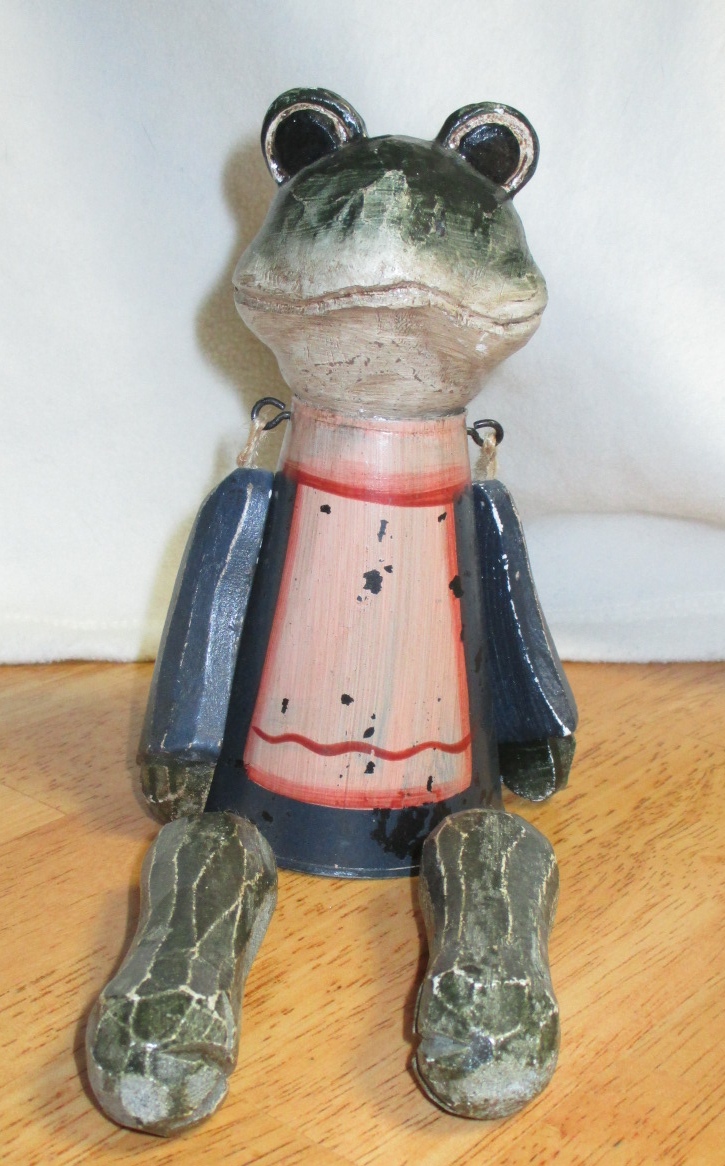
When I was younger, I had a collection of knickknack frogs. One of these—made of tin and wood with limbs that dangle from joints of twine and wire—was a gift that I received many years ago, and it has a simplicity to it that is reminiscent of an earlier era. As I have moved residences over the years, I’ve pared down my collection to my favorites. This particular frog remained as it reminded me of my past for reasons I can’t exactly pinpoint.

In the townhouse where I landed with my children after my divorce, the frog took up residence on a shelf that held some books and a few ornamental items. Seldom did I notice it sitting there in its decorative, take-up-space kind of way.

One day when my children were still fairly young, I found this very frog sitting in the middle of my propane heat stove, right next to a candle that I had placed there at the end of the most recent heating season. It was late spring, and warm enough out that the windows had been open with regularity. The sight of the frog startled me because I wasn’t expecting it to be there. How odd, I thought. I wonder who put that there? It seemed like a bold placement for such an object, and I picked it up and moved it back to its normal location on the shelf.

The next morning, I woke the children, and I took a quick trip to the basement laundry room to gather some clothes. As I passed through the living room, I stopped abruptly, startled when I spotted the frog, once again sitting proudly—albeit unexpectedly—on the heat stove. The children were upstairs waking and preparing for school. I glanced around the room, not really sure what I was looking for. The room was empty. I set the laundry basket on the floor, and returned the frog to his spot on the bookshelf.

I took a deep breath, shaking off my surprise, and I went about my morning preparations.

When I was ready for the day, I went downstairs to the kitchen. I opened the door to welcome the spring air, and went to the back of the house to open the back door. Mid-way through the living room, I froze. There, on the stove, was the frog, sitting right in the middle where he’d been twice, now three times. My heart pounded in my chest as I thought through the possibilities. I glanced around the room expecting the unexpected, only daring to move my head. I pondered going to the basement to look around, but I couldn’t do it. Not alone. I went to the kitchen phone and called my neighbor.

“I think there’s someone in my house,” I reported in a near whisper. “Can you come over?”

“I’ll be right there.” She arrived a minute later, wielding a kitchen knife.

“What are you going to do with that?” I asked her.

She looked down and shrugged, smiling weakly. “It’s better than nothing!” Together, we searched the house while I explained the unexplainable to her. We found nothing, but we got a good laugh. We concluded that one of the children was playing a trick on me. No one would fess up.

It wasn’t until several months later that my oldest finally admitted to moving the frog. He read in a book how to secretly move an object. Or something. I have to say, he got me good, and we will forever joke about it.

Since that experience, the mere sight of this little frog holds an unexpected emotional charge. When I happen to see it sitting (usually in its normal place) on the shelf, I have a momentary jump in heart-rate, as if its very glance in my direction has power beyond its inanimate self. Then I laugh at the memory.

Snow Wonder

IMG_1369

I went out the other evening to pick up my daughter from her team practice. It was snowing, though with the winter we’re having, I prefer not to acknowledge snow. I will admit, however, that it is beautiful when it is falling, even when the snow banks are already eight feet high and the grass may not reappear until July.

When I arrived in the parking lot, the carpool had not yet gotten back from the gym. I rolled down my window to talk to another mom, and her young son opened the back window and began playing with the snow that was gathering on the car. “What’s that?” I asked him.

“Snow,” he responded.

“No,” I shook my head. “There’s no more snow. That’s bugs. They’re spring bugs.”

“It’s snow,” he told me without a hint of question in his voice.

“It’s little tiny bugs. Lots and lots of them. Those bugs only come out in the spring.”

He shook his head. “No. It’s snow,” he said, and he rolled up the window. Clearly, he was done with my silliness, and he didn’t need me to change what he already knew.

My daughter arrived, and she immediately hung her head out the window to catch some big, juicy snowflakes on her tongue before we drove off. “Can you put on your high beams when we get to the back road?” she asked, settling back in to her seat. The snow was lazy, but steady as the car pulled out of the parking lot.

I smiled to myself. “I’ll try,” I told her, not making any promises. I never knew how the traffic would be, but the back road was usually not heavily traveled at this time of night.

When we turned onto the back road, she was disappointed to see there was a car ahead of us. I slowed down and the car pulled ahead and disappeared around a bend. I flipped on my high beams while I had a chance. The snow took on a life of its own, speeding toward our windshield like stars whizzing by a spaceship.

As we traveled down the road, the snow suddenly stopped; then a few feet later, it started back up again, like we had driven through a brief tunnel or a hole in the cloud.

An amazed exclamation of “Whoa!” escaped from my daughter. Her word, her tone of wonder, were perfectly synchronized with my own thoughts. The break in the snow was so unexpected, so incredible, so wonderful, “Whoa!” was a perfect reaction.

To share a moment of natural wonder with one of my children is always special. The fact that her outer reaction exactly mimicked my inner reaction let me know that somehow, as I have parented her through so many every day moments, I have taught her to appreciate the ordinary wonders in life.

Snow Days

1956692_10201528127188600_1607549408_o

When I was a child, snow days (days off from school because of a ‘snow event’) were announced in the early morning hours. If we happened to awaken by 6 am, we could lie in bed listening to the muffled silence that only comes when the world outside is blanketed with a thick, smothering layer of fresh snow. We would strain our ears, listening with all our might for the sound that would be distant, but audible nonetheless. If Mom came in to wake us, our deep listening would prove to be in vain.

The sound we listened for was the blaring of the horn on the firehouse, half a mile away. This was the same horn that would blow to alert us when there was a fire in town (and probably would have sounded for other emergencies, as well); the number of whistles let us know the location of the fire. For an announcement of no school, the signal was 22—two horn blasts with a brief pause before two more horn blasts. A longer pause then followed before the signal was repeated. If we heard that signal—one that seemed so far away, but so close and exciting—we would silently cheer, turn off our alarms, and go back to sleep.

These days, snow days have fallen victim to our constantly advancing technology. No more lying in wait; we are alerted of snow days via recorded cell phone call: “The following is an important message from the local school district…” the voice begins. Often, the calls come in at 5:30 in the morning. But for the big storms, the “sure thing” snow days, we are alerted the evening before, or sometimes even the previous afternoon. Since weather forecasting has become more accurate over the years (well, it often doesn’t seem so, but it has…), there seems to be more advanced warning that a storm really is going to be “epic.” Hence, more warning that it might be wise to cancel school.

Now, the announcement is closer than ever—an in your home and “in your face” type of close. No more wondering if you are going to hear the notice… or if you might merely be imagining the sound in the far off distance. It is clear your phone is ringing, and the message it carries is unmistakable. Now, the children can sleep in, and the morning doesn’t carry the same air of mystery and excitement.

I vividly remember those cold, dark mornings of waiting and listening as an integral part of my childhood winters. I wonder sometimes, if my children are missing out on an important rite of passage. But then I realize that there will be other things they will remember (and miss) when they grow up and have their own children.

Sharing

I have a new sweatshirt. It is grey and purple, fleecy and soft. And it is the perfect weight for winter we have been having. Not only was this sweatshirt on sale, I had a coupon and an extra discount for recently celebrating my birthday. All told, I believe the store paid me to take the sweatshirt off their hands.

Because it was a recent purchase, I wore it for the first time this weekend. It immediately got my daughter’s attention. “I like that shirt, Mom,” she told me, running her hand up my arm. “It’s so soft!”

“Thanks,” I replied. “It’s the same brand as the one you have, but it’s a different style.”

“I really like this one.” She paused, and I could see the wheels turning in her head. “Did you get me one, too?” she asked, smiling and batting her eyes for effect.

Of course, I thought. Because I always buy you things when I buy things… just to make it fair. But to her, I said, “Um, no. I didn’t think ‘matching your mother’ was on your fifteen-year-old bucket list.” I winked.

She shrugged her shoulders. “That’s okay. I’ll bet I can wear that one.” She turned, her hair flipping, and skipped up the stairs. And I realized that for the first time, she probably could wear this sweatshirt—my sweatshirt—and more importantly, that this is a major milestone for this kid.

Almost exactly a year ago, this child, who’s always run a little on the small side, was being tested to make sure that she wasn’t deficient in anything necessary for “normal” development. Even though she had always been off the bottom of the growth chart, the doctor just wanted to be sure. The blood tests and x-rays revealed that all is fine, but her bone age is two years lower than her chronological age.

Since that time, she has gained ten pounds and grown several inches. She eats non-stop, and she is always hungry. (I don’t know why no one ever talks about how much teenage girls can eat. If you get enough skinny dancers in your house, you may as well be feeding an army of teenage boys….)

While my daughter is still small for her age, she’s catching up. It wasn’t until she asked about my sweatshirt that I recognized my shirt is only one size larger than her own. She could easily wear it, and it would only be a little big. So for now, I’ll keep it in a safe (and hidden) place. But soon, she’ll be wearing it. I can share. And after all, I’m kind of flattered that my clothes fit her teenage sense of style.

Calculations

One never knows what is going to happen at the dinner table in my house, nor how that information might be used in future conversations. We have discussions that range from the sublime to the absurd, and everything in between. And the conversations tend to wander from one end of that spectrum to the other—often multiple times over the course of the same meal.

On Friday night, the boys became engaged in a conversation that was both entertaining and thought provoking. Dinner was going along smoothly until one of them dropped some food on the floor and started pondering the edibility of the morsel in question.

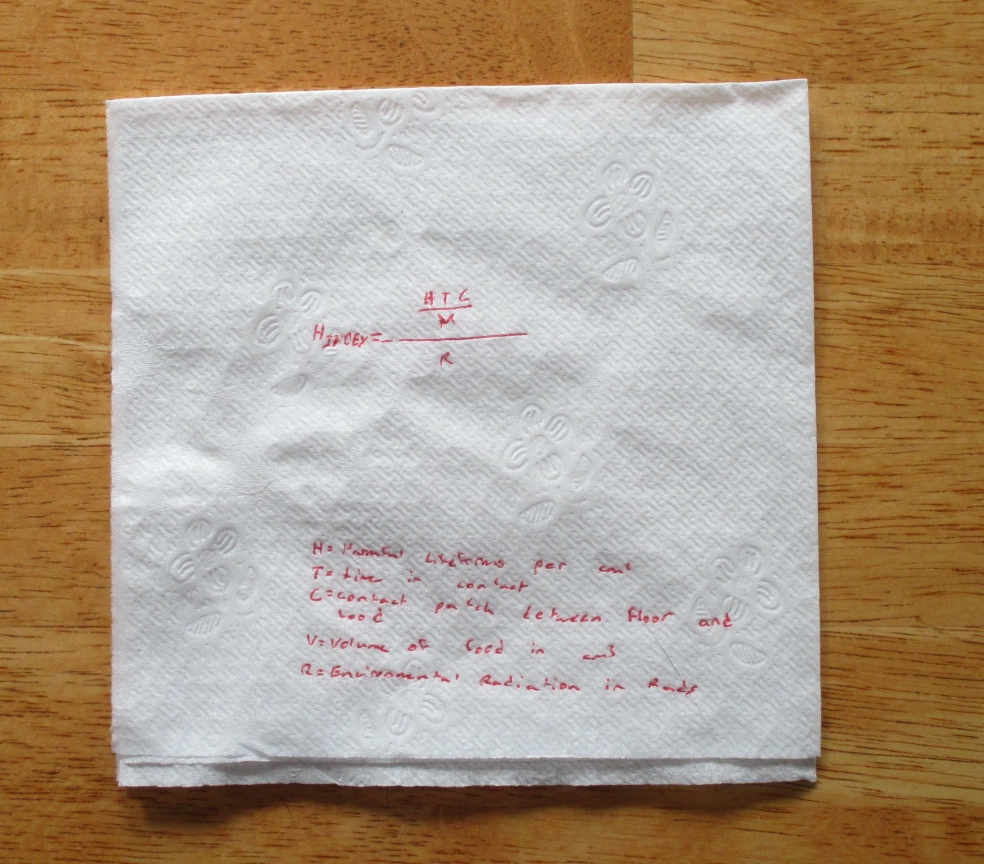
The next thing I knew, the older brother had pulled out his napkin, and was working through a formula to determine whether or not one should remove food from the floor and eat it. His napkin was the paper on which he was composing his formula—writing out the variables involved in making the necessary “calculations.”

The younger boy watched critically as his brother developed this idea, throwing in some of the factors he believed to be important. C had based his calculations on an “average bedroom floor,” using food on a plate and (basically) food in the cats’ litter box as his extreme conditions.

“Wait! Let me show you mine!” W said, grabbing the pen from C. The wheels in his head sped up, formulating, calculating. He developed a complicated equation in which one variable was “harmful life forms per square centimeter,” and another was “time in contact.” There were others, as well as a series of unknowns over other unknowns. They bantered back and forth as they considered whether they had covered all of the important elements.

Ultimately, the bite that fell on the floor made its way to the trash. Through it all, the boys were laughing and carrying on about various funny (i.e. “disgusting”) things that could happen to the food to affect edibility.

In my mind, I had to consider how this incident might have been different if I had been eating with two girls. The girls would have immediately picked up the food, thrown it out, and cleaned up the floor.

But in the interest of developing the boys’ talents at creating new formulas, I have some ideas. On Monday morning, I was texting my daughter—who spent the weekend with her father. I told her I missed her. She said she missed me more. “Tough to know,” I texted. “We can measure later.”

Perhaps the boys could write a formula for that.

IMG_1314 IMG_1315

Technology

1962 - the Jetsons-03 copyright - Hanna-Barbera from: https://www.flickr.com/photos/x-ray_delta_one/
1962 – the Jetsons-03 copyright – Hanna-Barbera
from: https://www.flickr.com/photos/x-ray_delta_one/

When I was a kid, I remember watching the Jetsons navigate their space-age world, and I would marvel at their futuristic (and highly improbable) technology. The family would zip around in flying vehicles, push buttons to complete simple tasks like raise the door and prepare their food, lift their feet when the robot maid was vacuuming, and even talk with their friends and family on their video telephone screen. My eyes were glued to the television, wondering what it might be like to have such amazing technology. Not once, while I was watching these cartoons, did I expect my own children would be holding video chats in my house.

Fast forward many years to Friday evening at my house.

Two of my teenagers are sprawled on the living room floor, the iPad propped up between them. (Ironically, my third teen is off the grid, camping in the woods….) They are watching funny videos, laughing, and chatting. They are telling jokes, and sharing favorite Internet sites. And they are discussing an economics assignment that is due by midnight. I can hear them talking about resources, analysis, and the performance of various companies.

Even though there are only two teens in my house, there is a friend with them. She is on the iPad via FaceTime. Early in their conversation, I had a brief chat with her about some treats I made that she particularly liked. Yes, the video chat technology that was thought to be science fiction back in my childhood is the reality of the world in which we live today.

These days, I never know who will appear in my living room. Friends and their pets are the usual visitors. My son’s teacher, teaching assistant, and classmates are also frequent visitors, now that he is a member of an online classroom. I always try to stay out of the room when the calls or classes are happening, as I am not a fan of video chatting; only every now and then will I take part in one of these conversations.

Despite my own reluctance to engage, FaceTime and video conferencing are wonderful tools, useful for many things. My children can talk to friends, hold study sessions, flirt with the objects of their affection, and spend lazy summer days with their step-sister, who resides hundreds of miles away. These tools are changing the face of education, employment, and many other areas. No longer do students need to be physically present to take part in a class. They can attend lectures from remote locations; they can hold virtual classes through chat rooms; and their classmates can hail from nearly anywhere in the world. I’ve had job interviews and held parent-teacher conferences via Skype. Video conferencing technology brings people together in ways never before possible.

Yes, in our world, my children have amazing technology at their fingertips, and it will continue to develop and change. It makes me wonder what might be next. While I don’t know what is coming, I am looking forward to the day I have my own robot maid!

Injuries and Imagination

At sixteen, my son has experienced a work related injury. Of course, you might have to use your imagination to call tripping up the stairs on one’s oversized teenage feet a “work-related injury.” In this case, he was carrying a heavy container, which he proceeded to drop on his hand, thereby causing the injury.

When he first texted me from work, “I am injured. They are sending me home at 2. Please be here at 2,” I panicked, and immediately lost my appetite for the bagel chips on which I was munching.

I texted back, “Injured?” I received no reply. It was 1:15. My overactive imagination went to work. I conjured images of blood, burns, compound fractures, a concussion. My head held bloody pictures from horror movies and my worst nightmares. I felt sick to my stomach, and the partially digested bagel chips rose in my throat.

I took a deep breath. No, I convinced myself. If he were badly injured, they would send him home right away. I calmed my beating heart with a few more deep breaths, and I swallowed hard to send the lump of bagel chips back toward my stomach.

The minutes ticked by slowly, loudly, as I played and re-played the mommy panic in my head; I calmed myself, but quickly started the panic cycle over again.

When I finally arrived in the parking lot of his work, I texted. “Do I need to come in?”

“No,” came the reply. “I’ll be right out.” More long moments before the door opened and he emerged. His hand was wrapped in a towel; a plastic bag of ice resting on top dripped as he approached. His finger was covered in a band-aid that needed changing. He was walking, talking, and held the slightest hint of an embarrassed smile in his eyes.

I let out a breath and realized I had been holding it in since he texted me. My boy was in one piece. One. A walking, talking whole.

He got in the car, looked at me, and I didn’t even ask before he started in on his story. He tripped going up the stairs, dropped a heavy box on his hand, and the rest, as they say, is history. He told the supervisor he would stay, but she sent him home. He sustained a nasty bruise and some swelling, but he had full range of motion; as long as no one touched his hand, he was fine. I was more than happy to monitor the swelling and pain.

The following morning—the Monday after Christmas vacation—I woke him for school. I asked him how it felt, to find out if his hand hurt excessively, or if it had stiffened up overnight. If it had, I figured we would have it checked out. His response was the classic teenage response.

“It hurts, Mom. I think I’ll have to take another the week off from school….” Ha! That settles it: he’s fine!

Oddities #2

As the mom of a brood of hungry teens, I tend to buy various favorite food items when they are on sale. Bagels fall into this category because they freeze well for a short period of time. I buy them, slice them, and pop them in the freezer for consumption over the next couple of weeks.

For some reason, it seems my children never finish one bag before they start another bag. I have, at times, had two or more bags with half a bagel kicking around in the freezer. After all, we all know that if you want a whole bagel, the top and bottom must both come from the same bagel, right? Teen rule #1 about consuming bagels: Do not ever split up a bagel to make a new whole.

Interestingly, the single bagel halves in my freezer tend to be the bottom half. In one way, that is not surprising. The bagel bottoms would likely be the last in the bag. The surprising thing is that I have found up to three bagel bottoms lingering in my freezer while a new bag is being consumed.

To discover the reasoning behind this oddity, I went straight to the source. “Would you rather eat the top of a bagel or the bottom?” I asked my youngest. He thought for a minute.

“The bottom,” he responded, so I asked him why. “It tastes better.” Hmm. If it is all the same bagel, does one piece “taste better” than the other? This thought is an interesting one, but does not explain the reasoning for the plethora of bagel bottoms in my freezer.

I moved on to my next test subject, who was cleaning her room. Since this activity is one I try not to interrupt, I made it quick. “Would you prefer to eat the bottom of the bagel or the top?”

“It depends on what kind of bagel it is. If it’s a sesame bagel, I’d rather eat the top because it has all the sesame seeds. If it’s a plain bagel, I like the bottom.”

The response of my oldest? “I eat them both,” …and everything else in sight, I’ve learned.

My research was, therefore, inconclusive. There is no reason that I should have three bagel bottoms loitering in my freezer. According to my children, they eat both tops and bottoms equally. Which leads me back to the question of when a container is empty. If half a bagel remains, but the eater wants a whole bagel, is the bag considered “empty”? This will likely remain another of the great mysteries of raising teens.