Bribes

For much of the week, the students at the school where C has his culinary program have been taking a new, way too time consuming standardized test (because another test is a good use of their time). So there has been no Voc program first thing in the morning. Needless to say, he has been getting up a few minutes later than usual. Friday morning, he was back to the regular schedule.

On Thursday night, he made it a point to tell me that he needed to get up in the morning; that I should not let him sleep in, as I have been. That is an interesting interpretation. I have been getting him up as usual, then calling to him more than usual—and more urgently than usual—to get him out of bed. “Make sure I’m out of bed early in the morning,” he told me.

“I am not the reason you have been sleeping in,” I informed him. “I have tried to get you up. You choose to stay in bed.”

“I know, but that’s because I don’t have to leave as early. Tomorrow, I need to get out of bed because I have to go.” True enough.

In the past, I have used a number of tactics to wake this sleepy head. When he was little, I would roll up socks and throw them at him. I tried a water gun once. I would sing to him. I tried tickling his nose. I put rings on all of his fingers while he slept. I contemplated applying make up….

Now, I have one tried and true way to wake my reluctant teen and get him moving, but it required just a bit of advance planning. I pulled out my supplies and started baking. We would have raspberry muffins for breakfast!

In the morning, after waking him, I made one simple statement. “If you don’t get up, all the raspberry muffins will be gone!”

W walked by me, fully dressed and ready for the day. “I’m going downstairs to eat all the muffins!” he reported.

That did the trick! I just hope C can find someone to bake for him when he goes off to college….

IMG_1552

Dinner harmony

It was Friday morning, and we had just returned from a short vacation the previous evening. We had little food in the house—other than crackers and chips—so I was going to have to go shopping, both for food and for inspiration.

“What do you want for dinner?” I asked J as we scrambled up some eggs for lunch. The question always presents a challenge—both for me and for the ones answering—but this time, I had no ideas and needed direction.

She thought for only a brief moment before she said, “Popovers!”

Popovers have become a favorite food item in our house, though when the kids were younger, they used to eat the egg-y middles, leaving the crispy outsides. As they grew and their tastes matured, they began to devour fresh-from-the-oven popovers in their entirety. With my work schedule, however, I tend to make them as a weekend or vacation treat. But on this day, I had time and it was still chilly outside, so popovers seemed like a good choice.

“And make a lot so we won’t fight over them,” she added, thinking ahead to the need to accommodate her teenaged appetite.

“Hmm. What do you want to have with them?” I questioned. Because I consider popovers to be cold weather food, we often pair them with soup or stew, but the beginning of May is no longer soup and stew season.

“I don’t know,” she replied. “Whatever.” And once again, I was on my own to think about what else to serve.

Later, when C finally got out of bed and came downstairs, I asked him the same question. (I didn’t ask W since he is still outgrowing his childhood pickiness and would be happy to eat pasta three meals a day, seven days a week. Then again, pasta is always a good choice…).

“Popovers!” came C’s immediate reply. “But make sure you make enough.”

Agreement! Because my children had been fighting all week, I had to give them credit for actually agreeing on something. Not that the choice of dinner is earth shattering, but I suppose it’s a start. And they both specified that I would have to make more than usual, so the “shortage” wouldn’t incite an unnecessary argument.

Clearly, we would have popovers for dinner. Some days, I’ll take whatever I can get.

IMG_1537

Temptation

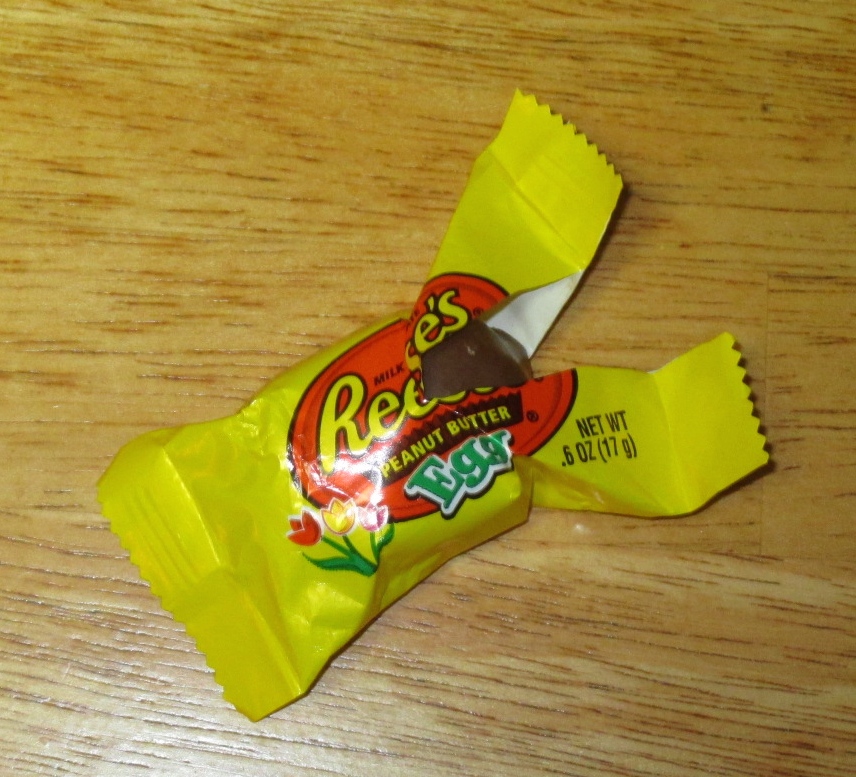
“I think I’m going to have a few peanut butter eggs,” C announced as he finished his dinner and pushed his chair away from the table. I had picked up a bag of chocolate covered peanut butter eggs from the clearance bin on a quick trip through the grocery store in the days after Easter. It was a temptation my sugar-addict couldn’t resist.

A few peanut butter eggs,” I repeated. “Exactly how many is ‘a few’?” He smiled in response, but made no reference to an exact number. Earlier, when I arrived home from work, I had noticed several wrappers from this very same treat in the trash. So I asked, “Didn’t you already have some when you got home from school?”

He raised one eyebrow, a talent he learned at a young age from his grandmother. “M-a-y-be…” he drew out the word, so as to throw in some uncertainty. It wasn’t working because… well, I had seen the wrappers in the trash.

“I think you’ve had enough,” I told him. I used to say, I think you’ve had enough sugar for one day, but that was when he was waist high and zipped around the house like a bouncy ball if he even so much as smelled sugar.

He feigned a look of shock. “Enough? There is never enough.” He shook his head as he made his way to the pantry cabinet. He reached in and took an egg. He held it up to his cheek, and he raised his eyebrows – Please?

And then his face shifted as it took on a hint of mischief. His expression mimicked one I’d first seen when he was a mere toddler. That day, I had given him some food in a glass bowl with the statement, “Be careful. This is a big boy bowl.” He had watched my face, calculating my response, as he pushed the bowl off his high chair tray onto the ceramic tile. This time, the consequence was minimal as he playfully ripped open the wrapper of the peanut butter egg. A satisfied look overtook his face as if to say, Now what are you going to do? I laughed.

In the end, he ate the candy egg. But just one. Our “argument” was all in fun, and was well worth it to see that mischievous expression again—the one that so easily transported me right back to his (much) younger days when he was still a toddler in the high chair.

IMG_1449

Snacks

The idea of a snack in my house has been evolving lately. It used to be that the kids would ask for a snack, and they wanted some crackers. I would put some crackers in one of our little plastic bowls with a handle, and they would sit quietly in front of their latest art project or a favorite tv program and eat the crackers. As the kids grew, they began to add a little protein to their snacks—yogurt, string cheese, peanut butter. For the most part, my children have been pretty good about eating healthy snacks.

Fast forward to the teen years. Well… to today. I had just arrived home from work and was preparing to make dinner. Mondays involve lots of evening activities, so dinner is quick. I opened the fridge and started to pull out the leftovers to go with the pasta that was happily boiling away in a pot on the stove. I found a great variety of leftovers: a bowl of baked ziti, some deviled eggs, a chunk of meatloaf. I studied the meatloaf as I removed it from the fridge. Huh… I would have sworn the piece was (quite a bit) bigger, but I have moments in which my memory is not what it used to be. But then a thought crossed my mind.

“C, did you have some meatloaf after school?” I questioned. Total stab in the dark here.

He looked up from his iPad, staring at me blankly for a long moment. “I might have.” He turned back to his iPad, no further explanation. Really, none needed.

“Protein,” W said walking by me through the kitchen. “Growing boys need protein.”

Yep. Meatloaf has now become an acceptable snack. Along with spaghetti and meatballs, chicken parmesan, a ham and cheese sandwich (with some pepperoni thrown on for good measure), half a dozen eggs­­—you get the picture.

I’m going to need a third job….

Culinary Issues

My culinary kid admitted to something by accident last night. And now I know the truth.

He started the school year in his culinary program with the basics: knife skills, chopping and cutting, and moved on to stocks, soups, salads, and sandwiches. I asked him if he got to bring anything home. “No Mom. We package it and sell it in the café,” because yes, vocational schools have cafés where teachers, students, staff, etc. can buy lunch and ready made dinners. It’s a great idea, really. Except for the fact that the culinary students don’t get to take any food home to test on their parents.

Second semester, my son moved to baking, and he has been studying the various processes involved in baking. So far, I have heard about the banana bread, the blueberry crumb cake, and the rolls. For the last two weeks, I’ve been hearing about the rolls. When I (once again) asked him if he would be bringing any of his baked goods home for sampling, he said no. Then he said, “The blueberry crumb cake wasn’t very good, anyway.” Okay then.

Last night, we were talking at the dinner table, and he started to talk about the “sculpture” he made in the middle of the school lunch table from everyone’s trash, i.e. leftover packaging. (In our house, we have a long history of making things out of—um—recyclables. That’s just the way we roll…). “First, I had a milk carton, then another milk carton, then the big bag from the rolls I brought, then another milk carton, then the ‘mushroom’ I made from my lunch bag….”

Stop. Right. There. My mind got stuck on the big bag from the rolls I brought. I didn’t hear anything else that was part of the sculpture because my mind stopped at that phrase. I realized he brought rolls from culinary.

“I’m sorry. Did you say you brought rolls to school?”

He stopped talking and looked at me with a crooked half-grin, then quickly looked away. “Yeah,” he said, fidgeting in his chair. He turned back to his siblings and continued his story, trying his best to ignore the piercing stare I was throwing directly at him. “So anyway, I offered one to my—“

“And you gave them out to your friends? At school? Without bringing any home?” Clearly, I must have misheard him.

“Yeah, Mum.”

“Why didn’t you bring one home so I could try it?” After all, I’ve only been asking since September, I wanted to say.

“Because I only brought six,” he paused here while he attempted to concoct a reason. “And I had plans for them.” And he turned back to his siblings and started talking about the people who were lucky enough to get a roll. Freshly baked. From his culinary class.

“You know what, C?” I interrupted his story.

“What, Mom?”

“I’m going to bake some cookies tomorrow, and I’m not going to give you any.” He turned to me. I looked him right in the eyes, my stare intense and unwavering. “Because I have plans for them.” I winked and smiled.

So now he knows the truth.

Calculations

One never knows what is going to happen at the dinner table in my house, nor how that information might be used in future conversations. We have discussions that range from the sublime to the absurd, and everything in between. And the conversations tend to wander from one end of that spectrum to the other—often multiple times over the course of the same meal.

On Friday night, the boys became engaged in a conversation that was both entertaining and thought provoking. Dinner was going along smoothly until one of them dropped some food on the floor and started pondering the edibility of the morsel in question.

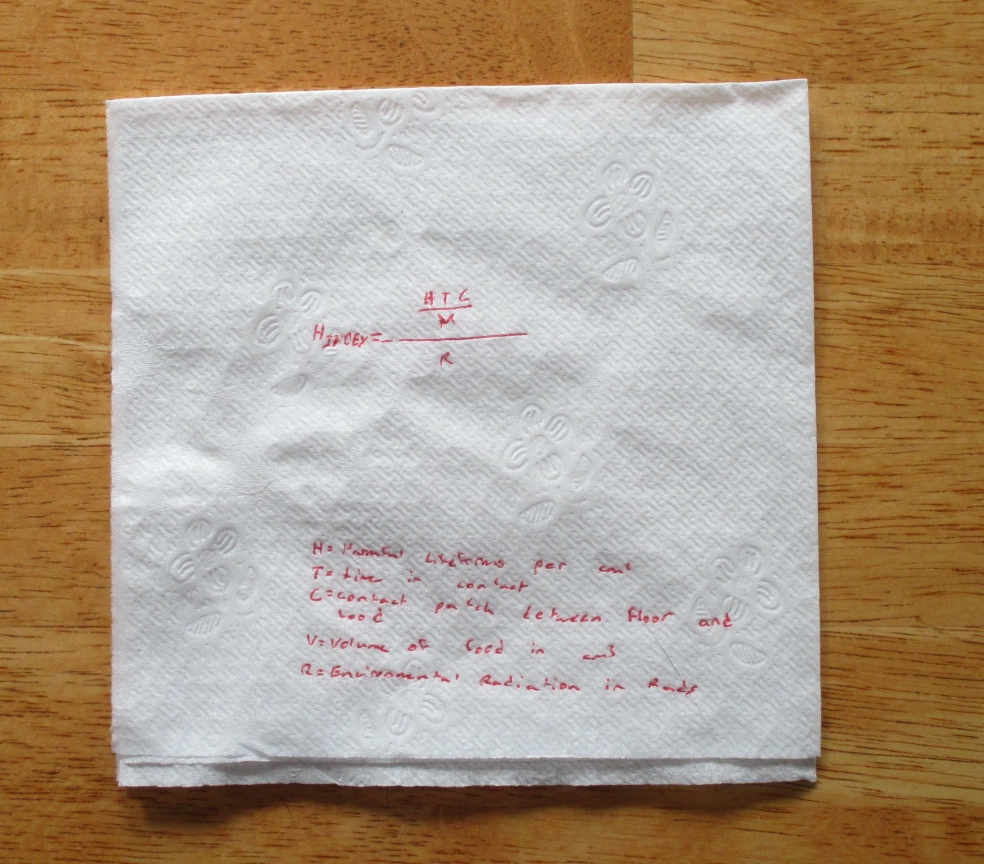
The next thing I knew, the older brother had pulled out his napkin, and was working through a formula to determine whether or not one should remove food from the floor and eat it. His napkin was the paper on which he was composing his formula—writing out the variables involved in making the necessary “calculations.”

The younger boy watched critically as his brother developed this idea, throwing in some of the factors he believed to be important. C had based his calculations on an “average bedroom floor,” using food on a plate and (basically) food in the cats’ litter box as his extreme conditions.

“Wait! Let me show you mine!” W said, grabbing the pen from C. The wheels in his head sped up, formulating, calculating. He developed a complicated equation in which one variable was “harmful life forms per square centimeter,” and another was “time in contact.” There were others, as well as a series of unknowns over other unknowns. They bantered back and forth as they considered whether they had covered all of the important elements.

Ultimately, the bite that fell on the floor made its way to the trash. Through it all, the boys were laughing and carrying on about various funny (i.e. “disgusting”) things that could happen to the food to affect edibility.

In my mind, I had to consider how this incident might have been different if I had been eating with two girls. The girls would have immediately picked up the food, thrown it out, and cleaned up the floor.

But in the interest of developing the boys’ talents at creating new formulas, I have some ideas. On Monday morning, I was texting my daughter—who spent the weekend with her father. I told her I missed her. She said she missed me more. “Tough to know,” I texted. “We can measure later.”

Perhaps the boys could write a formula for that.

IMG_1314 IMG_1315

Feast or famine

“There’s some Danish there you can have for breakfast,” I told the first child to the kitchen this morning.

“I saw it, but that’s not what I want. I’m going to have cereal,” my youngest said as he reached into the cabinet for a bowl. He opened the refrigerator and pulled out the milk.

“More than likely, no one will want the Danish. Your brother’s been looking for breakfast food all week. Now that we actually have something other than cereal, he’ll choose something else.” W smiled, knowing this was a real possibility. In fact, what my oldest has been seeking are the 26 muffins I didn’t buy him last week after our text exchange.

The text exchange went like this: I asked a simple question—a question about breakfast, asked via text because kids communicate via text anyway. I would have asked in person if I had been there. I would have waited to ask. But the fact was, I was at work and planned to stop at the grocery store on my way home. So I asked a reasonable question.

The answer was one of those moments when the true personality of the child emerged, unedited and unrestricted.

“If I go to the store on my way home, what do you want for breakfast?” was the question.

A few minutes later, the answer came: “A few cinnamon chip muffins (and by a few, I mean like a bunch because most likely I will eat one tomorrow and then try to consume multiple both weekend days and then I would want some for the following week and then also taking into account that other people would wish to consume some as well so maybe like 30 muffins).”

This response caught me off guard, but it shouldn’t have. I laughed out loud at the uncut version of a teenage super-appetite. I went home with eight muffins: four cinnamon chip, and four for my other teens to share.

Of course, the muffins were gone in seconds. Food doesn’t last when teenagers are around. Unless they are sick of it. Then it lasts too long. And they usually get sick of it just when I have purchased extra because it’s on sale. Cereal, chips, cookies… it doesn’t matter. The pattern is always the same. If we have enough to last more than a day, they realize they are sick of it. I believe this is where the saying “feast or famine” originated—from parents not only trying to keep enough food in the house, but food that their teenagers would actually eat.

In the end, C ate the Danish for his breakfast, though I’m sure he would have preferred muffins. Then again, if I’d had muffins, he would have preferred Danish.

Meals

The idea of “meals” takes on a whole new meaning when there are teenagers in the house. When my children were younger, we would eat three meals a day with the possibility of small snacks in between. Nowadays, meals all blend together with no real distinction. Snacks are simply a way to extend a meal and keep eating when it is not “meal time,” per se. My children seem to eat one meal a day, and it lasts all day.

The meal that I find most interesting is the Midnight Meal. It seems my children—one in particular—can’t make it through the night without a Midnight Meal. When I was a kid, we referred to this late night need to eat as a “midnight snack,” but I can honestly say I never took part in this practice myself. I remember being hungry at midnight, but the hunger was never enough to propel me out of bed, down the stairs, and into the kitchen where I could raid the refrigerator.

The “midnight snack” has morphed into a bowl of cereal, then another, and perhaps a third. A yogurt will supplement this small snack, and maybe some crackers. Oh wait! Is that a leftover BURGER I see?? Cold cuts!! Any food available is fair game for a hungry teenager at midnight.

Nope, it’s no longer a “snack” in my house. It is a veritable feeding frenzy, the panic that sets in as a teenager is about to go to bed, but realizes that bedtime means the possibility of hours without food. At that point, a teen can’t bear the thought of being away from the kitchen for more than a few minutes. It is this panic that leads to the Midnight Meal.

Interestingly, the quest for the Midnight Meal usually begins as soon as I say, “Hey, it’s time for bed.” By this time, it is already later than a kid should go to bed, but that doesn’t stop the hungry teen. The teen is hungry simply because it is bedtime. Which confirms my theory about a feeding frenzy.

If I went to bed with that much food in my stomach, I would not be able to sleep. But a teenager has merely to walk up the stairs to his/her room, and the majority of the food has been digested, the calories burned off. This super-charged metabolism gives me very little time to lock down what little food remains in order to save enough for the next day’s breakfast….

Oddities #2

As the mom of a brood of hungry teens, I tend to buy various favorite food items when they are on sale. Bagels fall into this category because they freeze well for a short period of time. I buy them, slice them, and pop them in the freezer for consumption over the next couple of weeks.

For some reason, it seems my children never finish one bag before they start another bag. I have, at times, had two or more bags with half a bagel kicking around in the freezer. After all, we all know that if you want a whole bagel, the top and bottom must both come from the same bagel, right? Teen rule #1 about consuming bagels: Do not ever split up a bagel to make a new whole.

Interestingly, the single bagel halves in my freezer tend to be the bottom half. In one way, that is not surprising. The bagel bottoms would likely be the last in the bag. The surprising thing is that I have found up to three bagel bottoms lingering in my freezer while a new bag is being consumed.

To discover the reasoning behind this oddity, I went straight to the source. “Would you rather eat the top of a bagel or the bottom?” I asked my youngest. He thought for a minute.

“The bottom,” he responded, so I asked him why. “It tastes better.” Hmm. If it is all the same bagel, does one piece “taste better” than the other? This thought is an interesting one, but does not explain the reasoning for the plethora of bagel bottoms in my freezer.

I moved on to my next test subject, who was cleaning her room. Since this activity is one I try not to interrupt, I made it quick. “Would you prefer to eat the bottom of the bagel or the top?”

“It depends on what kind of bagel it is. If it’s a sesame bagel, I’d rather eat the top because it has all the sesame seeds. If it’s a plain bagel, I like the bottom.”

The response of my oldest? “I eat them both,” …and everything else in sight, I’ve learned.

My research was, therefore, inconclusive. There is no reason that I should have three bagel bottoms loitering in my freezer. According to my children, they eat both tops and bottoms equally. Which leads me back to the question of when a container is empty. If half a bagel remains, but the eater wants a whole bagel, is the bag considered “empty”? This will likely remain another of the great mysteries of raising teens.