Bribes

For much of the week, the students at the school where C has his culinary program have been taking a new, way too time consuming standardized test (because another test is a good use of their time). So there has been no Voc program first thing in the morning. Needless to say, he has been getting up a few minutes later than usual. Friday morning, he was back to the regular schedule.

On Thursday night, he made it a point to tell me that he needed to get up in the morning; that I should not let him sleep in, as I have been. That is an interesting interpretation. I have been getting him up as usual, then calling to him more than usual—and more urgently than usual—to get him out of bed. “Make sure I’m out of bed early in the morning,” he told me.

“I am not the reason you have been sleeping in,” I informed him. “I have tried to get you up. You choose to stay in bed.”

“I know, but that’s because I don’t have to leave as early. Tomorrow, I need to get out of bed because I have to go.” True enough.

In the past, I have used a number of tactics to wake this sleepy head. When he was little, I would roll up socks and throw them at him. I tried a water gun once. I would sing to him. I tried tickling his nose. I put rings on all of his fingers while he slept. I contemplated applying make up….

Now, I have one tried and true way to wake my reluctant teen and get him moving, but it required just a bit of advance planning. I pulled out my supplies and started baking. We would have raspberry muffins for breakfast!

In the morning, after waking him, I made one simple statement. “If you don’t get up, all the raspberry muffins will be gone!”

W walked by me, fully dressed and ready for the day. “I’m going downstairs to eat all the muffins!” he reported.

That did the trick! I just hope C can find someone to bake for him when he goes off to college….

IMG_1552

3D Printers

We have been sick at our house for what seems like forever. The normal winter viruses hit hard on the first day of spring, and they haven’t stopped.

C has spent the spring struggling with bronchitis, pneumonia, bronchitis, etc. It’s a nasty cycle, and with the number of viruses that have gotten him, it just keeps cycling. The rest of us have been cycling in and out, so there are generally two of us sick at any given time. Enough already.

Meanwhile, W has spent the spring talking about 3D printers. He wants one. Badly. He also has enough money saved up to buy one. The kid doesn’t even have a job, but somehow, he has collected enough money in his bank account to pay for a 3D printer. A friend of his has the one he wants, so he knows how it prints pretty well.

Every chance he gets, he talks about 3D printers. At dinner: “If I had a 3D printer….” At breakfast: “Do you know what I could do with a 3D printer?” After school: “I could print you one… if I had a 3D printer.” While I’m cooking: “So, I was reading about 3D printers….”

After awhile, I just go with it. Whatever comes out, I fly. “So, this 3D printer I want…” he starts in for the gazillionth time.

“Did you know you could make body parts with a 3D printer?” I respond, without missing a beat. “You can print heart valves and ears. They are even using them to make affordable prosthetic limbs. You could go into business. I’ll bet you could make a lot of money!”

He looked at me, speechless for just a split second. I had stopped him in his tracks. He shook his head. “Not with the one I’m getting.” He paused to breathe, as he does when he is trying to shift the direction of the conversation.

“Really…” I jumped in before he had time to start his new direction. “If you could figure that out, it would be great. Think about all the people you could help!”

“Mom. Stop.” A bit of frustration was evident in his tone. “Those printers cost thousands of dollars. Mine won’t do that.”

“I KNOW!!” I said, an idea taking shape in my head. “You could print a new set of lungs for your brother!! Clearly, he could use them.” I pointed to the coughing, hacking, wheezing (and laughing) C across the table.

“Well…” said W, looking at me and smiling broadly. “If it means I get my 3D printer…. I can figure it out!”

Dinner harmony

It was Friday morning, and we had just returned from a short vacation the previous evening. We had little food in the house—other than crackers and chips—so I was going to have to go shopping, both for food and for inspiration.

“What do you want for dinner?” I asked J as we scrambled up some eggs for lunch. The question always presents a challenge—both for me and for the ones answering—but this time, I had no ideas and needed direction.

She thought for only a brief moment before she said, “Popovers!”

Popovers have become a favorite food item in our house, though when the kids were younger, they used to eat the egg-y middles, leaving the crispy outsides. As they grew and their tastes matured, they began to devour fresh-from-the-oven popovers in their entirety. With my work schedule, however, I tend to make them as a weekend or vacation treat. But on this day, I had time and it was still chilly outside, so popovers seemed like a good choice.

“And make a lot so we won’t fight over them,” she added, thinking ahead to the need to accommodate her teenaged appetite.

“Hmm. What do you want to have with them?” I questioned. Because I consider popovers to be cold weather food, we often pair them with soup or stew, but the beginning of May is no longer soup and stew season.

“I don’t know,” she replied. “Whatever.” And once again, I was on my own to think about what else to serve.

Later, when C finally got out of bed and came downstairs, I asked him the same question. (I didn’t ask W since he is still outgrowing his childhood pickiness and would be happy to eat pasta three meals a day, seven days a week. Then again, pasta is always a good choice…).

“Popovers!” came C’s immediate reply. “But make sure you make enough.”

Agreement! Because my children had been fighting all week, I had to give them credit for actually agreeing on something. Not that the choice of dinner is earth shattering, but I suppose it’s a start. And they both specified that I would have to make more than usual, so the “shortage” wouldn’t incite an unnecessary argument.

Clearly, we would have popovers for dinner. Some days, I’ll take whatever I can get.

IMG_1537

Crying

The other day, my cats were bad. VERY bad. In the midst of a scuttle, they tipped over a kitchen chair, the chair fell into my oven, and the exterior glass of the door shattered. Glass skittered from one end of my tiny kitchen to the other, littering the entire floor. It was a mess. And it was not funny. At all.

I was in the kitchen when it happened. Had I been just a foot or two closer, I could have intercepted the chair. Instead, I watched the shattered glass cascade to the floor in disbelief. It was Friday, and I would clearly be living with an oven missing its front for a few days, at the very least. After calling to order a replacement part, I posted a picture on Facebook because really, who would think cats could do such a thing?

It wasn’t long before the four-year-old neighbor girl came to my door, sent by her parents, who were in the yard nearby. “I came to see if you’re okay,” she said in her little voice, a shy smile on her face.

“I am,” I assured her. “Do you wanna come in and see what my cats did?” She nodded. “I have to pick you up because there’s glass all over my floor.” I opened the door and lifted her into my arms. I gingerly tiptoed through the broken glass so she could see over the kitchen table.

Her eyes grew large as she stared at the mess, contemplating how cats could do such a horrible thing. Finally, she turned to me and studied my face. “Why are you not crying?” she asked, unable to contain her child curiosity.

Hmm. To tell you the truth, crying had occurred to me only as a briefly passing emotion. Until she suggested it. And once she had suggested it, I found it to be quite a valid suggestion. Perhaps as adults, we don’t allow ourselves to cry nearly as much as we should. After all, if I had cried in this situation, she certainly wouldn’t have questioned it. So crying was now a thought that was floating around in my head.

But there was another thought that was more urgent, tugging on a tiny corner of my brain, threatening to tear a hole unless I faced it, head on. My cats had made a huge mess of my kitchen and caused destruction that I would not have believed possible had I not been standing three feet away when it happened. I was home only because it was a holiday on my work calendar. My children were still at school.

Had I not been home that day, I would have walked in to this mess. (No one would have cleaned it up, but that’s a story for another day). I would have seen the glass scattered from wall to wall. I would have noticed the gaping hole on the front of my oven. And I would have blamed the boys.

When you have two nearly grown boys who feel the need to constantly slam each other around, why would you believe such destruction was the result of a tussle between two ten pound cats? The boys would have argued with me, explained that they had found this mess, that something must have happened while they were at school. I would not have given them the benefit of the doubt. After all, who would believe such a thing?

And so I have this newfound awareness that perhaps I am too quick to judge. I am too quick to point fingers. I am not open-minded enough to listen to slightly far-fetched stories. Perhaps every situation demands that I listen, that I understand, and that I give others the benefit of the doubt. Perhaps there are circumstances that I might not be willing to consider before jumping to conclusions.

So the question remains: why am I not crying? I’m not sure, but now that I have processed all that came of this incident, maybe I will. And I will definitely leave that option open for the next time….

IMG_1434

Perspective

Every now and then, we catch a glimpse of our children’s lives through reflection on our own experiences, past and present. Recently, I had one of those moments… when my thoughts on my children’s attitudes suddenly clicked into place in a new and unexpected way. It was an “ah-ha” moment, of sorts.

Over the weekend, I was introducing my sister to some people who grew up one town over from our own hometown. Since it was a small town in a rural area, growing up in the next town implies that we shared a fair degree of history. We knew some of the same people, competed as rival schools in sports, hung out at some of the same places, frequented the only local movie theater, and shopped in the same stores.

As we briefly discussed the fact that my sister graduated from a different high school, my mind wandered back into the past. My sister and I had different teachers. And just like any school, a handful of teachers were known to be “difficult,” more in their behavior and attitudes toward students than in their educational expectations.

For the most part, I had teachers who were memorable in positive ways: they wanted to teach, and they genuinely liked working with students. However, there were exceptions. There were teachers for whom unflattering nicknames had been passed from one class to the next for near generations. And it was one of these teachers with just such a nickname that I stumbled over while I was taking my ‘mind journey’ down memory lane over the weekend.

And after stumbling, I sat sprawled on memory’s path, realizing that we hadn’t been very nice back in high school. And then, I was pulled to the present, to the words I had recently said to my son when he called one of his (male) teachers a diva. “You shouldn’t be disrespectful to your teachers, C. They have a tough job teaching you guys all the things you don’t think you want to know.”

Gulp!

There I was, stuck straddling a line. As a teacher myself, I would normally advocate for the teacher in this instance. Getting up in front of a classroom full of apathetic, sometimes ungrateful (insert year here: sophomores, seniors, you name it) day after day is not an easy task. It can be brutal.

Then again, being a kid in a class with a teacher who has forgotten what it is like to be a teenager—a teacher who hasn’t updated his or her approach to teaching since the age of the dinosaurs, and chooses not to (ever) smile—is not easy, either.

Suddenly, I realized that what I perceived as “disrespect” was really something of a rite of passage. As we work to figure out our relationship with the world and how to deal with people we don’t necessarily want to get along with, but need to get along with, we seek to find a comfortable place to fit them into our experiences. We use nicknames to diminish these people so they are slightly less intimidating and they fit more neatly into our experience. For teens, this can be the way they survive the classes that otherwise threaten to bore them, annoy them, or terrify them.

And straddling this line between kid and teacher is the constant battle I face as a parent. This is the battle that determines if I am successful or not. I am constantly faced with the need to remember what it was like to be in my children’s shoes—whether they are teenagers or toddlers, while still teaching the skills necessary for them to function in a world which requires an ever changing mix of diplomacy, sensitivity, and candor.

For the most part, my children are respectful and polite when they walk out my door and into the world. Perhaps then, they really are learning what they need to know to make their way in the world. Perhaps a little name-calling, in the right context, can help to put relationships in perspective.

Culinary Issues

My culinary kid admitted to something by accident last night. And now I know the truth.

He started the school year in his culinary program with the basics: knife skills, chopping and cutting, and moved on to stocks, soups, salads, and sandwiches. I asked him if he got to bring anything home. “No Mom. We package it and sell it in the café,” because yes, vocational schools have cafés where teachers, students, staff, etc. can buy lunch and ready made dinners. It’s a great idea, really. Except for the fact that the culinary students don’t get to take any food home to test on their parents.

Second semester, my son moved to baking, and he has been studying the various processes involved in baking. So far, I have heard about the banana bread, the blueberry crumb cake, and the rolls. For the last two weeks, I’ve been hearing about the rolls. When I (once again) asked him if he would be bringing any of his baked goods home for sampling, he said no. Then he said, “The blueberry crumb cake wasn’t very good, anyway.” Okay then.

Last night, we were talking at the dinner table, and he started to talk about the “sculpture” he made in the middle of the school lunch table from everyone’s trash, i.e. leftover packaging. (In our house, we have a long history of making things out of—um—recyclables. That’s just the way we roll…). “First, I had a milk carton, then another milk carton, then the big bag from the rolls I brought, then another milk carton, then the ‘mushroom’ I made from my lunch bag….”

Stop. Right. There. My mind got stuck on the big bag from the rolls I brought. I didn’t hear anything else that was part of the sculpture because my mind stopped at that phrase. I realized he brought rolls from culinary.

“I’m sorry. Did you say you brought rolls to school?”

He stopped talking and looked at me with a crooked half-grin, then quickly looked away. “Yeah,” he said, fidgeting in his chair. He turned back to his siblings and continued his story, trying his best to ignore the piercing stare I was throwing directly at him. “So anyway, I offered one to my—“

“And you gave them out to your friends? At school? Without bringing any home?” Clearly, I must have misheard him.

“Yeah, Mum.”

“Why didn’t you bring one home so I could try it?” After all, I’ve only been asking since September, I wanted to say.

“Because I only brought six,” he paused here while he attempted to concoct a reason. “And I had plans for them.” And he turned back to his siblings and started talking about the people who were lucky enough to get a roll. Freshly baked. From his culinary class.

“You know what, C?” I interrupted his story.

“What, Mom?”

“I’m going to bake some cookies tomorrow, and I’m not going to give you any.” He turned to me. I looked him right in the eyes, my stare intense and unwavering. “Because I have plans for them.” I winked and smiled.

So now he knows the truth.

The Frog

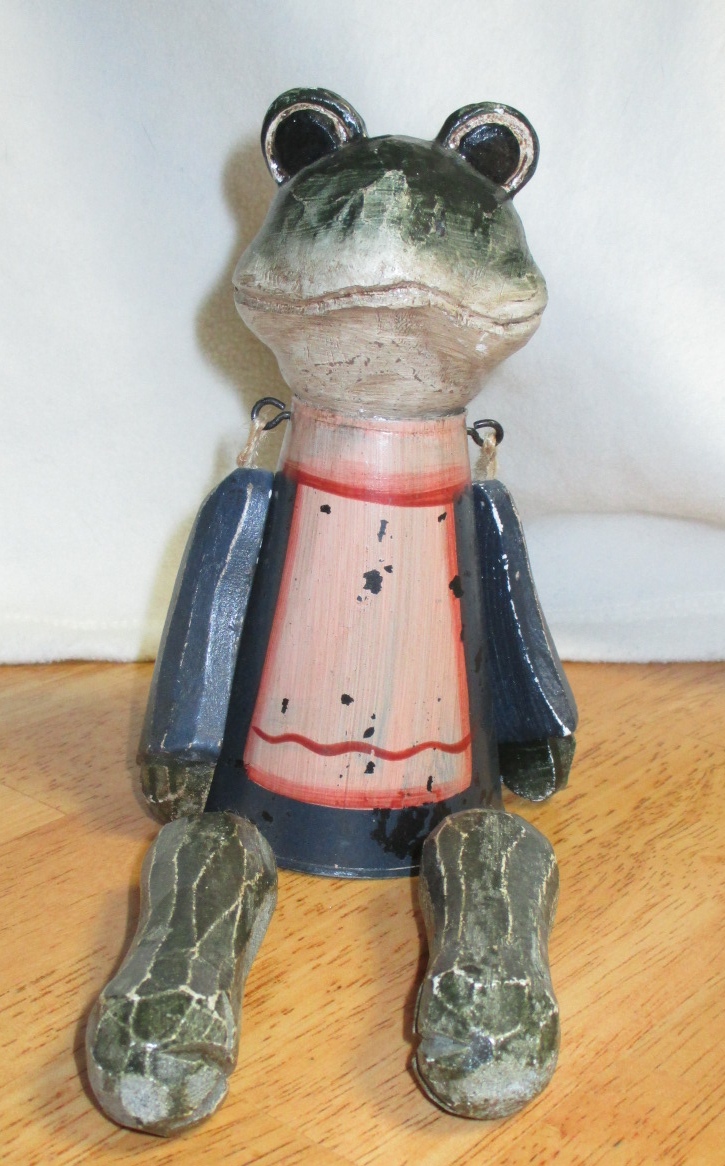
IMG_1411

When I was younger, I had a collection of knickknack frogs. One of these—made of tin and wood with limbs that dangle from joints of twine and wire—was a gift that I received many years ago, and it has a simplicity to it that is reminiscent of an earlier era. As I have moved residences over the years, I’ve pared down my collection to my favorites. This particular frog remained as it reminded me of my past for reasons I can’t exactly pinpoint.

In the townhouse where I landed with my children after my divorce, the frog took up residence on a shelf that held some books and a few ornamental items. Seldom did I notice it sitting there in its decorative, take-up-space kind of way.

One day when my children were still fairly young, I found this very frog sitting in the middle of my propane heat stove, right next to a candle that I had placed there at the end of the most recent heating season. It was late spring, and warm enough out that the windows had been open with regularity. The sight of the frog startled me because I wasn’t expecting it to be there. How odd, I thought. I wonder who put that there? It seemed like a bold placement for such an object, and I picked it up and moved it back to its normal location on the shelf.

The next morning, I woke the children, and I took a quick trip to the basement laundry room to gather some clothes. As I passed through the living room, I stopped abruptly, startled when I spotted the frog, once again sitting proudly—albeit unexpectedly—on the heat stove. The children were upstairs waking and preparing for school. I glanced around the room, not really sure what I was looking for. The room was empty. I set the laundry basket on the floor, and returned the frog to his spot on the bookshelf.

I took a deep breath, shaking off my surprise, and I went about my morning preparations.

When I was ready for the day, I went downstairs to the kitchen. I opened the door to welcome the spring air, and went to the back of the house to open the back door. Mid-way through the living room, I froze. There, on the stove, was the frog, sitting right in the middle where he’d been twice, now three times. My heart pounded in my chest as I thought through the possibilities. I glanced around the room expecting the unexpected, only daring to move my head. I pondered going to the basement to look around, but I couldn’t do it. Not alone. I went to the kitchen phone and called my neighbor.

“I think there’s someone in my house,” I reported in a near whisper. “Can you come over?”

“I’ll be right there.” She arrived a minute later, wielding a kitchen knife.

“What are you going to do with that?” I asked her.

She looked down and shrugged, smiling weakly. “It’s better than nothing!” Together, we searched the house while I explained the unexplainable to her. We found nothing, but we got a good laugh. We concluded that one of the children was playing a trick on me. No one would fess up.

It wasn’t until several months later that my oldest finally admitted to moving the frog. He read in a book how to secretly move an object. Or something. I have to say, he got me good, and we will forever joke about it.

Since that experience, the mere sight of this little frog holds an unexpected emotional charge. When I happen to see it sitting (usually in its normal place) on the shelf, I have a momentary jump in heart-rate, as if its very glance in my direction has power beyond its inanimate self. Then I laugh at the memory.

Creative Mathematics *

“Jimmy wants to determine the height of the tree on the corner of his block. He knows that a fence by the tree is 4 feet tall. At 3 pm, he measures the shadow of the fence to be 2.5 feet tall. Then he measures the shadow of the tree to be 11.3 feet. What is the height of the tree?” I hear from the other room. Homework is going on, and from her tone, I can tell my daughter is disgusted by the question being asked of her in geometry. “Ugh!” she says to no one in particular.

I remember this type of word problem as the bane of my existence in high school. “It’s 27.2,” I call to her, omitting the unit (because really, does it matter?). I am fully confident that I am not even close.

“What?” she says, a hopefulness in her tone that indicates she believes I might actually be supplying her with the right answer.

“I said, the answer is 27.2. I just did it in my head. Impressive, isn’t it?” I walk into the living room and smile at her. All three children are staring at me like I have three heads, maybe four. “What?” I look at them innocently. “I made it up. It’s called ‘creative mathematics.’ It’s a new thing I just invented.”

“Oh!” My daughter jumps up, completely on board with the new class I have just discovered. It would be kind of like creative writing, but on a math scale. “Where do I sign up? I could totally get into that class!”

Me too… and probably, many other people I know would also appreciate it. Word problems would be awesome! The question would no longer say, Calculate the height of the tree. It would now ask, How tall do you want the tree to be? Or maybe you could simply decide how tall you need the tree to be to suit your purposes. Of course, you would have to give the reasons to support your answer.

Creative mathematics would have nothing to do with calculations. It would be about problem solving and creating your world with the specifications that you find necessary. Plausible or not, you would be allowed to reimagine your world to suit your needs.

Granted, just like creative writing, creative mathematics would not fit every situation. For example, if you were putting new counters in your kitchen, you would need an accurate measurement rather than simply deciding how big you wanted your counter to be. However, such a mathematical option would allow the creative among us to enjoy math and take a break from the many long years of calculating the right answer and showing the work we did to get there.

In life—even in situations like medicine—there are very few “right” answers. Creative mathematics would honor that fact and encourage effective problem solving. Yes, in mathematical calculation, students would still be expected to find the right answer. But in creative mathematics… the sky’s the limit.

* this post is dedicated to the best math teacher I have never had. Once upon a time, a long time ago, she spent hours in daily telephone tutelage to move my sorry math-challenged self through high school calculus.

Essays

“I have to work on my history essay,” my son announces.

“Isn’t that due tomorrow?” I ask.

“Yes. But it won’t take long.” To me (a writing teacher), writing an essay seems like something that might take some time. This particular essay involves a bit of research in the gathering of sources, and while it’s not a lengthy piece, this particular teacher is a stickler, to say the least.

“What should my thesis be?” he asks me from the other room, as if I know the assignment and the points he will make. I think about how much easier it would be if he would venture into the kitchen where I am preparing dinner so we could discuss without yelling back and forth. And since I have been struggling with my own writer’s block, I am not feeling particularly adept to be giving advice on how to start writing.

“Think about the points are you going to make,” I say. When pressed, yes, I can hold a writing conference from a different room. “Those need to be part of your thesis. But you probably want to do your research first.”

“I’ll just start writing,” he declares, dismissing any input I might offer at this point in the process. Fine then. He did ask for my help, after all. I swallow hard as the teacher in me wells up, desperately wanting to comment about the research piece.

I go about my business making dinner and finishing up some evening chores. After about half an hour, I start to the basement to tend to the laundry. My son is staring off into space. “You need to focus or you’ll never get that done,” I say in passing.

“Mom…!” he says in his favorite tone of teenage incredulity. “I’m working on it!” He springs from the couch, iPad in hand, and starts following me. “You have to see this….” But I am already down the stairs in the laundry. “Mom, look.” He holds the iPad out for me to see, and three solid paragraphs fill the screen. I am impressed. “See?” he says. “I’ve got this.”

It isn’t long before he is finished, and he brings me the essay to read. Aside from some repetition in two of his points, which I mention, it’s not bad. We work on the thesis, and he returns to the living room to type and reformat. In a few minutes, he says, “I need help with my citations.”

After a brief discussion of whether or not we can work from the same room, we decide he needs the computer, and I need to cook dinner. So, from the kitchen I say, “You’re going to write the author’s last name followed by a comma, then the first name, period….”

“Mom!” my daughter interrupts. “You have that memorized?? That’s so wrong!” Maybe. But since I use it often—as in daily—the memorization came as a side effect.

“Hey Mom! My friend hasn’t even started his paper yet. He’s hoping for a snow day tomorrow!” C laughs.

“Hmm. He does know we had a snow day today, right? Is he planning to write the essay?”

“Who knows,” C says. “But mine’s done!” He pauses for a minute. “I just need a title. What should my title be?”

He struggled with the title longer than he did on writing the entire essay. Which just goes to show, sometimes the easy things can trip us up. Sometimes, we get caught up in the little things in life and end up with writer’s block. As for his friend? He’s still working on the essay. I think he’s stuck on the first sentence.


Mirages

The other morning, in a moment of ultimate optimism, I heard the radio dj say, “65 degrees today.”

Wow, the thought flew through my head, too fast for me to really linger on it. It’s warmer than I was expecting. But in that brief moment, it didn’t seem unusual.

I had a fleeting feeling of peace as my body relaxed ever so slightly, no longer holding on to the muscle tension necessary for the constant shiver of winter. I felt my mind relax about my wardrobe as well, since I wouldn’t have to bundle up against the cold, and my options were suddenly more plentiful. Maybe I’ll wear a pair of capris, I thought. Because 65 is actually spring warmth around these parts, I probably wouldn’t even need a sweater.

But no, I realized with a sudden jolt back to reality. Something is wrong. The words of the dj—the words I’d heard or imagined—were like a desert mirage to a thirsty man. When you want something badly enough, the slightest hint can push you to convince yourself of its presence.

While it is not unheard of for the temperature to be 65 at the end of January, it is highly unlikely considering the winter we’ve been having. And there had been nothing in the forecast for unseasonably warm temperatures.

I backtracked in my hearing, and replayed what I had heard. The dj did not say 65 degrees. In fact, what the dj actually said was, “It’s 5 degrees today.” Ugh! I was off by 60 degrees! Clearly, my mind made up what it wanted to hear. And the day would not only be five degrees, but extremely blustery. Wind chills in the negative teens and blowing snow to mess up the roads and decrease visibility.

Like a mirage, 65 degrees is out of reach right now. We can see it off in the distance WAY up ahead. We will keep moving toward it, hopeful that it won’t be long before we get there.