Social Media

This post was written for Writing 101, Day 5: Respond to a quote…

Just as we teach our children how to ride a bike, we need to teach them how to navigate social media and make the right moves that will help them. The physical world is similar to the virtual world in many cases. It’s about being aware. We can prevent many debacles if we’re educated.”     —Amy Jo Martin


The great thing about social media is that it is (for the most part) public. We can see what others are posting, saying, doing, thinking. Social media allows us to navigate a different world—to create a persona, if you will, of how we see ourselves or would like to be seen. Because it is so public, it provides great lessons for parents who are willing to trot out their ‘friends’ as examples, both good and bad.

A few years back, a young acquaintance of ours made an impulsive tweet in a moment of adolescent thoughtlessness. Hundreds of miles away, his tweet was picked up by people paid by our federal government to monitor such things, and he ended up squarely in the center of their radar. By the time he arrived at his first class of the school day, the local police were there to meet him. His parents were called, and ultimately, he was asked to quietly withdraw himself from the school—a private institution—and finish his senior year elsewhere.

What parent wouldn’t use this incident as an example for his or her children? Granted, this is an extreme example, but nothing that ends up on the Internet is private. Or unmonitored. Or irretrievable. If SnapChat postings actually did “disappear,” the terms and conditions wouldn’t ask users to agree to allow them to store all posts forever. But who reads the terms and conditions, right?

Every now and then, I see things on the Facebook sites or blog posts of the adult crowd. “I don’t think she should have shared that,” I grumble to my children. “Her children might not be on Facebook, but their friends and their friends’ parents are….” I wonder sometimes if people consider the ramifications of the things they post.

As C prepares for college, he is going out into a different world—his own world, away my watchful eye, where he has to make his own decisions and create his own identity and purpose. What I don’t want is for him to suddenly find that his Facebook, Tumblr, Instagram, or whatever are under scrutiny and not be prepared for that. This is the world in which we live, Friends. If you are putting yourself on the Internet for people to see, you very well may fall under scrutiny. That scrutiny may mean that you are held as an example within the private world of your “friends,” or it may have much bigger implications.

This lesson is one that each of us—teen or adult—will benefit from keeping in the forefront of our minds as we venture ever further into the virtual world.

Superheroes

IMG_1824

The senior English classes at our high school are working on their college essays, which is both brilliant and problematic. It is brilliant because the students will get these essays written and perfected under the instruction of their teacher; it is problematic because my son is not prepared with a topic. He thought he had another month or two to think. He has nothing to write about. Not. A. Thing.

According to this kid, there is nothing that has happened to him that is essay-worthy. And “college-essay-worthy” at that. There are no experiences that define him. I can’t even get a story from him, and I am a woman who believes everyone has a unique and interesting story.

I sat him down, and I talked to him (actually, I followed him around the house to brainstorm with him, but I digress…). We discussed the trips he has taken, the activities in which he is involved, the club he is starting at school, his culinary program, his “broken” family of origin. Still, we came up empty. Nothing.

Each day, I would hear his rants about the essay, his lack of topic, his teacher and her nagging until I finally threw out anything I could think of. “Why don’t you write about your trip to Hawaii?” I suggested.

“Mom,” the sarcasm oozed thick and heavy. “No one wants to hear about my trip to Hawaii.”

“Well, how about when you almost fell in the volcano?” I continued.

“I didn’t almost fall into a volcano—”

“And your father risked his life to save you,” I interrupted.

“My father would never risk his…,” his voice trailed off. “You know, Mom, you might be on to something!” I could almost see the light bulb go off in his head. “I can write about the time my father died trying to save me!”

Um…. That wasn’t quite what I had in mind, but that was the direction he took my suggestion. “You can’t really make up your college essay,” I informed him. “They want to know who you are, what defines you.”

“But Mom,” his excitement was evident on his face. “What better essay to write if I’m going to school for creative writing? I’m going to tell my teacher that this is my topic for my essay!” He disappeared into the living room.

I sighed. I had grasped at straws, handing him one without thinking it through in the way a high school senior might. There is a lesson to be learned here … I’m just not sure what it is.

One lesson I know for sure. Every kid wants to believe that his parents might have a touch of superhero… that his parents would do anything to save him, should the need arise. I believe we all need to believe in parental superheroism.

But for parents who are not very “parental,” who think only of themselves (year after year, in situation after situation) and their children know there is not even a speck of superhero, well… they might just find themselves starring in an essay featuring a poorly placed volcano.

Virtual coffee date…

For Writing 101, Day 10 (which was many days ago…), we were asked to update our readers in a post of a “virtual coffee date.” So here goes….

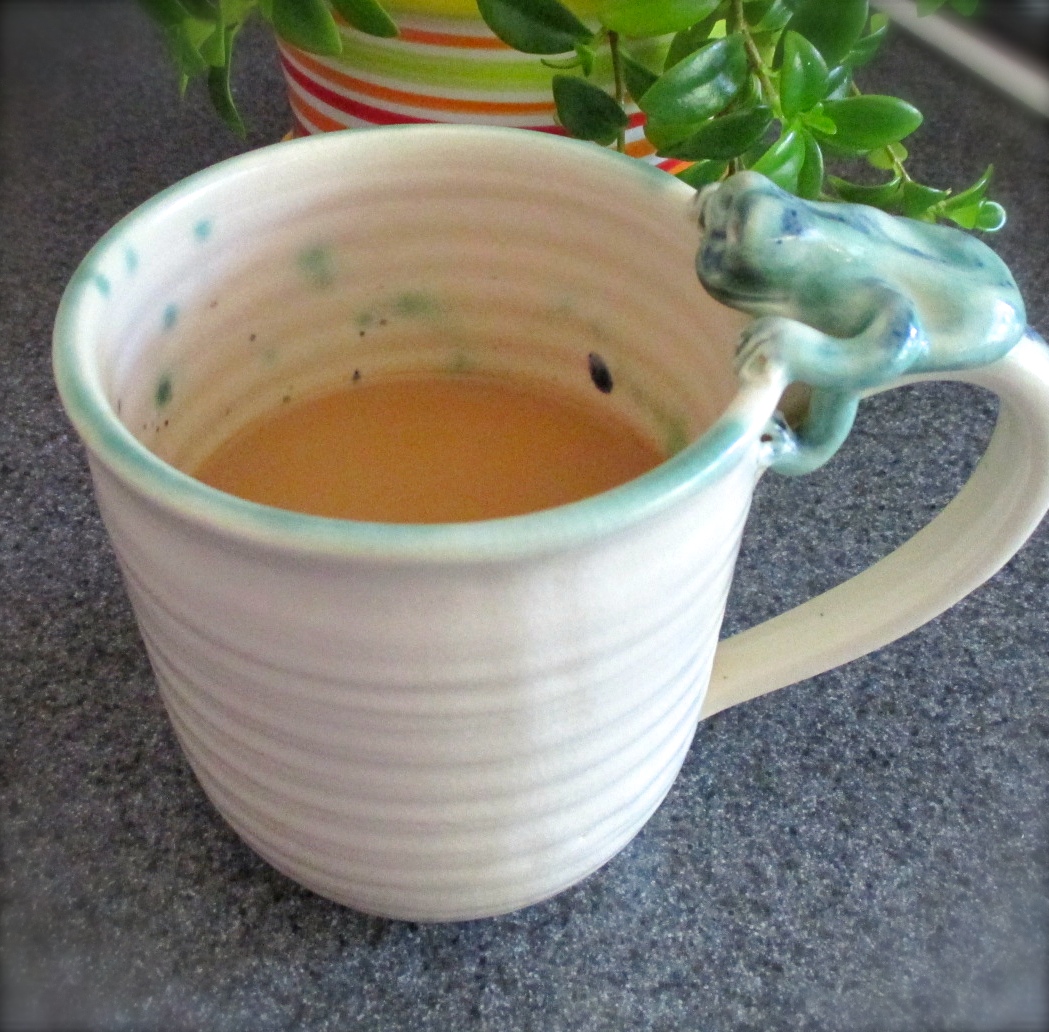
IMG_1806

If we were having coffee, I would tell you that the school year is getting off to a slow start. Every September, I marvel at how late the sun rises, and yet every September when I wake up at 5:30, it is dark. Just like last year. Getting up at 5:30 is not my favorite thing to do, and the weeks are already feeling long, while the weekend is a mere blink. This year, readjusting to the strict schedule has been taxing to my mind and body. Each day, it seems, I wake up with a new pain that I chalk up to aging for the time being. For now, I will leave those “aging” pieces where they lie.

If we were having coffee, I would tell you how much I love reading the essays of my college freshmen—the narrative essays on a place that shaped them. Through years of reading these essays, I have learned that students don’t choose to write about the elaborate vacations, and the events or places that represent the material parts of life. I have learned that an overwhelming number of students choose the places where they have been able to connect with their families, spend meaningful time together, and feel the love and support that surrounds them. These essays let me know that even though I am not able to take my children on long vacations far away—even though they haven’t had some of the amazing experiences that their peers have had—maybe, just maybe, what I am doing is not so bad.

If we were having coffee, I would tell you how often I hear the phrase “Welcome to my life,” and how very much I despise it. There are so many things people keep secret, not revealing their pain, their failures, and their worries. No one has a right to assume that their life is more difficult than that of another person. Their life is different. Period. Using this phrase only serves to diminish the road traveled by others.

If we were having coffee, I might tell you that I had a challenging summer. I took on a great deal of work—more than usual—because it was available, it was offered and the offer halfway felt like a promotion, and I need to support my family. The workload might not have been such a great idea. Other areas of my life suffered, and I felt as though I was unable to do anything well. I hate not doing things well.

If we were having coffee, I might tell you that I worry a lot about my children. I would tell you that I try my best to keep up with everything that needs to be done, but sometimes things slip. Letting things slip falls under the category of “not doing things well.” Did I mention I hate that? Being a single parent is the toughest thing I’ve ever done, and I need to learn to let go of some of the things that can slip and not be noticed.

If we were having coffee, I would tell you that I am truly blessed to have three teenagers and a boyfriend who love me. I am sure that some days, they love me more than others, but they love me. And that’s what matters. Sometimes, when I am being honest with myself about my life, my past, and my future, I realize that I would not trade a thing. My road is difficult sometimes, but everyone’s is. Some days, I am stronger than I look, and those days are the ones that get me through.

Then again, if we were having coffee, I might have second thoughts about not trading any of it… I can think of one or two toxic people I would trade for something more positive….


A Letter on Navigating Adolescence…

Posted in response to Writing 101, Day 9: Reinvent the letter format.

Dear Teen,

I see you sitting quietly on the edge of the action, deciding whether you will jump in and get involved or not. You are observing the situation, sizing up the participants, and gauging whether or not you will take part. I see the uncertainty you are feeling as you approach new situations and new people, wondering what will happen if you insert yourself into this activity and this group. As you sit here, you are deciding the likelihood of your success, defining what that success might look like, and determining whether you will be rejected if you don’t succeed…and if it matters.

I see your struggle because I have been around teenagers for the vast majority of my life. I have been a teacher, coach, mentor, dorm parent. These days, I am even a parent to my own teenagers. Eons ago, before the Internet and cell phones and MP3 players, I was a teenager. And despite how old I may seem, from my perspective, it wasn’t that long ago.

Adolescence is a bumpy ride. You may hear that these are the best years of your life, but don’t believe it for a second; these years are tough! Some of your friendships may grow stronger, but some will dissolve. Through the conflicts you have with friends now, you will learn to recognize the people who will be there for you through thick and thin—the friends you will support and who will support you through even the toughest of times, the ones you will want to keep close by always. These years can have a huge impact on the person you will become and the sensitivities you will have. I see the tolerance you have developed when you accept the people around you, regardless of how they are different from yourself. You have watched how mean other people can be, and you have recognized that not everyone is thoughtful, considerate, and accepting of others.

You are caring and sensitive and polite, and you are stronger than you believe. These traits are important. They will help you to navigate life and make your mark. And you will leave a beautiful mark in the footprints you leave behind.

Consequently, I would urge you to make good decisions and live like you don’t care what other people think. In the grand scheme of things, the opinions of others don’t matter. What matters in your life are your own opinions and those of the people closest to you. Be nice, be creative, be loving, but most importantly, be brave enough to stand out. Remember… fitting in is over-rated.

So jump in there and be a participant. These people are having fun, and you are likely to have fun, as well. Perhaps you’ll make a new friend. Perhaps you’ll discover a new activity you love. You never know until you try! Life is short—get involved and live it to the fullest.

May you always know that any time you need it, you have support right here!

Love,

Mom

Writing

This post was written in response to the Writing 101, Day 1 prompt: I write because….

I write because I grew up in a small town where fitting in was not my forte. I was artistic and academic, borderline hyperactive (before that was a diagnosis) and just about the opposite of athletic. I created “treasures” from items that were tossed aside, and I was overflowing with sass. The combination was one that didn’t work well for a kid navigating the waters of small town school life. At first, the fact that I didn’t fit in mattered to me. But after a while—and too many reminders that my sharp edges and rounded corners didn’t match everyone else’s—I accepted my lot in life.

I write because in kindergarten, a light went on when I learned to squeeze meaning from the squiggly lines that formed words on a page. A door was opened to new adventures and new worlds where I could easily lose myself. The public library and local bookstore became my refuge, and I hid behind the mask of a voracious reader.

I write because sometimes, when I felt lost and alone, reading was not enough. I would take out a notebook, usually in the late hours of the day when dusk turned to darkness. At first, I wrote fiction and poetry, depending on my mood. I would craft stories, churning out page after page, simply to see how much I could write and to watch the page curl under the weight of my words.

I write because as I ventured from adolescence into adulthood, my ideas and my identity were fluid and changing. I wrote my feelings and my dreams into stories as I worked to make sense of the world and my place within it. I wrote stories of realistic fiction with characters who might have been my friends.

I write because when I divorced, I needed a way to pull myself out of the all-consuming black hole that is emotional abuse. Suddenly, I was the character, and the world was my own. There were many soul-searching journal entries. Many nights of listening to the rain outside my window while my thoughts and my words spilled onto the page.

I write because once I freed myself from the abuse and regained my confidence, not writing was no longer an option. Through my journey, I had evolved into a writer. I had discovered a home in creative non-fiction. I discovered that writing my story helps me to live a better life.

I write because I never did find the place where I fit in. But fitting in is over-rated. Writing is a journey that fits perfectly with who I am.

Projects

image

This summer, more than any other I can remember, my children have been off in different directions, pursuing their own interests. I have one who can drive, so he will frequently take the car and go off with his friends.

My daughter trained for, traveled to, and competed in a national competition in her chosen sport. She returned home only to sequester herself in her bedroom so she can complete her many hours of summer reading and projects for the courses she will be taking in the fall.

The youngest has spent the better part of the summer in the woods. He has been to camp; he has been camping; he has hiked more than one mountain; and he went off on a multi-day canoe trip. In between his adventures, he has been pursuing his other interests by finding ways to “tinker” and improve one aspect of our house or another.

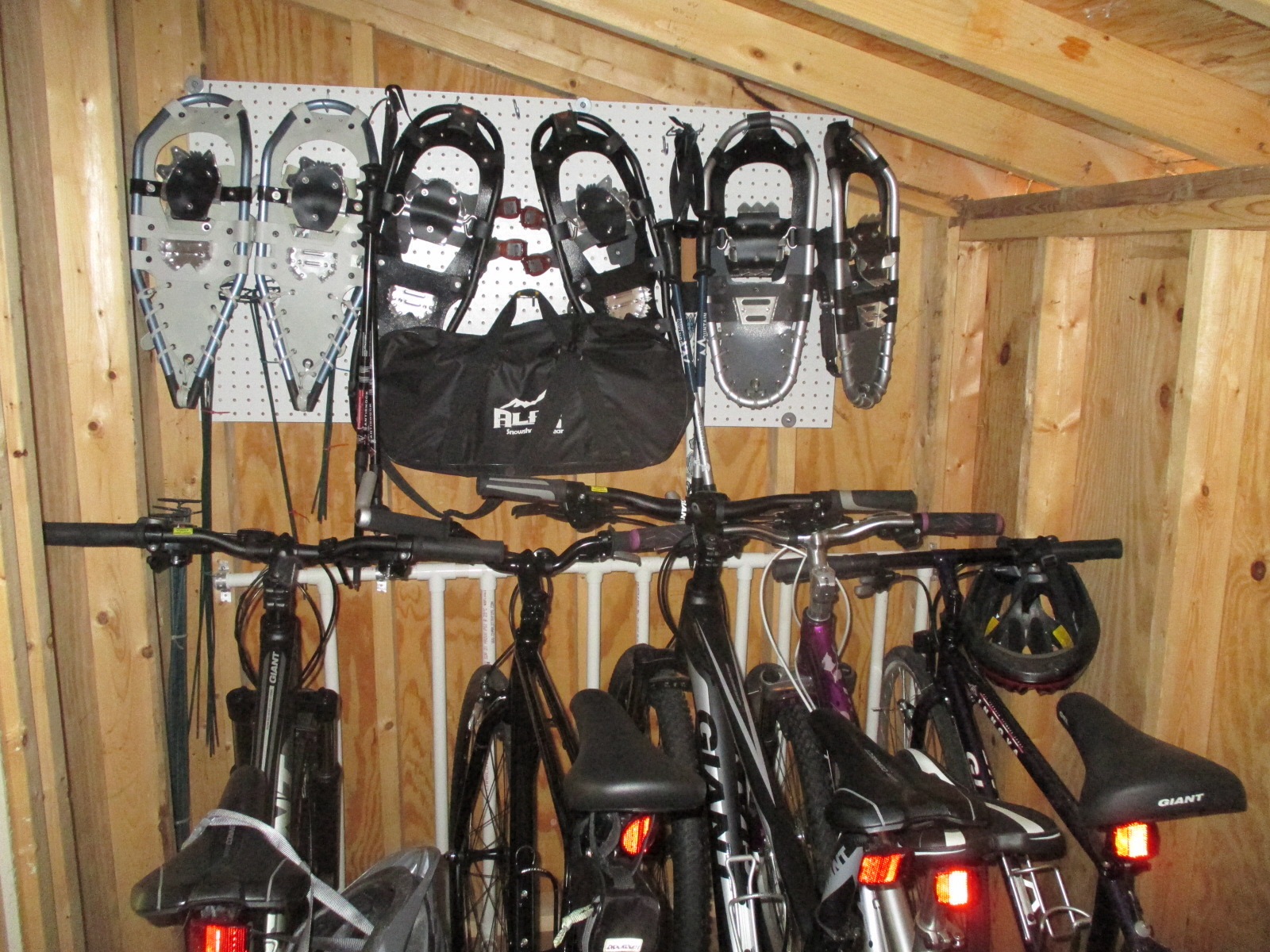
When I returned from several days away with my daughter, I found a fifth bike in my shed, and all of the bikes leaning against each other. Since my shed provides tight quarters for four bikes and the small amount of junk that usually resides there, the fifth bike had to be crammed in.

“These bikes shouldn’t be leaning against each other like they are,” I told W. “The gears are going to get bent.”

“They’re not leaning on each other,” W replied as he walked to the door of the shed and peered in. “Oh. Oops. They must’ve fallen over.”

“Right. That would be my point.” I walked back up to the house, but the seed had been planted, and a plan was beginning to develop.

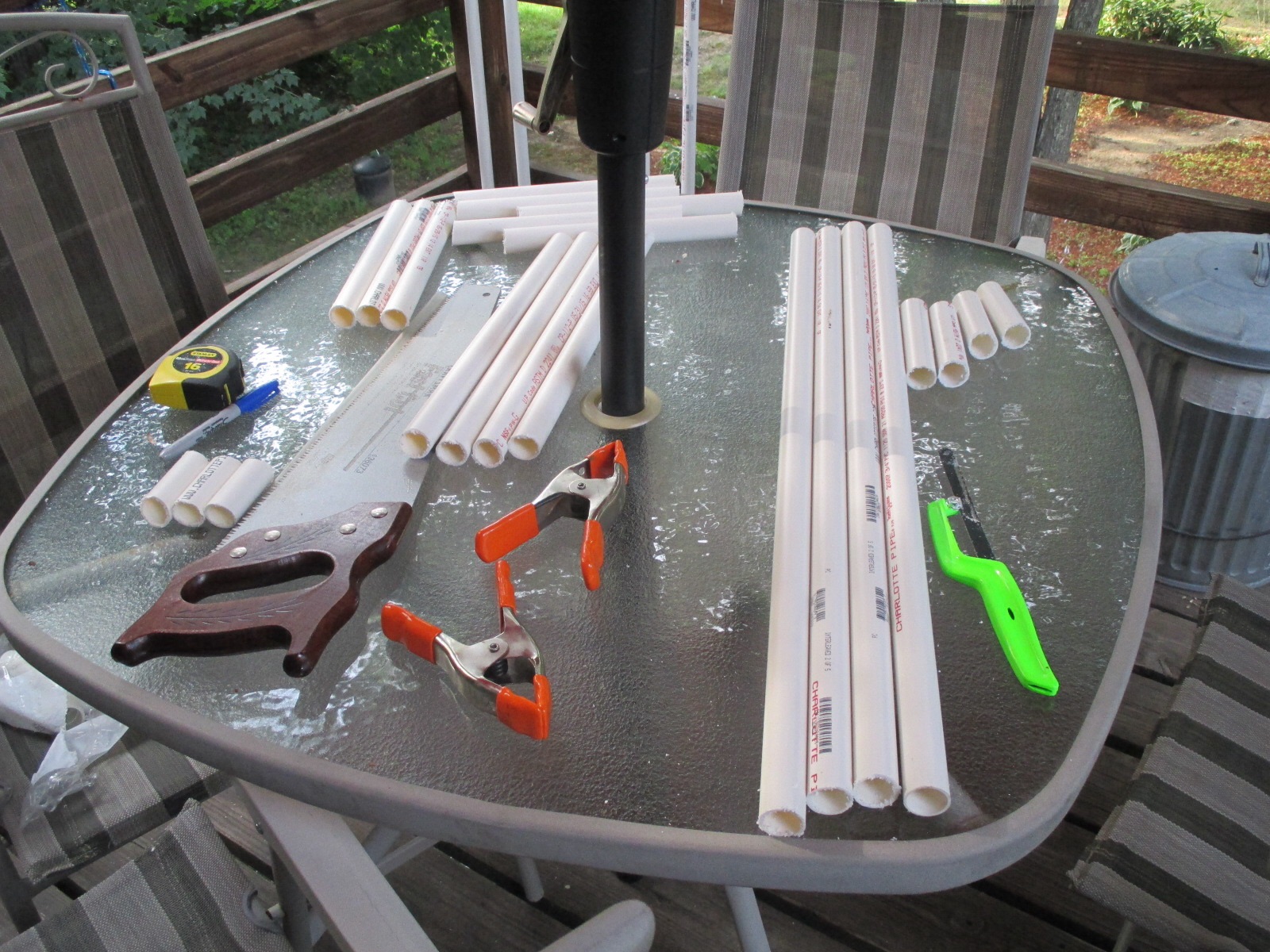
Two days later, I had several ten-foot lengths of PVC pipe, joints, and various hardware on my living room floor. Acquiring the materials was the first step of the project. But then the project leader left the house for a meeting to prepare for his next journey into the woods.

C, who had been out with a friend for the day, returned home around dinner time. He walked in the door and started to tell me about his day, and about his thoughts on the headaches he’d been having lately. He was walking into the bathroom while he was telling me this.

“This morning, I didn’t sleep late at all. I really don’t think that the headaches are from sleeping too—” His monologue stopped abruptly. He had apparently spied the “supplies” scattered on the floor of the living room. “Oh no,” he paused for effect. “What’s the new project?”

I burst out laughing. It seems there is always a project. Always “supplies” somewhere in the house. The supplies for the bigger projects end up in the living room for a time. The last time we had PVC pipe in the living room, there was a model “black hole” in the works for a school project.

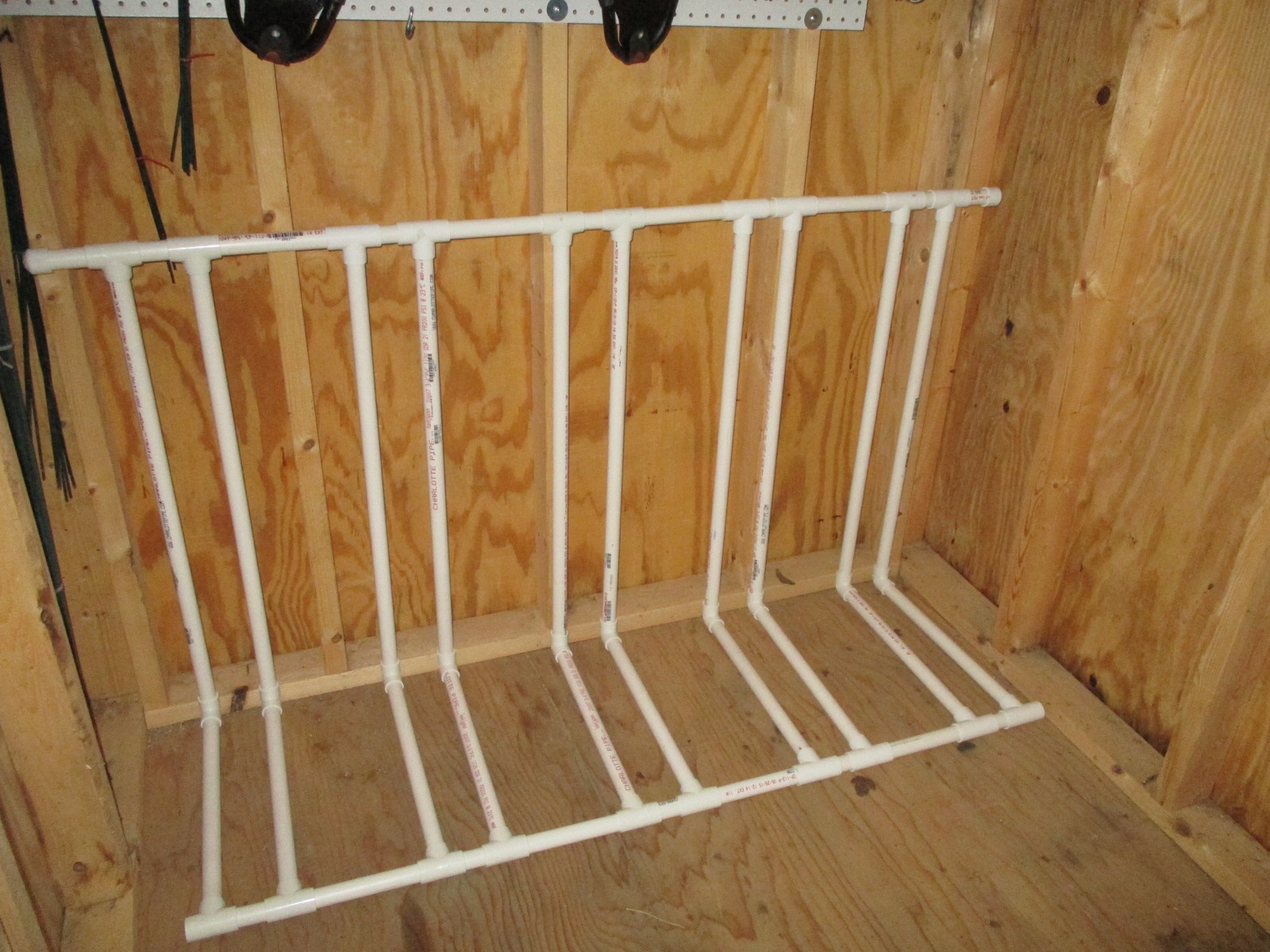
But this time, the project was for the family. Together, W and I sketched and planned; he measured the space, considered distances, and manipulated the plans to get them to work. He tried the “prototype,” and revised his design. He cut the pipe into appropriate lengths, and connected them all together. And now, we have a bike rack in our shed that keeps the bikes upright.

Isn’t it amazing what summer boredom can do?

image   image

The Dog

The expiration of the dog has come full circle.

Ever since my daughter went away to camp for the first time, and the paperwork said not to send mail that contained sad news (i.e. an announcement that the dog died), our non-existent dog has died each year while the kids are at camp. At some point during their week away, I send a letter announcing that the dog has died, and the kids are amused (although sometimes their bunk mates are horrified!). The expiration of the dog has been an ongoing joke for five years now.

This year, in a strange twist of events, I was the one who went away from home. J and I traveled out of state for an athletic competition. The boys were busy with their own activities back at home, so my boyfriend stayed with them, and kept them company.

When the kids go away, it has been my pattern to wait until a few days have gone by before I deliver any news about the dog. When I left, however, C couldn’t wait to tell me about the dog. Apparently, he felt the need to get it out of his system right away. Perhaps he thought he might forget as the week went by.

I had barely landed and settled in my hotel room halfway across the country when the message came. And it was a doozy of a message! Just in case you thought we’d be all right, Mom, here are some of the things you feared could go wrong. Oh, and the dog died.

Interestingly, when I got to the part about the dog, I knew that everything was under control, and I could relax. This trip was the first time that I had left home for more than a brief while, and I was on edge, concerned about what would go on in my absence. I had voiced my anxiety to the boys in the days leading up to my trip.

As it turned out, I had little to fear. The boys are older; my boyfriend is competent; and just maybe my neighbors were doing a little “neighborhood watch” in my absence….

But I’m glad ‘the dog died’ early in the week. That message relieved me of my worries!

Bump in the Night

Screen Shot 2015-06-28 at 11.32.59 AM

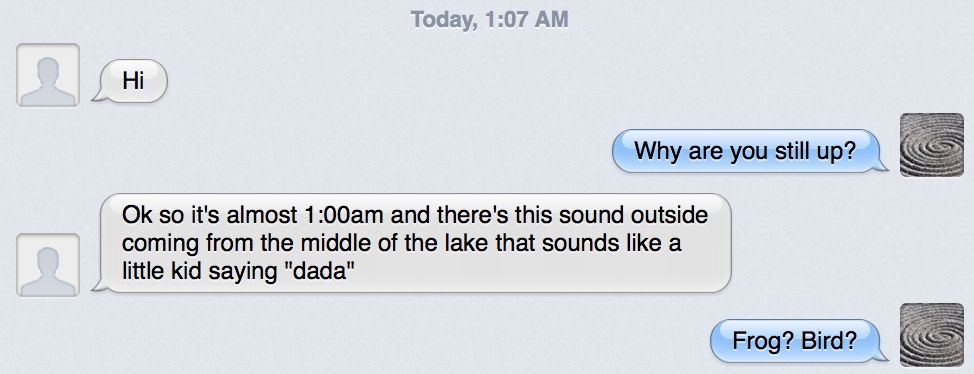
It’s one o’clock in the morning, and my daughter has just messaged me. Now, there is no way I should still be up at one o’clock in the morning, but I am balancing three overlapping sessions in my summer online job, and I’m trying to finish up something. Anything. And suddenly, my biggest concern is not that I am still up, but that she should clearly be sleeping. And she’s not.

In fact, sleep schedule has been a point of contention between her father and myself for all of the many years we have been apart. He insists that the children are on the same schedule at his house as at mine. Solid evidence proves otherwise.

“Hi,” she types, as if it’s one o’clock in the afternoon.

I hear the bell announcing the message’s delivery. I read it, and I think, What. The. Heck. “Why are you still up?” I hastily type back.

“Ok so it’s almost 1:00am and there’s this sound outside coming from the middle of the lake that sounds like a little kid saying ‘dada,’” she responds.

And here I am, a thousand miles away, wondering what I am expected to do. I choose to take the reasonable approach. “Frog?” I type. “Bird?”

In my mind, I can see her shaking her head. “So C comes into our room with a knife and a flashlight and we don’t know what to think of it.”

This sounds like a totally safe situation. “Well, if it’s in the middle of the lake, it’s somewhat far away,” I reassure her.

“It could’ve also been W sleep talking and we misheard where it was coming from,” she tells me. And with the next sentence, I know she’s not buying my reassurance. “But creepy ghost children can travel quickly,” she continues, going with the supernatural because it is, after all, the middle of the night. And the supernatural can explain anything. Truly.

“You’re right,” I type. I figure at this point, the only approach is to agree. “I didn’t think of that. Those creepy ghost children can travel very fast. Hopefully, they are only after slow, old people.” I figure I may as well have some fun with this one.

It is only a second or two before she types back, “But there are slow old people IN THIS HOUSE!!”

“Yes,” I say. “I know. They will go after the slow old people and leave you alone.”

“MAYBE. BUT MAYBE NOT.”

“I don’t know,” I finally surrender. “I can’t hear it. It is raining here, and the rain is muffling the sounds from your lake.” Because the truth is, no matter what the sound is or is not, there is nothing I can do when I am a thousand miles away.

Nothing.

But now, I must go to sleep wondering what is calling “dada” in the night.

Oddities #3

On Tuesday, I took my children to the airport and put them on a plane to travel to their father’s house for their annual two-week summer visitation. Their flight was scheduled for the middle of the day. Lunch time, to be exact. But for C, who has cashed in his school schedule for the teen sleep-plan, breakfast is often the midday meal. When he got up that morning, he didn’t want to eat.

“I’m not going to buy you a meal at the airport,” I told him in my sternest no nonsense tone. “I don’t have money to pay airport prices. Find something to eat.”

“There’s nothing to eat,” he complained. “I’ve already looked. I’ll just eat when I get there,” he stated. As if that was an option.

“You tell me how hungry you are every time you go to your father’s. You say he doesn’t feed you. You say there’s never any food in the house. And now you say the first thing you’re going to do when you get there is eat lunch?” He stared at me with the blank expression that said he didn’t want to engage—with me or the world. “Eat something, please. We’re going to be late.”

He grabbed a box of cereal and a sandwich bag. “I’ll just take a bag of these,” he said, holding up the box. Fine, I thought. At least it’s better than nothing. He filled the bag, and we were on our way.

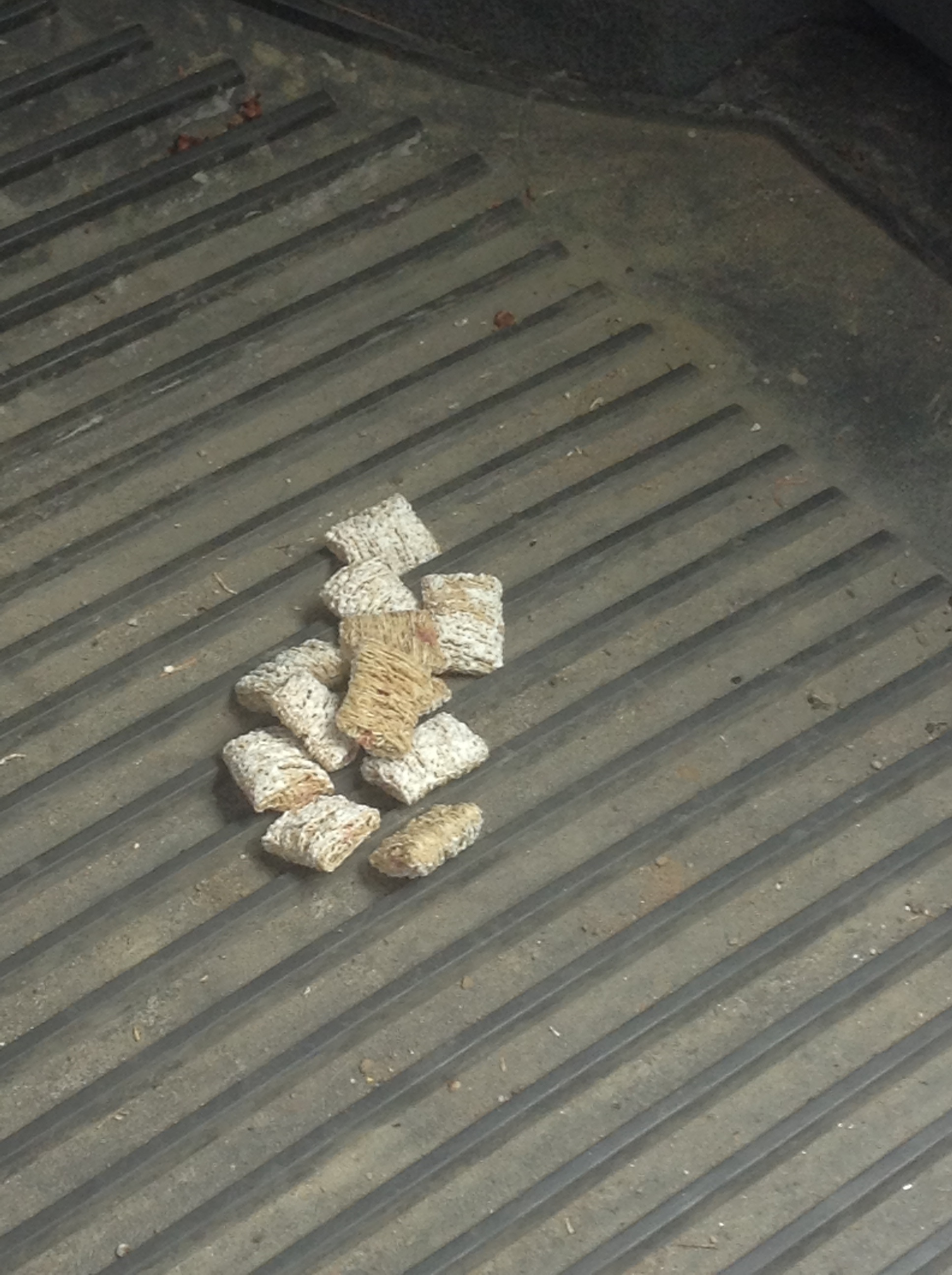
He ate a few bits of cereal on the way to the airport. When I stopped fast to avoid the car in front of me, the bag of cereal slid off C’s lap, and the cereal scattered across the floor on the passenger side. He didn’t even try to save it.

“Are you kidding?” I asked.

“What?” he replied, as if he had absolutely no control over the situation. He sat there, looking at me. I raised my eyebrows. “What?” he repeated.

“Seriously? Are you going to pick it up?”

He looked down at the cereal at his feet and sighed. He bent down and pushed it into a pile. “Throw it out the door when you get out,” I instructed. Because clearly, that wasn’t obvious. Some days, I feel like a walking, talking instruction manual.

It started to rain. Hard. I turned the windshield wipers on high and wished they’d go higher. They beat their rhythm as we drove. “Do you want me to drop you off and then park?” I asked over the roar of the rain, the drumming of the wipers.

“Sure,” came three voices in unison. I pulled up in front of the doors by the ticket counters. The kids got out, grabbed their bags from the trunk and stepped onto the sidewalk.

I drove around, pulled into short-term parking, and parked the car. Just as I was turning off the engine, I looked down at the floor of the passenger side. Cereal. It looked like the work of squirrels.

I am sure C would blame it on the rain.

IMG_0139

Nothing Good

One day this week, my daughter came downstairs for breakfast. She opened the fridge and looked inside. She stood there just a moment too long, surveying. She sighed, “There’s nothing good in here.” No, there is never anything good to eat in my house.

This is one thing I dread about school letting out for the summer. My children will check the refrigerator, the cabinet, wherever, sigh and declare, “There’s nothing good to eat.” In an hour or so, they will come back to stare into the fridge and repeat the process. They don’t seem to notice that I have not left the house and no one has entered. “There’s nothing good to eat,” is a complaint I hear daily.

Last night, I made a batch of blueberry muffins—a dozen muffins in all. I got up this morning to make lunches and get the kids out the door. By the time I sat down for breakfast, the muffins were gone.

Monday afternoon, I came home from an errand to find C, who had just arrived from school, sitting at the kitchen table downing a rather large bowl of pasta salad. Actually, it was the “Family Sized” bowl, and I know this because we were going to have it for dinner.

“What are you doing?” I asked, trying to temper my accusatory tone into curiosity. I didn’t want him to think that I was accusing him of doing something wrong when he had made a relatively healthy snack choice.

“Mom!” he nearly yelled, immediately defensive that I should walk in and catch him eating, of all things. “I eat four meals a day! My school lunch is at 10:30. You can’t even call that lunch.

“So this is one of your meals?” I questioned.

“Yeah. This is my lunch!” Well, it’s good to know my pasta salad wasn’t merely a snack, I suppose.

And during the warmer weather—like now—I try to keep some cut up fruit in the fridge. I cut up an average of two whole watermelons a week. I cut it into bite-sized pieces and put it in a bowl, so it will be cold and delicious and ready to eat. Every time I think I might snack on some watermelon, I go into the fridge and it’s not there. The empty bowl sits in the sink with only a bit of pink juice remaining in the bottom. One of the teens in the house has consumed the contents of said bowl, though he or she blames another. “I only ate some of it. C ate the rest!” or “J ate the last piece….”

Come to think of it, I’m beginning to understand why my kids say, “There is nothing good to eat!” I can’t find anything, either….