Positivity Post: Useless Gems from the Past

Recently, I have taken on the job of sorting through stuff. The stuff in question consists of items that were hidden in long forgotten boxes stashed in the attic of my childhood home—old family photographs, school papers, letters, greeting cards, books, newspaper clippings… you name it. Every now and then, in amongst the useless stuff, I encounter a rare—albeit worthless—gem, and sometimes, I feel the need to share it before I throw it out.

Being a woman of a certain (non-youthful) age, I was immediately intrigued when I came across a 1941 booklet entitled “The new way to a Youthful Figure.” I am most likely the exact target demographic of this publication, though two generations out. In fact, I have finally hit the point where I can put on a pound or two just looking at ice cream, which does not thrill me. So I opened the booklet to see what the 1941 trending logic was to maintain—or regain—a youthful figure.

What I discovered is that the dieting information of yesteryear is pretty much the same information as today. There is information on alkaline versus acid: “If you would feel at your best, be quick on the trigger, physically and mentally, you should let the alkaline-forming foods be slightly in excess of the acid-forming ones.”

There is a 3-day cleanse to begin. And we are assured, “By Monday morning your system will be thoroughly cleansed. You will be so hungry that the reducing menu will taste delicious.” Ah, now that’s the ticket to a successful diet—starve yourself first so you are happy to have anything edible! Your stomach will be happy, but your brain might be foggy.
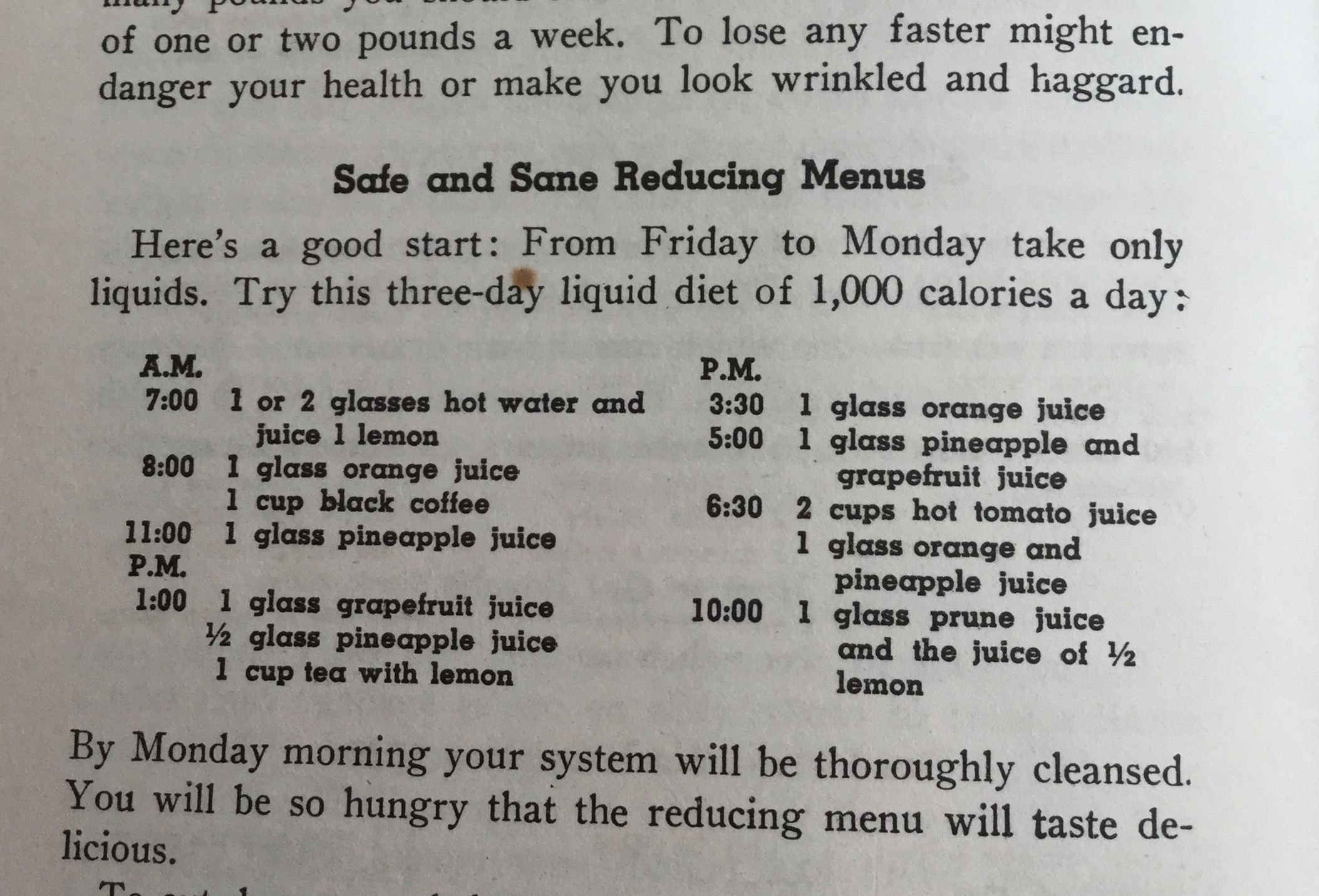
In the back of the booklet, there are menus to help limit calories each day, and there is a lengthy list of 100-calorie portions. Pretty typical. “The reducing menus, pages 15-19, provide all the nourishment your body requires. Moreover, if carefully prepared, appetizingly served, they are not only satisfying but delicious. If you follow them carefully, with absolute honesty even for a few weeks, you may look in your mirror some morning and cry, ‘Eureka! I have a waistline! And behold this faint blush of rose in my cheeks! It’s amazing how fit and lively I feel!’” I don’t know about you, but the day I talk to myself in the mirror this way is the day I might need to be moved to a safe location.

Should you feel the need to read this booklet, I would be happy to scan it and send it to you. Heck, I’ll just send it to you, so you can have the original! And I will go back to sorting my stuff. I’ll be sure to share any more gems I find.

Meanwhile, I am caught between advising readers to sort through and dispose of their own clutter so that others won’t have to do it and advising readers to save a few completely useless items just to give future generations a laugh or two.
Fine

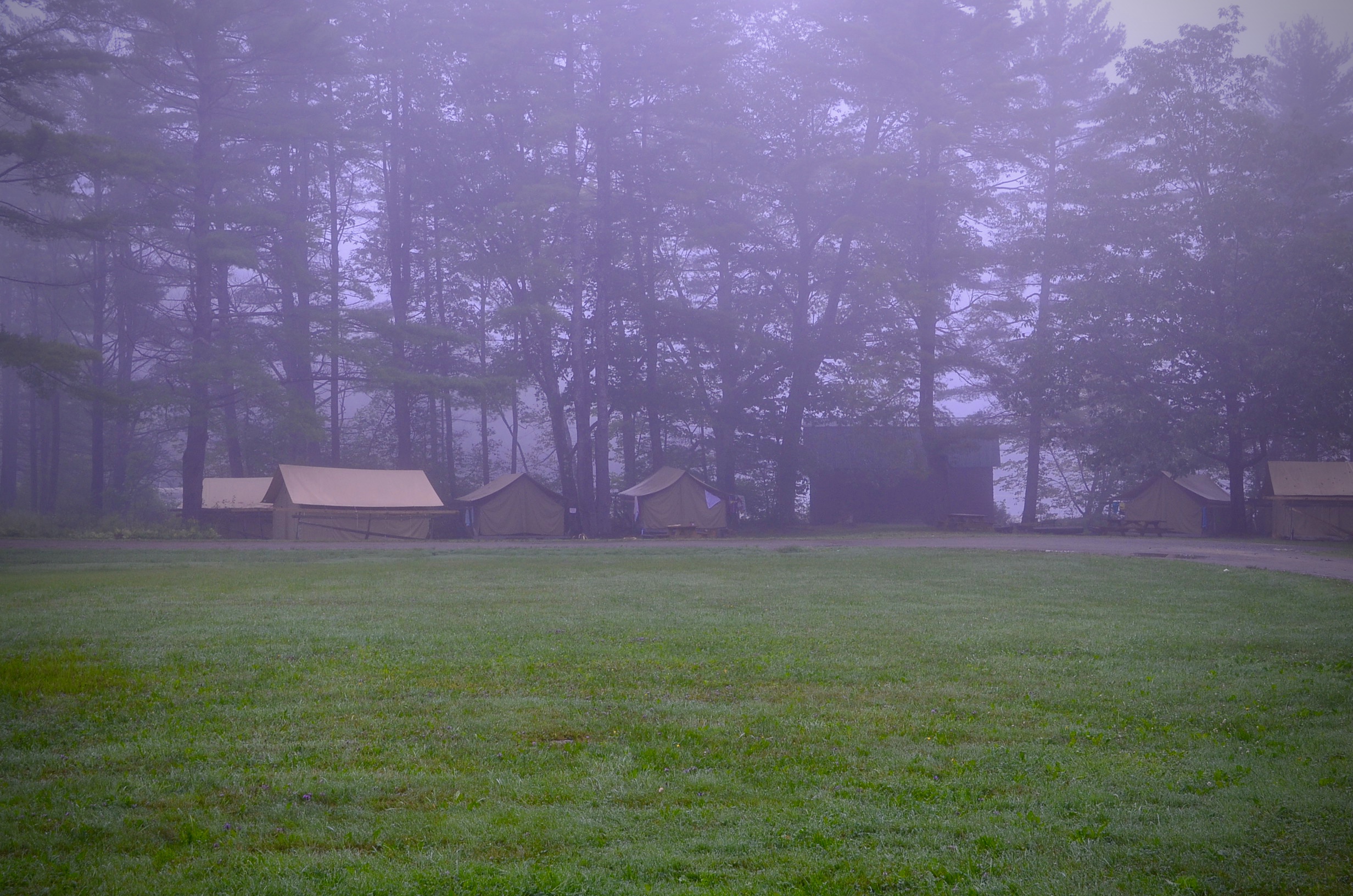
“This is the camp nurse,” I heard through the phone in the shallow end of Friday morning’s sleep. This was the third call I’d received that morning and the one that truly woke me up. I’ll admit I was sleeping late, but in my defense, I am recovering from surgery—and minor or not, it’s a perfect excuse to savor extra time behind the hazy veil of sleep where there are no demands on my time and energy.

“Your son is fine,” she continued. No, I thought. If my son was fine, there would be no reason for you to call me. I have been around the sun more than once, he’s my third kid, and I understand if the camp/school/health center nurse is calling me, all is not fine. I held my breath as I sat up too quickly, waiting for her next words.

Low-grade fever, sore throat, general achiness, she outlined my son’s not-so-fine physical state. A virus, it seemed, or possible strep. “Since he works in the kitchen…” she stopped and let me fill in the rest of the sentence. Yes, he would need to be seen by the doctor.

As an educator, I completely understand. But in the back of my mind there is the nagging lack of fairness that even though it’s fine for the campers to get my son sick, it’s not as fine for my son to get the campers sick. I drove to camp earlier than expected to take my son to the doctor where he was pronounced fine, as I suspected. Well… there is no doubt he has a virus, but thankfully, no strep.

In fact, on the way back from the doctor, we remembered that last year, when he was a CIT, he had the same symptoms at almost exactly the same point in the summer,  so we’ve dubbed it “camp crud.” Next year, when I get a call from the camp nurse during week five, I’ll know to say, “Oh, it’s just camp crud. He’s fine!”

Aimless

Lately, I have been aimless, so I have decided to post an aimless, wandering blog post. Perhaps doing so will help to spur something interesting in my brain, something that is so deeply hidden that only wandering over it will help to pull it out of the weeds. In the past week, I have started numerous posts, but none has stuck. I have been entertaining myself with television and surfing the Internet, and my blog has suffered.

In truth, I have not been totally aimless. I have been completing my work—on schedule, I might add—despite the extenuating circumstances of my life. I am grateful that my online summer work allows for a relaxed work environment while still providing a paycheck.

This evening, I eavesdropped on a conversation of my children discussing the boxes in which they receive gifts. “What are those shoes?” one teen asked another, who quickly explained that that was just the box the gift was in.

He replied, “If everything you ever got was what belonged in the box, you’d have a lot of weird stuff.” I had to laugh as he proceeded to list the items my children would receive: Girl Scout Cookies, DHC Skincare products, dance shoes….

And then my cats became fascinated with the summer beetles and moths that were drawn to the outside light by the front door. I could hear the click of their claws as they batted at the bugs through the glass of the storm door. When I went to check on them (and close the door) I found some impressive two inch bugs making their way up the door. It’s good they stayed outside.

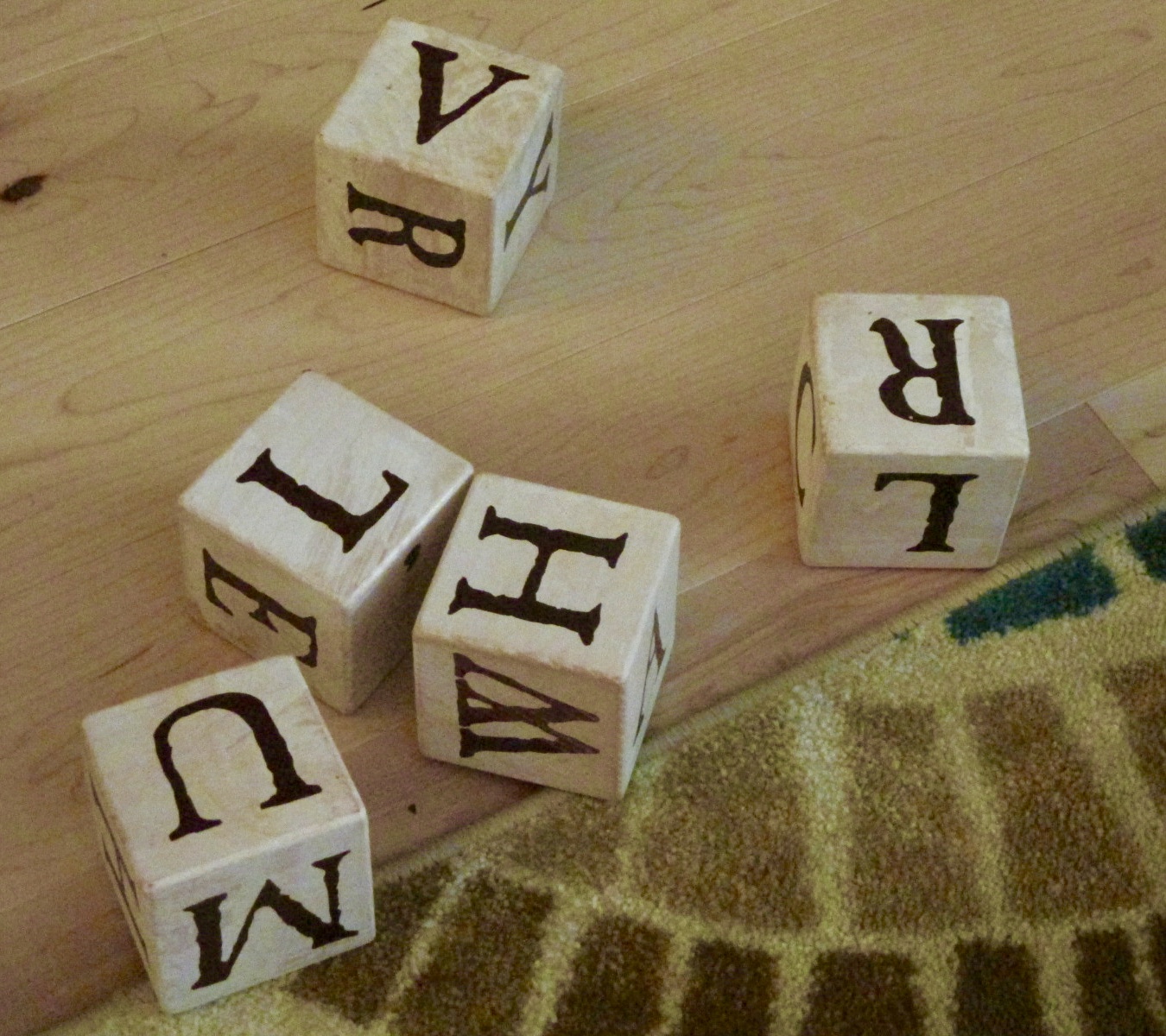
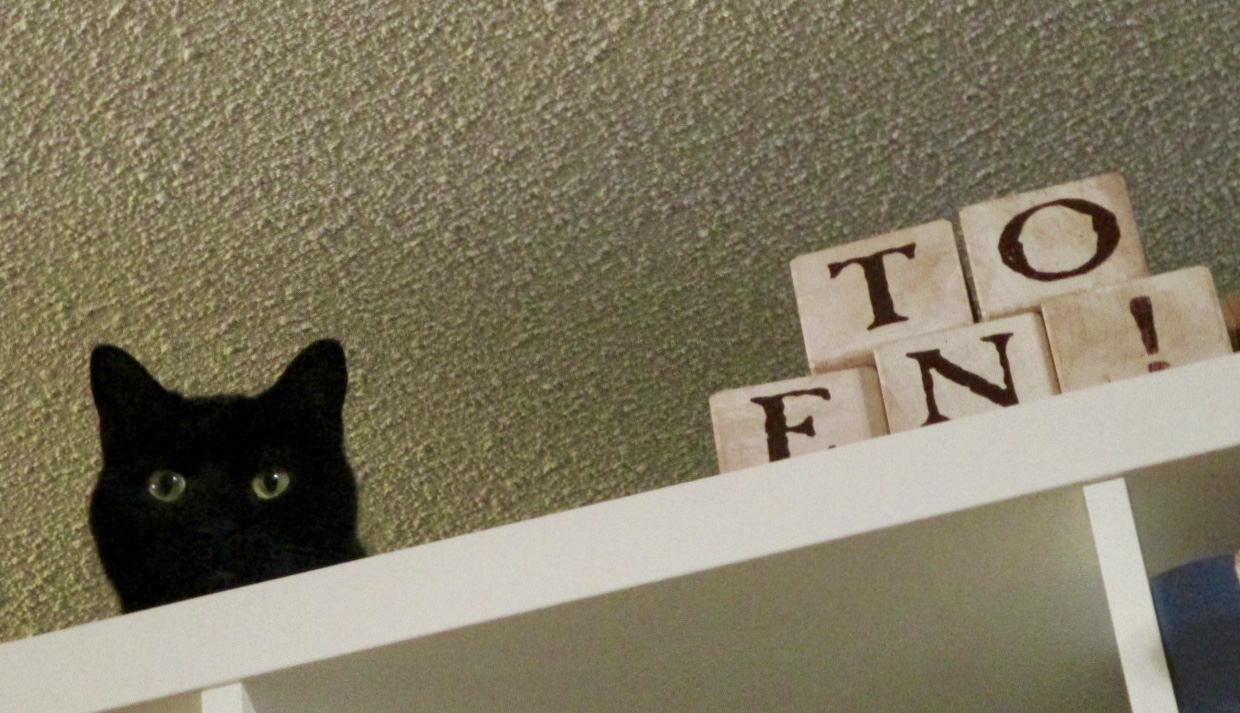
And finally, I will report that the message of my message blocks was finally… well … changed. Even though I wrote about changing the message back on May 31, it never happened. Now, I won’t say that the kids left the message completely alone. There were some small changes made to the spelling, the orientation of the letters, etc. There were comments made about the fact that the message remained unchanged, even after I had blogged about changing it. But no one could quite bear to rearrange the letters. In the end, it was appropriate that the cat—who sleeps on the shelf—pushed the message onto the floor. Dad was a fan of cats and would’ve loved this one. She has quite a purr-sonality! Maybe we’ll put the blocks away for awhile… at least until the cat can keep her paws off them.

Or maybe not.

Sunscreen

The morning was sunny as I helped my daughter apply sunscreen for a trip to the beach. I was responsible for covering her back, and I worked to slather the lotion on her skin around her bathing suit straps. I was careful to apply a liberal coat in hopes that all of her back would be protected.

When I was done, I launched into a disclaimer about the fact that while I tried the best I could, there was no guarantee that I had actually covered every bit of her exposed skin. If she were to burn in strange blotches, I apologized. But as this disclaimer was tumbling out, a brilliant idea momentarily slid into my brain. “They should make a sunscreen that’s color changing. That way, you’ll know if you are completely covered. For example, it could go on blue and then change to clear after a minute or so….”

“That’s disgusting, Mom!” my daughter argued, not even giving my idea half a chance. Color-changing technology works for other things like bathroom cleaner, baby bath thermometers, ceiling paint…. (Although, color-changing technology didn’t work for the large swatch of unpainted ceiling in my kitchen, but that is a story for another day). “What if you were putting it on at the beach?” she questioned. “That’s just wrong.”

Actually, I think color-changing technology could be a brilliant solution to this age-old problem. Though I have to admit, it might be somewhat off-putting to be an innocent bystander and watch people smearing themselves with bright blue lotion at the beach.

Painting Rainbows

It’s been almost six months without Dad. In those six months, the grief comes and goes in waves, but lately, the waves have been farther apart. I think this perhaps because I am not in the car as much during the summer, not alone as much, and therefore, I don’t have the opportunity to cry. As much. And some days, that creates an illusion that the grief is subsiding.

But on Sunday, I had one of those “sneak attacks” of grief I had been warned about. I was at my daughter’s dance recital, and I was enjoying the show. I had remembered years when Dad had been in this very auditorium watching his only granddaughter perform, but I was able to bury that thought. That is… until the kindergarten class took the stage. The little ones are always the cutest, but then their music came on, a rendition of “Baby Mine” performed by Alison Krauss. And suddenly, feelings I didn’t know I was having came bubbling to the surface in a figurative storm of emotion. It was a whole mixture of Dumbo and circuses and Dad. And sitting there in the dark, I cried.

That afternoon, after a literal storm, there was a rainbow. It was the second that weekend and was followed by two more the next day. These rainbows were gifts that lifted my spirits and filled my heart.

When Dad passed away back in January, I found—tucked in a drawer with some other papers for safe-keeping—an old card that he had sent me when I was living some distance away on the other side of the country. On the front of the card was a picture of two painters on ladders, each painting opposite ends of a rainbow. The card, and the message inside, became the basis for my words at Dad’s service. I talked of the notes and silly poems that he wrote, and I ended with the following:

When we were in college, Mom and Dad would send care packages at exam time, and Dad would write poems to encourage us to study hard, to do our best, but also to let us know he believed in us. Before I returned home this time, I searched through a few old letters I had hanging around. The best of the notes are in storage boxes, but I did find one he sent to me when I was in California. This one was “just because.” After a brief newsy letter, he ended with a poem. It started out, Wish I could… and went on:

Paint you some rainbows

Write you some prose

Find you some fellows

(Even more of those!)

Bake you a cake

Offer you some laughter

Give you a break

Help you get what you’re after

Not many dads take the time to write poetry for their daughters. But my dad—he was the best. So Dad, we send you off with all the love we can muster and a promise to miss you forever. And if you’re listening, paint us some rainbows.

This year, I have seen more rainbows than usual. And for me, every rainbow is a gift—a very special gift—that lets me know Dad is still with us in some way, and he is letting us know he is thinking about us.


Road Rage Cure

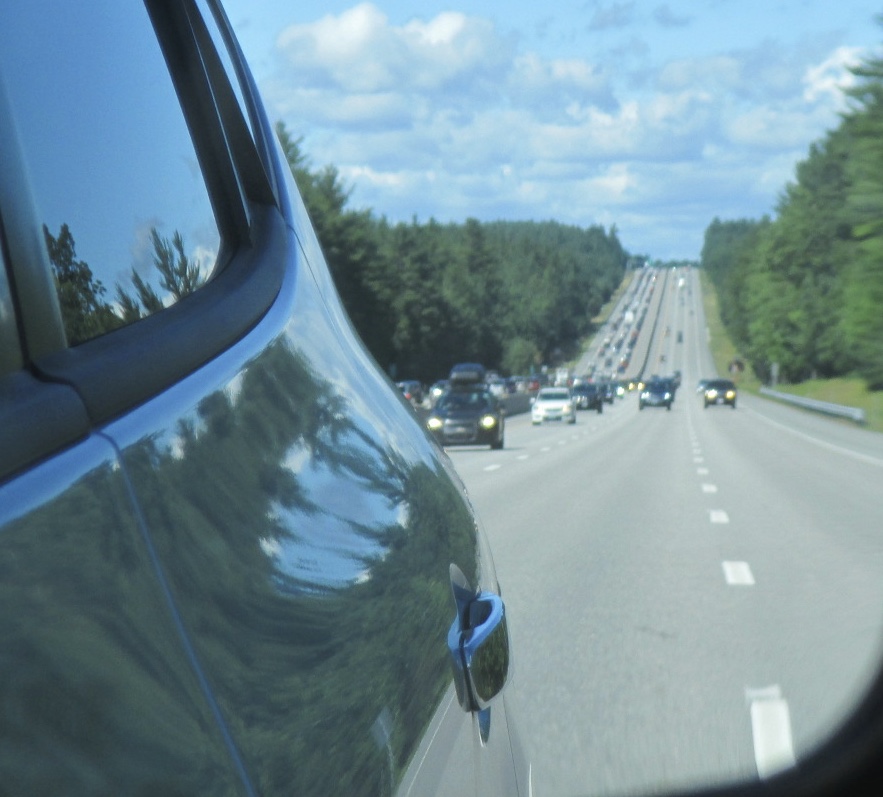
If everyone was required to drive around with something silly in—or on—their car, people might be less angry as they drove around. And after a couple of recent incidents with road rage, that would probably be a good thing.

Most recently, over the weekend, we suddenly—and unintentionally—took a detour into the creepy and frightening land of road rage. I’m not exactly sure what set off the driver who was behind us at a stoplight. It had something to do with my oldest child, in the backseat at the time, who made eye contact with the driver of the other vehicle. She was a middle-aged woman.

Now, I don’t want to meddle in her life, but perhaps she had bottled up too much of the week’s negativity. Whatever it was that set her off, it was very clear that she had a profound need for attention, and she was willing to compromise the safety of everyone else on the road in order to get it.

At the next light, she pulled up beside us and tried to get me to roll down my window. But thank you anyway, I know better than to engage with a crazy stranger. Through the window, I could hear her screaming and cursing, and my peripheral vision was catching her wild gestures.

The light turned green. “Go!” I instructed the fifteen-year-old driver (who remained amazingly calm), and he turned left around the corner. The woman swerved her black Mercedes from a non-turning lane, and that’s when it was clear we weren’t going to lose her any time soon. At the next light, she again pulled up beside us, this time on the left, her hands still waving as her passenger window lowered.

I picked up my phone. We had just passed a cruiser, so I knew there were police in the area. I debated calling 9-1-1, but opted instead for the non-emergency number. But this was not my town, so I had to go through directory assistance, all the while, the woman was in hot pursuit and my son continued to drive.

In the back seat, my daughter was audibly hyperventilating at the same rate that I was silently hyperventilating. As the adult in the situation—and clearly the only adult despite the middle-aged woman in the car beside me screaming obscenities—I was responsible for displaying an impression of utmost calm.

“Police Department, can you hold?” the voice said.

“Uh, not really,” I responded, my heart pounding in my chest. “I’m in a road rage situation.”

Bit by bit, he took pieces of information, and I updated him on my location. One mile. Another. Finally, as the woman pulled up beside me, I was able to read her license directly to the dispatcher, and I think she realized what I was doing. It was at this light that I heard her scream, “Is that your son? You should teach him some manners!”

I have never been more relieved than I was when she turned right onto the side street at that light. She was probably trying to disappear before the police caught up to us.

But the police had her license number and a description of her car. I really hope they found her. It seems she might benefit from a lengthy discussion on, well … manners.

And I would definitely benefit from carrying a silly inflatable animal in the back of my car.

Lessons from the Tollbooth

Every experience, good or bad, can be considered an adventure. And every adventure, positive or negative, has its lessons. Let me set the scene….

It is 6:00 in the morning. It is still dark, and there is an unmistakable crispness in the air, despite the calendar’s July date. My daughter and I are traveling an unfamiliar highway in a Midwestern state to get to the airport for an early flight home from a nearly week-long adventure.

I have my electronic toll pass in the car with me, and even though it is from our home state, in theory, it should work here. The toll experience on the way in was spotty, but we made it through. Our home state removed the gates on their tollbooths many years ago in favor of speed and efficiency. Such is not the case here in this Midwestern state.

At the first tollbooth, we pull up to the gate, but the booth does not pick up the signal from our transponder. I wave it around in the car. Nothing. I push the “help” button on the tollbooth, and a male voice wishes me a good morning. I explain my situation. He asks me to read my transponder number. Um… it’s fairly dark in the car and I don’t have my reading glasses, but I don’t tell him this. I pass the transponder to my daughter. She reads the number, and I repeat it to the voice in the void. Once he confirms that I do, in fact, have an account, the gate rises, and I drive through.

After an hour or more on the road, the second tollbooth comes into view. We pull up, fully expecting (well… hoping for) our toll pass to work. Of course, it doesn’t. I roll down the window and lean way out, holding it under the barcode scanner that I discovered at the last tollbooth. The bright red laser line crosses the code. I watch the gate, but it doesn’t move from its persistent placement directly in front of the car. I push the “help” button and wait for a friendly voice. Nothing. In my rear view mirror, I see a semi truck approaching, but I figure he will go into a different toll lane. He doesn’t. In seconds, the massive rig is directly behind my car. We are trapped, and my daughter is trying desperately to hold herself together as she begins to panic in the seat beside me.

I step out of the car into the chilly dawn air, transponder in hand. I frantically wave it in front of the scanner while simultaneously pushing the “help” button. This tollbooth is completely unresponsive—nothing functional here, it seems. I breathe deeply, forcing air into and out of my lungs. I turn to the truck driver behind me. I muster my most helpless and apologetic expression and I shrug, still holding my transponder in my hand.

He pauses for two seconds. Then motions for me to get back in my car, and he begins to slowly back up so I can switch to a lane with a real, live attendant. But not only does he back up, he angles his truck in such a way as to block any traffic that might be approaching. Oh, bless you! I think to myself. I roll down my window as I move over several lanes, and I wave my thanks.

“How many more tollbooths do we have to go through?” my daughter asks quietly.

I sigh, reluctant to tell her. “I think only one,” I say, keeping my tone low and tender.

It’s finally light out when the third—and final—tollbooth comes onto the horizon. The tension I feel from the passenger seat is pulling on my heart. I take a deep breath. “It will be fine,” I say by way of calming us both down. And it is. We sail right through. What? How is that possible? I glance in my rearview mirror, looking for answers that are not there. I take a deep breath and finally relax.

We survived and have had substantial time to decompress, and I am happy to share the lessons I gleaned from my not-so-good-morning at the tollbooth:

Don’t believe everything you hear or read on the Internet. We heard our toll transponder would work, but I checked the website to confirm. Even so, our transponder didn’t work exactly as we’d hoped.

Trust that people will work with you and rely on the kindness of strangers. For the most part, if people see you are in a tough situation, they generally offer their assistance. That could come as a helping hand, but it could also come as a truck driver backing up and blocking oncoming traffic so you can do what you need to do.

Always have an escape plan, or just a plan, in general Even if you don’t need it, it is good to have a plan in the back of your head. Just think, for a moment, about what you will do if you get stuck. What is it they say…? Anticipate the worst but hope for the best.

Be a calming force for those around you. Now in reality, I had no idea how we were going to get out of our predicament. But experience tells me that these things have a way of working themselves out. And after only a brief panic, they did work out. After all, when was the last time you heard of someone being permanently stuck in a tollbooth?

{Image: FreeImages.com / Travis Cripps}

[Mom] Behaving Badly

There are days when where we should be is a vast distance from where we are. We should be close to self-sufficiency. We should be willing to go places on our own. We should be able to find things (tools, shoes, staplers, sweatshirts, etc.) within the confines of our not-very-large house. And in the moments when we can’t do whatever it is, my failings as a mommy come tumbling in on me like a building with an unstable foundation. How, I ask myself, have I failed to provide the very basic skills required for navigating the world?

Two steps forward, one step back, I remind myself. But when all three children are experiencing lapses at the same time, it is sometimes more than I have patience for. On these days, I want to throw everyone out of my house, barricade the door, sink to the floor and melt into a river of never-ending tears. Not very mature, I know, but I am the only parent, and the entire burden of raising productive members of society falls on my shoulders. And my shoulders are weary. Some days, the cracks brought on by the weight of my life are more evident than others.

Perhaps the long stretches of dreary weather have affected my usually positive outlook. We have had a more than healthy portion of bad weather, experiencing spring in one-day spurts that only show us what we are missing. It has been cold and rainy for months. And non-stop rain and heavy storm clouds can really wear on a girl. Enough already!

But then I remind myself that this moment—the moment when I want to barricade the door—is one moment in the grand scheme of things. We are moving in a forward direction… generally. My children may stumble, but they continue to grow and change and become young adults. It takes time, but they (hopefully) will figure out how to get things done. My mood will improve. Once I’ve wallowed in my puddle of tears long enough, I will stand up, adjust my burden on my shoulders, and move on.

And if the weather doesn’t change… well, at least the drought is over.

The Driver

I have found myself in the interesting situation of no longer needing to drive my own car. Well, not very often, at least. I can sit in the passenger seat, look out the window, and enjoy the ride.

I have moved into “chauffeur mode.” In this mode, I announce that I have to go somewhere, and I immediately hear, “Can I drive?” It doesn’t matter if I was planning to go alone or with my newest driver. New driver will find any trip—real or imaginary—a chance to do the driving and rack up some of the 40 hours he needs behind the wheel before he can get his license. Never mind that he is still 4+ months away from being of licensing age.

Imaginary trips involve the need to make up places to go just so he can get behind the wheel. We have taken a trip to Lowe’s for a three dollar package of screws, spending more in gas to get there than we did on the actual purchase. I think this kid would be more than happy to drive me around town in search of places that didn’t exist. Perhaps we could start a new adventure: new driver geo-caching from behind the wheel. Not only would they be driving the car, they would have to navigate while also paying attention to necessary land marks. Obviously, the kids would have to get out of the car to access the actual treasure and sign into the log at the end, but that would aid in the ever-challenging skill of parking the car.

In truth, I appreciate the fact that this driver is eager to get behind the wheel and regularly asks to drive. My other two were a bit more reluctant as far as volunteering, or even wanting to drive, often saying no when asked. And even though I am in “chauffeur mode,” I still have to constantly keep my eyes on the road.

If we cut a corner too close, and I say, “You’re going to hit the curb,” the reply comes instantly.

“I’m not going to hit the—” his voice breaks off when the rear wheel scrapes the edge of the curb.

But we are still early in the driving process, still learning to judge distance and where the car is on the road. My job as the chauffeured will become easier with time and practice. And soon enough, he’ll get his license. Then he’ll say, “Hey, can I drive?” And he’ll walk out the door, get in the car, and drive away without me.

Messages

I’ve written about my blocks before—my “grown up” alphabet letter blocks. It was the end of December when I wrote a post about how my children often …um, alter the messages I create, changing the words to nonsense or silliness.

But the current message on our blocks has remained unchanged for a while now—almost since that December post. In fact, I think this is the longest running message we’ve had without some sort of interference at the hands of the teenagers in the house. But that’s because this message is special; it was created in a deeply emotional moment—one that we all survived—and no one has the heart to disturb it.

It was the night my dad passed away; the children had gone to bed, and I couldn’t sleep. I was gathering all of the items we would need for an indefinite amount of time away from home, but I was directionless. I sat down on the floor of the living room, and in a mess of tears, I composed the message—Love to Heaven—tracing the letters with my finger.

My children didn’t see the new message until we returned from our time away. “Look what Mrs. L did with our blocks!” they summoned me into the room. Mrs. L is the neighbor who had been feeding our cats and taking in our mail while we were away. I went into the living room and looked to the top of the shelf.

I half smiled to myself. “No,” I told the kids. “I did that. I wrote that message the night before we left, while you were all sleeping.” I turned away and went back to the kitchen, hiding the tears that now flow freely and often.

Those moments, nearly five months ago now, they were a time of deep and pervasive sorrow. And while grief remains with me, it has found pockets in my life where it can emerge safely—when I am alone in the car, in the morning when I get ready for my day, in the evening when I prepare dinner. And there are also the sneak attacks that take me by surprise, and probably always will.

But the message has served its purpose of comfort to all who read it. And now, perhaps maybe we could use these blocks—as we have in the past—to summon the resistant summer weather. With reluctance, I will change this long-standing message. It will take courage to sit on the floor, dismantle the words, and scramble the blocks. I will remember the last time I turned these blocks in my hands to find just the right letters—the moment when creating the perfect message was so very important.