The Rules

“So have you been following ‘deflate-gate’?” my boyfriend asks J as she is cleaning up the dishes from dinner.

She turns and stares at him as if he has asked her what size jeans she wears. I can see her formulating a response, and it takes her a minute to answer. When she does, her tone is one of authoritative condescension. “P, you might not know this, but this is a ‘football free home.’ We do not talk about football in this house.”

In my head, I am silently cheering her. Really, I have no interest in football; I have never had an interest in football; and since I have single-handedly raised my children, they seem to have no interest in football, either.

“Come on,” he goads her. “Football is the American pastime. You have to have an interest in football.”

She shakes her head. “We don’t do football.”

Just to get her going, he launches into a discussion of some team or other with some coach or other who is supposed to be amazing. Or something. Truly, J is right. We don’t do football.

When she’s heard enough, and she can no longer ignore him by running the water and playing in the suds, she stops him. “If you want to live in this house, you’re going to have to give up football.”

P’s jaw drops in mock shock. “Give up football? Back when I was coaching….” And he starts yet another story about football. She scrubs the skillet just a little harder, no doubt trying not to listen.

“Football. Free. House,” she reminds him when he finishes his story. It was nice of her to let him finish.

“What are you going to do when you go off to college and some nice guy starts talking to you about football and asks you if you want to go to a game?” The hypothetical situation is fabricated to get her to consider the possibilities. “You’re going to have to be able to talk intelligently about football.”

“Not going to happen,” she says, as she rinses the pan in the sink. “We are football free.” She dries the pan, sets it on the stove, and flounces out of the room.

Apparently, we are. Football free.
Bump in the Night

Screen Shot 2015-06-28 at 11.32.59 AM

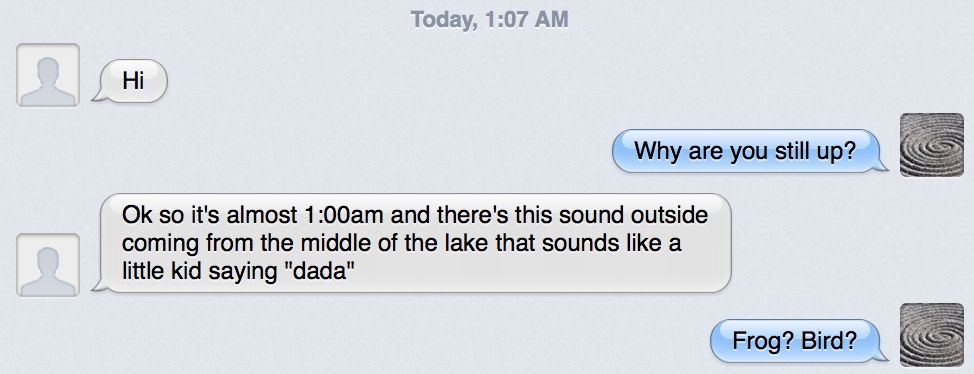
It’s one o’clock in the morning, and my daughter has just messaged me. Now, there is no way I should still be up at one o’clock in the morning, but I am balancing three overlapping sessions in my summer online job, and I’m trying to finish up something. Anything. And suddenly, my biggest concern is not that I am still up, but that she should clearly be sleeping. And she’s not.

In fact, sleep schedule has been a point of contention between her father and myself for all of the many years we have been apart. He insists that the children are on the same schedule at his house as at mine. Solid evidence proves otherwise.

“Hi,” she types, as if it’s one o’clock in the afternoon.

I hear the bell announcing the message’s delivery. I read it, and I think, What. The. Heck. “Why are you still up?” I hastily type back.

“Ok so it’s almost 1:00am and there’s this sound outside coming from the middle of the lake that sounds like a little kid saying ‘dada,’” she responds.

And here I am, a thousand miles away, wondering what I am expected to do. I choose to take the reasonable approach. “Frog?” I type. “Bird?”

In my mind, I can see her shaking her head. “So C comes into our room with a knife and a flashlight and we don’t know what to think of it.”

This sounds like a totally safe situation. “Well, if it’s in the middle of the lake, it’s somewhat far away,” I reassure her.

“It could’ve also been W sleep talking and we misheard where it was coming from,” she tells me. And with the next sentence, I know she’s not buying my reassurance. “But creepy ghost children can travel quickly,” she continues, going with the supernatural because it is, after all, the middle of the night. And the supernatural can explain anything. Truly.

“You’re right,” I type. I figure at this point, the only approach is to agree. “I didn’t think of that. Those creepy ghost children can travel very fast. Hopefully, they are only after slow, old people.” I figure I may as well have some fun with this one.

It is only a second or two before she types back, “But there are slow old people IN THIS HOUSE!!”

“Yes,” I say. “I know. They will go after the slow old people and leave you alone.”

“MAYBE. BUT MAYBE NOT.”

“I don’t know,” I finally surrender. “I can’t hear it. It is raining here, and the rain is muffling the sounds from your lake.” Because the truth is, no matter what the sound is or is not, there is nothing I can do when I am a thousand miles away.

Nothing.

But now, I must go to sleep wondering what is calling “dada” in the night.

Nothing Good

One day this week, my daughter came downstairs for breakfast. She opened the fridge and looked inside. She stood there just a moment too long, surveying. She sighed, “There’s nothing good in here.” No, there is never anything good to eat in my house.

This is one thing I dread about school letting out for the summer. My children will check the refrigerator, the cabinet, wherever, sigh and declare, “There’s nothing good to eat.” In an hour or so, they will come back to stare into the fridge and repeat the process. They don’t seem to notice that I have not left the house and no one has entered. “There’s nothing good to eat,” is a complaint I hear daily.

Last night, I made a batch of blueberry muffins—a dozen muffins in all. I got up this morning to make lunches and get the kids out the door. By the time I sat down for breakfast, the muffins were gone.

Monday afternoon, I came home from an errand to find C, who had just arrived from school, sitting at the kitchen table downing a rather large bowl of pasta salad. Actually, it was the “Family Sized” bowl, and I know this because we were going to have it for dinner.

“What are you doing?” I asked, trying to temper my accusatory tone into curiosity. I didn’t want him to think that I was accusing him of doing something wrong when he had made a relatively healthy snack choice.

“Mom!” he nearly yelled, immediately defensive that I should walk in and catch him eating, of all things. “I eat four meals a day! My school lunch is at 10:30. You can’t even call that lunch.

“So this is one of your meals?” I questioned.

“Yeah. This is my lunch!” Well, it’s good to know my pasta salad wasn’t merely a snack, I suppose.

And during the warmer weather—like now—I try to keep some cut up fruit in the fridge. I cut up an average of two whole watermelons a week. I cut it into bite-sized pieces and put it in a bowl, so it will be cold and delicious and ready to eat. Every time I think I might snack on some watermelon, I go into the fridge and it’s not there. The empty bowl sits in the sink with only a bit of pink juice remaining in the bottom. One of the teens in the house has consumed the contents of said bowl, though he or she blames another. “I only ate some of it. C ate the rest!” or “J ate the last piece….”

Come to think of it, I’m beginning to understand why my kids say, “There is nothing good to eat!” I can’t find anything, either….

Stage directions

IMG_1555

Always, there are the insights of people who are part of our lives, but just outside the inner circle of our immediate home life, to bring an objective perspective to what we do. With a word, a phrase, we suddenly see our everyday actions in a different light.

Last night, my sister stopped by my house on her way home from work. I had picked up some plants that she wanted for the garden, but I did not want the responsibility of keeping them alive through the predicted weather of another night of drought or severe thunderstorms—either seemed a distinct possibility. So she agreed to pick them up.

She arrived as we were eating dinner, and since part of our meal contained none of the ingredients that trigger her allergies, I offered her some food, and she accepted. Which is a long-winded way to say she hung around for a while.

After dinner, there was some talk of who was responsible for the dishes, and it was determined that it was J’s night. She promptly left the room, stating that “the leftovers needed to be left-overed” before she could begin. She spent the next ten minutes flitting in and out of the kitchen—complete with her J-like theatrical flourish—while I talked with Auntie.

The cat came in from outside and proceeded to regurgitate the organic material he had ingested—as cats do—onto the kitchen floor. It was a lovely addition to the non-stop-ness of the evening.

J flitted back into the kitchen. “Steps wide over the cat vomit,” she announced as she lifted her foot in an exaggerated dance-step over the puddle the cat left behind.

Auntie scrutinized J’s action. “Does everything come with stage directions now? ‘J enters the kitchen. Steps wide over the cat vomit….’”

I laughed. How many times had I heard one of the kids narrate his or her actions? How many times had I done so myself? Often, I would make a similar statement as I stepped over a child sprawled on the floor; my objective was first, to let the child know that I was trying to avoid him or her, and second, to let the child know that he or she was smack in the middle of the pathway through the room.

But this statement—a simple observation—from my sister helped me to reframe these narrations. They are like stage directions, and they tell the actor or actors what to do and how to do it.

I wonder if there is some way that I can edit these narrations and add my own. “J enters the kitchen; cleans up the cat vomit….’”

I think I’ll work on that….

Going nowhere

We were on vacation recently, staying in a place that has all sorts of fun things to keep active kids of most ages occupied and entertained. One of these attractions is a Fun Barn in which there is a bounce house, a ping-pong table, a climbing wall, and an area in which kids (um… and adults) can have nerf-ball battles. This area is caged in with netting and has hundreds of foam balls with several air powered shooters strategically placed around a climbing structure with a slide, making it easy for groups to have rousing battles. So we did.

It was after dinner on our last night. As four teenagers and two adults, we were able to have quite a battle before some younger children showed up, and we had to turn the energy down a notch. It was getting dark by then, so we decided to leave the Fun Barn to walk back to the lodge. It was chilly for the end of April, but the days were getting longer, the snow had finally (mostly) melted, and the flowers were starting to bloom. We could hear spring peepers off in the distance.

As we exited the Fun Barn, J wanted to go to the playground. It was getting dark, and the sign posted on the playground fence claimed the area closed at dusk. But a simple sign would not deter J. “Let’s just go see,” she said, running ahead with W to check out the playground. “The chain’s not up!” she reported of the yellow plastic chain used to discourage after hours playground use.

Gleefully, the two of them slipped through the gate and ran to the merry-go-round. Not a carousel merry-go-round, but a playground merry-go-round—the kind that most schools did away with years ago as children flew off when they spun too fast and couldn’t hold on. My two each grabbed a side and started running to get the merry-go-round moving.

“When I say THREE, jump on!” called W. “One, two, THREE!” They both landed with the muffled thud of rubber soles on metal platform. They hung their heads off the edge, hair flying up in the centrifugal force. They completed this exercise several times before their activity diminished to lying on the platform while the movement slowed, looking up at the branches of the tree above.

“Mom, can I have your camera?” J asked, and I handed it over. She started taking pictures from her spot on her back looking up at the sky. She spent several minutes clicking, checking the the screen, sighing and trying again.

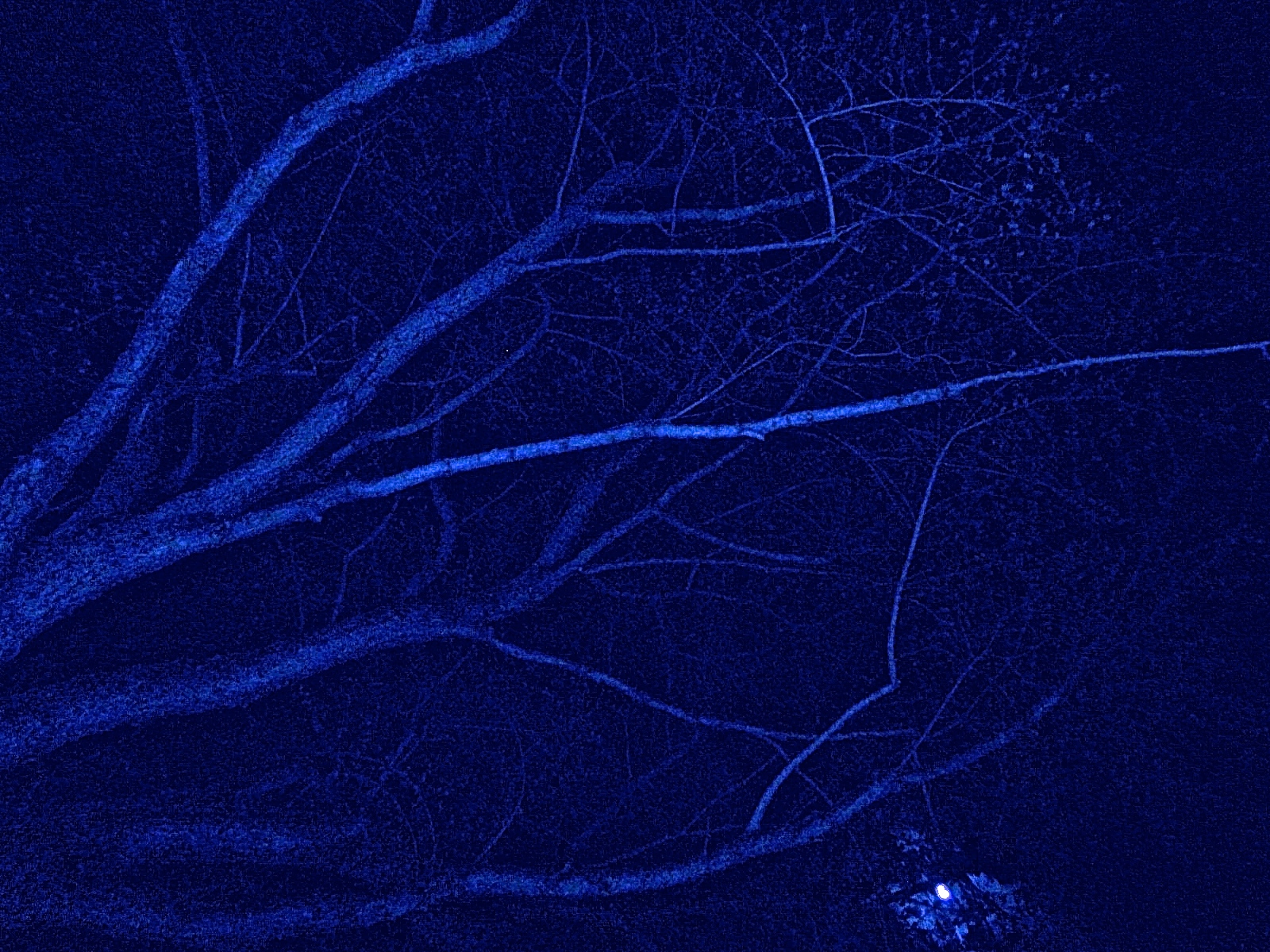
What she didn’t realize was that it was too dark for pictures. And she also didn’t realize that what she wanted to capture was not the branches above her and the moon in the background. She wanted to capture the moment, the feeling of a beautiful spring night, vacation, and family time spent together. She wanted to capture the spinning, the breeze, the feeling of going nowhere, and the thrill of the ride.

IMG_1519

Faux Pas

I was driving my daughter home from dance the other night, listening to the radio, and absently pulling on the material of my pant legs. We had been having a conversation about dance, play practice, school, and what was for dinner. A song came on the radio, and I started to sing.

Suddenly, my daughter looked down at my leg. “Are you wearing leggings?” she asked in that incredulous tone that teenagers use to indicate that their parents are doing something unbelievably ignorant.

I rubbed my leg, trying to remember which pants I was wearing, while continuing to keep my eye on the road. “No, they’re not leggings. They’re knit jeans.”

“Good! There are a lot of people who wear leggings who shouldn’t,” she continued, clearly not thinking through the implications of what she was saying. But her dialogue was effective. Immediately, visions of people who shouldn’t wear leggings entered my mind. Then I thought about her comment.

“I’m sorry…. Are you saying I shouldn’t wear leggings?” I asked.

“I didn’t mean you!” she responded, too quickly. She backed up. “I’m just saying that a lot of people wear leggings, and they shouldn’t wear them.”

“I have some leggings,” I admitted. “Is it bad for me to wear them? Is there something that says I shouldn’t wear leggings? Maybe I’m too … old?” I wasn’t trying to push her. I was just trying to figure out the teenage rules for what mothers should wear. I wouldn’t want to cross any invisible lines.

“Really, Mom?” That was it. No explanation. No further comment. Just, really?

“How about if I wear them tomorrow?” I pressed. “I have something that I could wear with them that would be completely appropriate.” I waited for her reply.

“No Mom.”

“So I can’t wear leggings?” I made sure my tone was now bordering on a teenage whine. “But they’re comfortable!”

She sighed a loud, disgusted sigh. “Not to work, Mom.”

Oh.

Yes, the fashion police now live in my house. The fashion police take notice of all adult wardrobe faux pas, and “they” are not afraid to intervene….

Invisibility

One day, when my children were fairly young, I discovered that I had the power of invisibility. While this discovery was totally unexpected, invisibility has been a useful trait over the years.

My children were preparing for bed one night. They were somewhere around the ages of four, six, and eight. I had set them to the task of getting into their jammies and brushing their teeth in preparation for bed.

I was exhausted, as I so often am at the end of the day. I went in my room to lie down for a minute—my own mommy “time out”—while I waited for them. I started to zone out, my mind drifted, though I remained attentive. I remember over-hearing their kid conversation. My oldest was talking about something that had happened on the school bus that day, and the manner in which he spoke was just a little different than when he spoke to me. The tone in his voice as he relayed the event to his sibling was one of authority. It was pure kid-to-kid conversation, and as the oldest, he knew the most.

I heard my name mentioned in the conversation. Then I heard little footsteps in the hall, stopping at the door to my room. My room was dark, but light shone in from the hallway.

“Mommy?” a tentative voice asked into the darkness. I was tired and almost asleep. I didn’t answer. The footsteps retreated. “Do you know where Mommy is?” the little voice asked her little brother.

“No,” brother responded.

“I can’t find her,” said the little voice. She had barely looked, but brother didn’t know that. “Will you come downstairs with me to look for her?” And two sets of footsteps padded down the stairs and around the first floor while I puzzled over the fact that she had stood in the doorway of my room and not seen me lying on the bed. I heard a far-off voice inquiring into the dark basement. And then the footsteps came back up to the second floor.

“Where is she?” the two little ones continued to look for me as they conversed about my whereabouts. Hand in hand, they walked into my dark bedroom and passed inches from the foot of the bed as they checked the bathroom—also dark. They turned around and walked out the door, still calling to me despite my presence just a hair’s breadth away. I smiled in fleeting satisfaction that I was somehow invisible.

However, the discussion right outside my door was growing emotional and slightly panicky as the children considered how I could possibly have disappeared. “Hey you two,” I piped up. “I’m right here. You walked right by me.” To myself, I marveled that I could be invisible while I was in plain sight.

These days, it’s not so easy to be invisible. But when I am, I have learned to use my invisibility carefully. Sometimes, I try hard to conjure this power with no success; other times it just happens. Driving the car—especially with a car full of kids—I tend toward invisibility. Other times, I might be invisible from a different room.

No matter where I am when this power overtakes me, I have come to realize that in my times of invisibility, I must remain quiet and listen in order to get the greatest benefit.

Snow Wonder

IMG_1369

I went out the other evening to pick up my daughter from her team practice. It was snowing, though with the winter we’re having, I prefer not to acknowledge snow. I will admit, however, that it is beautiful when it is falling, even when the snow banks are already eight feet high and the grass may not reappear until July.

When I arrived in the parking lot, the carpool had not yet gotten back from the gym. I rolled down my window to talk to another mom, and her young son opened the back window and began playing with the snow that was gathering on the car. “What’s that?” I asked him.

“Snow,” he responded.

“No,” I shook my head. “There’s no more snow. That’s bugs. They’re spring bugs.”

“It’s snow,” he told me without a hint of question in his voice.

“It’s little tiny bugs. Lots and lots of them. Those bugs only come out in the spring.”

He shook his head. “No. It’s snow,” he said, and he rolled up the window. Clearly, he was done with my silliness, and he didn’t need me to change what he already knew.

My daughter arrived, and she immediately hung her head out the window to catch some big, juicy snowflakes on her tongue before we drove off. “Can you put on your high beams when we get to the back road?” she asked, settling back in to her seat. The snow was lazy, but steady as the car pulled out of the parking lot.

I smiled to myself. “I’ll try,” I told her, not making any promises. I never knew how the traffic would be, but the back road was usually not heavily traveled at this time of night.

When we turned onto the back road, she was disappointed to see there was a car ahead of us. I slowed down and the car pulled ahead and disappeared around a bend. I flipped on my high beams while I had a chance. The snow took on a life of its own, speeding toward our windshield like stars whizzing by a spaceship.

As we traveled down the road, the snow suddenly stopped; then a few feet later, it started back up again, like we had driven through a brief tunnel or a hole in the cloud.

An amazed exclamation of “Whoa!” escaped from my daughter. Her word, her tone of wonder, were perfectly synchronized with my own thoughts. The break in the snow was so unexpected, so incredible, so wonderful, “Whoa!” was a perfect reaction.

To share a moment of natural wonder with one of my children is always special. The fact that her outer reaction exactly mimicked my inner reaction let me know that somehow, as I have parented her through so many every day moments, I have taught her to appreciate the ordinary wonders in life.

Creative Mathematics *

“Jimmy wants to determine the height of the tree on the corner of his block. He knows that a fence by the tree is 4 feet tall. At 3 pm, he measures the shadow of the fence to be 2.5 feet tall. Then he measures the shadow of the tree to be 11.3 feet. What is the height of the tree?” I hear from the other room. Homework is going on, and from her tone, I can tell my daughter is disgusted by the question being asked of her in geometry. “Ugh!” she says to no one in particular.

I remember this type of word problem as the bane of my existence in high school. “It’s 27.2,” I call to her, omitting the unit (because really, does it matter?). I am fully confident that I am not even close.

“What?” she says, a hopefulness in her tone that indicates she believes I might actually be supplying her with the right answer.

“I said, the answer is 27.2. I just did it in my head. Impressive, isn’t it?” I walk into the living room and smile at her. All three children are staring at me like I have three heads, maybe four. “What?” I look at them innocently. “I made it up. It’s called ‘creative mathematics.’ It’s a new thing I just invented.”

“Oh!” My daughter jumps up, completely on board with the new class I have just discovered. It would be kind of like creative writing, but on a math scale. “Where do I sign up? I could totally get into that class!”

Me too… and probably, many other people I know would also appreciate it. Word problems would be awesome! The question would no longer say, Calculate the height of the tree. It would now ask, How tall do you want the tree to be? Or maybe you could simply decide how tall you need the tree to be to suit your purposes. Of course, you would have to give the reasons to support your answer.

Creative mathematics would have nothing to do with calculations. It would be about problem solving and creating your world with the specifications that you find necessary. Plausible or not, you would be allowed to reimagine your world to suit your needs.

Granted, just like creative writing, creative mathematics would not fit every situation. For example, if you were putting new counters in your kitchen, you would need an accurate measurement rather than simply deciding how big you wanted your counter to be. However, such a mathematical option would allow the creative among us to enjoy math and take a break from the many long years of calculating the right answer and showing the work we did to get there.

In life—even in situations like medicine—there are very few “right” answers. Creative mathematics would honor that fact and encourage effective problem solving. Yes, in mathematical calculation, students would still be expected to find the right answer. But in creative mathematics… the sky’s the limit.

* this post is dedicated to the best math teacher I have never had. Once upon a time, a long time ago, she spent hours in daily telephone tutelage to move my sorry math-challenged self through high school calculus.

Memory foam

This weekend, I took my daughter to get some new sneakers for the P. E. class she will have through the new semester. We went to a store not far from our house where they were having a buy one pair, get the 2nd for 50% off. She found some sneakers she liked, and began the search for her size, 6.5.

I don’t really need shoes, but I tried some on, just for kicks. I started with a 7.5, which was large, so I moved to a 7. While I found the memory foam insole quite appealing, the shoe was a bit big and gappy on my foot. (Since I’ve had children, my feet have shrunk. Most women say the opposite is true, which proves that I am an anomaly). Needless to say, we left the store with only my daughter’s new sneakers.

On the drive home, she asked me why I didn’t buy any shoes. “50% off, Mom. You could have gotten some shoes for yourself.”

“But I don’t really need shoes,” I told her. “I tried some, but the 7 was a little big, and the 6.5 probably would have been too small.”

“Wait…” she paused while she thought about what I had just said. “If you can wear a 6.5 shoe, that means I can wear your shoes!” She said this as if she were making a great announcement. “You could have gotten some new shoes, and I could wear them!”

All the more reason not to buy some shoes, I thought, but instead, I quickly built upon her newfound realization. “And that also means that I could wear your new sneakers!”

“But you wouldn’t,” she stated with matter-of-fact certainty.

“Why not? I like the shoes you just picked out. They’re a nice color.”

“Mo-o-o-m!” she drew out in that teen tone that borders on a whine, but isn’t quite. “That’s gross.”

“What’s gross? It’s gross for me to wear your shoes, but not for you to wear mine? How is that different?”

“Well,” she began in her best voice of authority. “When you wear my shoes, you will mash down the memory foam, and it won’t be any good any more.”

“Wow. Did you just call me fat?” I teased. “Really? I don’t weigh that much more than you.”

“Mom, I weigh 76 pounds…”

“84,” I corrected. “Nice try, but that’s not the way memory foam works. It doesn’t remember who was in the shoes last. It’s called memory foam because it remembers… well…. Okay, I don’t really know. But I won’t ‘break’ it just because I wear your shoes.”

By this point, we were both laughing. Back when the kids were little, I used to be able to make up the details I didn’t know, and they didn’t question it. Today, that’s not so easy.

Truly, I have no idea how memory foam works, but I know that “memory foam” is not a good name for it. There is no “memory” of who used it and how they used it. But I do know this: if you’re going to try to reason with a teenager, you should probably know what you’re talking about! (Unlike me….)