Snow Wonder

IMG_1369

I went out the other evening to pick up my daughter from her team practice. It was snowing, though with the winter we’re having, I prefer not to acknowledge snow. I will admit, however, that it is beautiful when it is falling, even when the snow banks are already eight feet high and the grass may not reappear until July.

When I arrived in the parking lot, the carpool had not yet gotten back from the gym. I rolled down my window to talk to another mom, and her young son opened the back window and began playing with the snow that was gathering on the car. “What’s that?” I asked him.

“Snow,” he responded.

“No,” I shook my head. “There’s no more snow. That’s bugs. They’re spring bugs.”

“It’s snow,” he told me without a hint of question in his voice.

“It’s little tiny bugs. Lots and lots of them. Those bugs only come out in the spring.”

He shook his head. “No. It’s snow,” he said, and he rolled up the window. Clearly, he was done with my silliness, and he didn’t need me to change what he already knew.

My daughter arrived, and she immediately hung her head out the window to catch some big, juicy snowflakes on her tongue before we drove off. “Can you put on your high beams when we get to the back road?” she asked, settling back in to her seat. The snow was lazy, but steady as the car pulled out of the parking lot.

I smiled to myself. “I’ll try,” I told her, not making any promises. I never knew how the traffic would be, but the back road was usually not heavily traveled at this time of night.

When we turned onto the back road, she was disappointed to see there was a car ahead of us. I slowed down and the car pulled ahead and disappeared around a bend. I flipped on my high beams while I had a chance. The snow took on a life of its own, speeding toward our windshield like stars whizzing by a spaceship.

As we traveled down the road, the snow suddenly stopped; then a few feet later, it started back up again, like we had driven through a brief tunnel or a hole in the cloud.

An amazed exclamation of “Whoa!” escaped from my daughter. Her word, her tone of wonder, were perfectly synchronized with my own thoughts. The break in the snow was so unexpected, so incredible, so wonderful, “Whoa!” was a perfect reaction.

To share a moment of natural wonder with one of my children is always special. The fact that her outer reaction exactly mimicked my inner reaction let me know that somehow, as I have parented her through so many every day moments, I have taught her to appreciate the ordinary wonders in life.
Creative Mathematics *

“Jimmy wants to determine the height of the tree on the corner of his block. He knows that a fence by the tree is 4 feet tall. At 3 pm, he measures the shadow of the fence to be 2.5 feet tall. Then he measures the shadow of the tree to be 11.3 feet. What is the height of the tree?” I hear from the other room. Homework is going on, and from her tone, I can tell my daughter is disgusted by the question being asked of her in geometry. “Ugh!” she says to no one in particular.

I remember this type of word problem as the bane of my existence in high school. “It’s 27.2,” I call to her, omitting the unit (because really, does it matter?). I am fully confident that I am not even close.

“What?” she says, a hopefulness in her tone that indicates she believes I might actually be supplying her with the right answer.

“I said, the answer is 27.2. I just did it in my head. Impressive, isn’t it?” I walk into the living room and smile at her. All three children are staring at me like I have three heads, maybe four. “What?” I look at them innocently. “I made it up. It’s called ‘creative mathematics.’ It’s a new thing I just invented.”

“Oh!” My daughter jumps up, completely on board with the new class I have just discovered. It would be kind of like creative writing, but on a math scale. “Where do I sign up? I could totally get into that class!”

Me too… and probably, many other people I know would also appreciate it. Word problems would be awesome! The question would no longer say, Calculate the height of the tree. It would now ask, How tall do you want the tree to be? Or maybe you could simply decide how tall you need the tree to be to suit your purposes. Of course, you would have to give the reasons to support your answer.

Creative mathematics would have nothing to do with calculations. It would be about problem solving and creating your world with the specifications that you find necessary. Plausible or not, you would be allowed to reimagine your world to suit your needs.

Granted, just like creative writing, creative mathematics would not fit every situation. For example, if you were putting new counters in your kitchen, you would need an accurate measurement rather than simply deciding how big you wanted your counter to be. However, such a mathematical option would allow the creative among us to enjoy math and take a break from the many long years of calculating the right answer and showing the work we did to get there.

In life—even in situations like medicine—there are very few “right” answers. Creative mathematics would honor that fact and encourage effective problem solving. Yes, in mathematical calculation, students would still be expected to find the right answer. But in creative mathematics… the sky’s the limit.

* this post is dedicated to the best math teacher I have never had. Once upon a time, a long time ago, she spent hours in daily telephone tutelage to move my sorry math-challenged self through high school calculus.

Essays

“I have to work on my history essay,” my son announces.

“Isn’t that due tomorrow?” I ask.

“Yes. But it won’t take long.” To me (a writing teacher), writing an essay seems like something that might take some time. This particular essay involves a bit of research in the gathering of sources, and while it’s not a lengthy piece, this particular teacher is a stickler, to say the least.

“What should my thesis be?” he asks me from the other room, as if I know the assignment and the points he will make. I think about how much easier it would be if he would venture into the kitchen where I am preparing dinner so we could discuss without yelling back and forth. And since I have been struggling with my own writer’s block, I am not feeling particularly adept to be giving advice on how to start writing.

“Think about the points are you going to make,” I say. When pressed, yes, I can hold a writing conference from a different room. “Those need to be part of your thesis. But you probably want to do your research first.”

“I’ll just start writing,” he declares, dismissing any input I might offer at this point in the process. Fine then. He did ask for my help, after all. I swallow hard as the teacher in me wells up, desperately wanting to comment about the research piece.

I go about my business making dinner and finishing up some evening chores. After about half an hour, I start to the basement to tend to the laundry. My son is staring off into space. “You need to focus or you’ll never get that done,” I say in passing.

“Mom…!” he says in his favorite tone of teenage incredulity. “I’m working on it!” He springs from the couch, iPad in hand, and starts following me. “You have to see this….” But I am already down the stairs in the laundry. “Mom, look.” He holds the iPad out for me to see, and three solid paragraphs fill the screen. I am impressed. “See?” he says. “I’ve got this.”

It isn’t long before he is finished, and he brings me the essay to read. Aside from some repetition in two of his points, which I mention, it’s not bad. We work on the thesis, and he returns to the living room to type and reformat. In a few minutes, he says, “I need help with my citations.”

After a brief discussion of whether or not we can work from the same room, we decide he needs the computer, and I need to cook dinner. So, from the kitchen I say, “You’re going to write the author’s last name followed by a comma, then the first name, period….”

“Mom!” my daughter interrupts. “You have that memorized?? That’s so wrong!” Maybe. But since I use it often—as in daily—the memorization came as a side effect.

“Hey Mom! My friend hasn’t even started his paper yet. He’s hoping for a snow day tomorrow!” C laughs.

“Hmm. He does know we had a snow day today, right? Is he planning to write the essay?”

“Who knows,” C says. “But mine’s done!” He pauses for a minute. “I just need a title. What should my title be?”

He struggled with the title longer than he did on writing the entire essay. Which just goes to show, sometimes the easy things can trip us up. Sometimes, we get caught up in the little things in life and end up with writer’s block. As for his friend? He’s still working on the essay. I think he’s stuck on the first sentence.


Memory foam

This weekend, I took my daughter to get some new sneakers for the P. E. class she will have through the new semester. We went to a store not far from our house where they were having a buy one pair, get the 2nd for 50% off. She found some sneakers she liked, and began the search for her size, 6.5.

I don’t really need shoes, but I tried some on, just for kicks. I started with a 7.5, which was large, so I moved to a 7. While I found the memory foam insole quite appealing, the shoe was a bit big and gappy on my foot. (Since I’ve had children, my feet have shrunk. Most women say the opposite is true, which proves that I am an anomaly). Needless to say, we left the store with only my daughter’s new sneakers.

On the drive home, she asked me why I didn’t buy any shoes. “50% off, Mom. You could have gotten some shoes for yourself.”

“But I don’t really need shoes,” I told her. “I tried some, but the 7 was a little big, and the 6.5 probably would have been too small.”

“Wait…” she paused while she thought about what I had just said. “If you can wear a 6.5 shoe, that means I can wear your shoes!” She said this as if she were making a great announcement. “You could have gotten some new shoes, and I could wear them!”

All the more reason not to buy some shoes, I thought, but instead, I quickly built upon her newfound realization. “And that also means that I could wear your new sneakers!”

“But you wouldn’t,” she stated with matter-of-fact certainty.

“Why not? I like the shoes you just picked out. They’re a nice color.”

“Mo-o-o-m!” she drew out in that teen tone that borders on a whine, but isn’t quite. “That’s gross.”

“What’s gross? It’s gross for me to wear your shoes, but not for you to wear mine? How is that different?”

“Well,” she began in her best voice of authority. “When you wear my shoes, you will mash down the memory foam, and it won’t be any good any more.”

“Wow. Did you just call me fat?” I teased. “Really? I don’t weigh that much more than you.”

“Mom, I weigh 76 pounds…”

“84,” I corrected. “Nice try, but that’s not the way memory foam works. It doesn’t remember who was in the shoes last. It’s called memory foam because it remembers… well…. Okay, I don’t really know. But I won’t ‘break’ it just because I wear your shoes.”

By this point, we were both laughing. Back when the kids were little, I used to be able to make up the details I didn’t know, and they didn’t question it. Today, that’s not so easy.

Truly, I have no idea how memory foam works, but I know that “memory foam” is not a good name for it. There is no “memory” of who used it and how they used it. But I do know this: if you’re going to try to reason with a teenager, you should probably know what you’re talking about! (Unlike me….)

Mirages

The other morning, in a moment of ultimate optimism, I heard the radio dj say, “65 degrees today.”

Wow, the thought flew through my head, too fast for me to really linger on it. It’s warmer than I was expecting. But in that brief moment, it didn’t seem unusual.

I had a fleeting feeling of peace as my body relaxed ever so slightly, no longer holding on to the muscle tension necessary for the constant shiver of winter. I felt my mind relax about my wardrobe as well, since I wouldn’t have to bundle up against the cold, and my options were suddenly more plentiful. Maybe I’ll wear a pair of capris, I thought. Because 65 is actually spring warmth around these parts, I probably wouldn’t even need a sweater.

But no, I realized with a sudden jolt back to reality. Something is wrong. The words of the dj—the words I’d heard or imagined—were like a desert mirage to a thirsty man. When you want something badly enough, the slightest hint can push you to convince yourself of its presence.

While it is not unheard of for the temperature to be 65 at the end of January, it is highly unlikely considering the winter we’ve been having. And there had been nothing in the forecast for unseasonably warm temperatures.

I backtracked in my hearing, and replayed what I had heard. The dj did not say 65 degrees. In fact, what the dj actually said was, “It’s 5 degrees today.” Ugh! I was off by 60 degrees! Clearly, my mind made up what it wanted to hear. And the day would not only be five degrees, but extremely blustery. Wind chills in the negative teens and blowing snow to mess up the roads and decrease visibility.

Like a mirage, 65 degrees is out of reach right now. We can see it off in the distance WAY up ahead. We will keep moving toward it, hopeful that it won’t be long before we get there.

Periodic Table

We were discussing the periodic table at dinner last night because … well, doesn’t everyone discuss the elements at dinner? It was just the boys and me at the table—J was off doing whatever thespians do on opening night. The conversation started with, “Let’s see how many elements we can name that start with the letter….” It might have been a fun game when I was in high school and actually remembered the elements; but I’m resourceful, so I was making them up.

I made up elements that included the names of our cats (Potonium). I made up elements after some random foods (Maltedmilkballium). And I made some with names that were just plain silly (Phantomite), but elemental, nonetheless.

The boys were getting bored with my silliness (interesting role reversal), so they decided to switch it up. “Let’s name the elements in order,” W challenged his brother. “Hydrogen.”

“Helium!” I shot in before anyone else could. I knew it was the only one I had a chance of getting right.

“Lithium,” C added to the game.

“Beryllium,” W continued, and they both seemed to wait for me to jump in. Nope. I got nothing.

“Boron,” C guessed.

“If you took regular chem, this would be a piece of cake,” I told him. He looked offended. “No,” I back-pedaled. “You would have had to memorize the periodic table. I memorized it when I took chemistry.” Of course, I only took two years of science in high school because there was ART, after all.

“Yeah Mom, but that was back when the periodic table only had five elements,” W informed me. Ow.

Yes, to my children, I am “old,” and they love to tease me about it. And someday, they will be “old” to their children, as well. It’s the circle of life. One day, when W is talking about the periodic table of elements at his dinner table, the circle of life will come full circle, and I will be the one laughing.

Snow Days

1956692_10201528127188600_1607549408_o

When I was a child, snow days (days off from school because of a ‘snow event’) were announced in the early morning hours. If we happened to awaken by 6 am, we could lie in bed listening to the muffled silence that only comes when the world outside is blanketed with a thick, smothering layer of fresh snow. We would strain our ears, listening with all our might for the sound that would be distant, but audible nonetheless. If Mom came in to wake us, our deep listening would prove to be in vain.

The sound we listened for was the blaring of the horn on the firehouse, half a mile away. This was the same horn that would blow to alert us when there was a fire in town (and probably would have sounded for other emergencies, as well); the number of whistles let us know the location of the fire. For an announcement of no school, the signal was 22—two horn blasts with a brief pause before two more horn blasts. A longer pause then followed before the signal was repeated. If we heard that signal—one that seemed so far away, but so close and exciting—we would silently cheer, turn off our alarms, and go back to sleep.

These days, snow days have fallen victim to our constantly advancing technology. No more lying in wait; we are alerted of snow days via recorded cell phone call: “The following is an important message from the local school district…” the voice begins. Often, the calls come in at 5:30 in the morning. But for the big storms, the “sure thing” snow days, we are alerted the evening before, or sometimes even the previous afternoon. Since weather forecasting has become more accurate over the years (well, it often doesn’t seem so, but it has…), there seems to be more advanced warning that a storm really is going to be “epic.” Hence, more warning that it might be wise to cancel school.

Now, the announcement is closer than ever—an in your home and “in your face” type of close. No more wondering if you are going to hear the notice… or if you might merely be imagining the sound in the far off distance. It is clear your phone is ringing, and the message it carries is unmistakable. Now, the children can sleep in, and the morning doesn’t carry the same air of mystery and excitement.

I vividly remember those cold, dark mornings of waiting and listening as an integral part of my childhood winters. I wonder sometimes, if my children are missing out on an important rite of passage. But then I realize that there will be other things they will remember (and miss) when they grow up and have their own children.

Sharing

I have a new sweatshirt. It is grey and purple, fleecy and soft. And it is the perfect weight for winter we have been having. Not only was this sweatshirt on sale, I had a coupon and an extra discount for recently celebrating my birthday. All told, I believe the store paid me to take the sweatshirt off their hands.

Because it was a recent purchase, I wore it for the first time this weekend. It immediately got my daughter’s attention. “I like that shirt, Mom,” she told me, running her hand up my arm. “It’s so soft!”

“Thanks,” I replied. “It’s the same brand as the one you have, but it’s a different style.”

“I really like this one.” She paused, and I could see the wheels turning in her head. “Did you get me one, too?” she asked, smiling and batting her eyes for effect.

Of course, I thought. Because I always buy you things when I buy things… just to make it fair. But to her, I said, “Um, no. I didn’t think ‘matching your mother’ was on your fifteen-year-old bucket list.” I winked.

She shrugged her shoulders. “That’s okay. I’ll bet I can wear that one.” She turned, her hair flipping, and skipped up the stairs. And I realized that for the first time, she probably could wear this sweatshirt—my sweatshirt—and more importantly, that this is a major milestone for this kid.

Almost exactly a year ago, this child, who’s always run a little on the small side, was being tested to make sure that she wasn’t deficient in anything necessary for “normal” development. Even though she had always been off the bottom of the growth chart, the doctor just wanted to be sure. The blood tests and x-rays revealed that all is fine, but her bone age is two years lower than her chronological age.

Since that time, she has gained ten pounds and grown several inches. She eats non-stop, and she is always hungry. (I don’t know why no one ever talks about how much teenage girls can eat. If you get enough skinny dancers in your house, you may as well be feeding an army of teenage boys….)

While my daughter is still small for her age, she’s catching up. It wasn’t until she asked about my sweatshirt that I recognized my shirt is only one size larger than her own. She could easily wear it, and it would only be a little big. So for now, I’ll keep it in a safe (and hidden) place. But soon, she’ll be wearing it. I can share. And after all, I’m kind of flattered that my clothes fit her teenage sense of style.

Family business

I was in the grocery store the other day, and I wandered into the bread aisle where a mother was arguing with her teenager. She was telling him how disrespectful he had been of late. She was disappointed that he wasn’t taking more responsibility around the house. She wanted him to be more involved with the family and their activities. He never went anywhere with the family anymore, she whined. Why did he have to act this way? His counselor said he was making progress, but he was supposed to be more involved…. Why wasn’t he doing what his counselor said??

This conversation went on at great length as mom carried on about all the things that were wrong with her child and his behavior. She palmed the loaves of bread, weighing one against the other, as she told the boy how much of a disappointment he was to her. Her voice became louder, whinier, and though she didn’t actually yell at him, it might have been better if she had. But she was in the grocery store, after all.

I was embarrassed for this woman. I thought about quietly suggesting that she take her conversation elsewhere. The boy probably would have appreciated it. No doubt, he would have been mortified if he had known how many people now knew about his business—his family situation, his counseling, and his inability to live up to his mother’s expectations. The store was quite crowded, after all, and the bread aisle is always popular.

But the boy wasn’t actually there. In fact, I don’t know that she was talking to a boy at all. I don’t know that she was talking to a teenager, though her tone and demeanor gave me my biggest clues. The entire conversation took place on her cell phone.

For whatever reason, cell phones allow people to believe that their private conversations should be held in public. They haul out their cell phones when they feel the need to say something, and they don’t bother to look around to see who might overhear. Or who might be offended. And they don’t consider that not all conversations are appropriate for all forums.

In this case, Mom was complaining that her son was disrespectful, and I’m pretty sure I know where he learned that trait. I would guess I’m not the only one who figured that out.

So the next time you’re tempted to haul your private business into the grocery store in a loud and unfiltered cell phone conversation, look around to see who might overhear what you have to say… and blog about it later.

Calculations

One never knows what is going to happen at the dinner table in my house, nor how that information might be used in future conversations. We have discussions that range from the sublime to the absurd, and everything in between. And the conversations tend to wander from one end of that spectrum to the other—often multiple times over the course of the same meal.

On Friday night, the boys became engaged in a conversation that was both entertaining and thought provoking. Dinner was going along smoothly until one of them dropped some food on the floor and started pondering the edibility of the morsel in question.

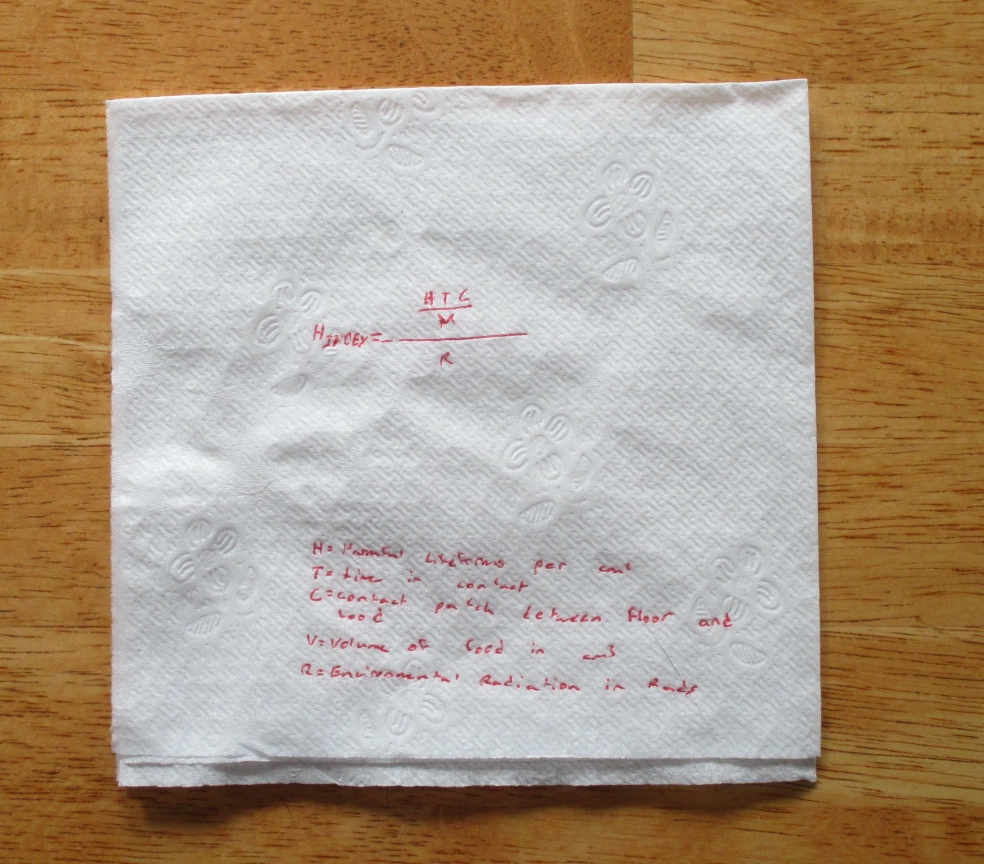
The next thing I knew, the older brother had pulled out his napkin, and was working through a formula to determine whether or not one should remove food from the floor and eat it. His napkin was the paper on which he was composing his formula—writing out the variables involved in making the necessary “calculations.”

The younger boy watched critically as his brother developed this idea, throwing in some of the factors he believed to be important. C had based his calculations on an “average bedroom floor,” using food on a plate and (basically) food in the cats’ litter box as his extreme conditions.

“Wait! Let me show you mine!” W said, grabbing the pen from C. The wheels in his head sped up, formulating, calculating. He developed a complicated equation in which one variable was “harmful life forms per square centimeter,” and another was “time in contact.” There were others, as well as a series of unknowns over other unknowns. They bantered back and forth as they considered whether they had covered all of the important elements.

Ultimately, the bite that fell on the floor made its way to the trash. Through it all, the boys were laughing and carrying on about various funny (i.e. “disgusting”) things that could happen to the food to affect edibility.

In my mind, I had to consider how this incident might have been different if I had been eating with two girls. The girls would have immediately picked up the food, thrown it out, and cleaned up the floor.

But in the interest of developing the boys’ talents at creating new formulas, I have some ideas. On Monday morning, I was texting my daughter—who spent the weekend with her father. I told her I missed her. She said she missed me more. “Tough to know,” I texted. “We can measure later.”

Perhaps the boys could write a formula for that.

IMG_1314 IMG_1315