Real Estate

“Mom, can we grow some fresh herbs on the windowsill?” C—my culinary kid—asks me out of the blue. We live in a townhouse, and we have windows on only our north and south walls. We have one main window where plants will actually grow, our south-facing kitchen window, and thankfully, it is a picture window with a deep sill.

“Um, sorry,” comes the voice of W from the other room. “I’ve already reserved the windowsill for a science experiment.”

“Dude!” C replies (because for some unknown reason, boys always call each other “dude”). “You can’t reserve the windowsill!! What kind of ‘science experiment’ do you have planned that you can do in the kitchen anyway?” His attitude is typical of a 16 year old who knows everything, and it is designed to be off-putting to a younger brother. W doesn’t bother to respond. He knows he will be criticized and chastised for even thinking he could take over the windowsill. In fact, through his brother’s tone of voice, he already has been.

“You can’t claim the windowsill,” C continues on his rant. “All I want to do is grow some herbs. Herbs belong in the kitchen. We can use them for cooking… we can dry them… and, your science experiment… in the kitchen? Really?”

“Mom already said I could do my science experiment. On the windowsill.” W is quiet but firm in his response. Personally, while I remember him saying he wants to ionize soil to see if plants will grow better, I can’t remember any other experiment; so I am hoping that this is the one. The combination of the stress of single-handedly raising three teenagers and middle age is not always the most conducive to productive thought processes. Things get lost in my head more often than I would like to admit.

“W, remind me again which experiment you want to do? I remember several you mentioned recently,” and it’s true. There is always something brewing in the head of this kid. Newer, better, more effective ways to do whatever the task at hand. And unlike his Mama, he has no problem accessing his thoughts and ideas in his amazingly complex mind. Thankfully, I am right that he wants to test plants and soil.

“Why don’t you combine your projects?” I suggest. “We can see if herbs grow best in soil that is ionized as opposed to soil that isn’t.” I, of course, think this is the perfect solution to the problem, and one that will limit the clutter on my windowsill. My boys do not.

“I don’t want my herbs to be part of some science experiment! He can grow his own plants in his experimental soil!” Clearly, this discussion is going nowhere. At least nowhere positive.

“Well, that would be a way for you to both use the windowsill and to collaborate. Ionizing the soil isn’t going to hurt your herbs. It’s not like he’s using radiation or something hazardous.”

“No way, Mom!” C leaves the room, and W and I look at each other. I roll my eyes. It is going to take some convincing. Teens are tough that way. Once they know something (and by know, I mean yup, he’s the expert), it can be difficult to sway them otherwise. Experimental soil or not, it seems this is the most likely solution to the real estate issue.

Of course, there is another option. I could continue to hog the windowsill with my plants. I do, after all, pay the mortgage.
Words

It is 6:40 in the morning, and I am sitting in my car outside the high school. The drizzly not-quite-rain, not-quite-ice precipitation that has been falling for days has rendered the darkness a sooty mess that severely limits visibility. As on every way-too-early weekday, I am waiting for my son to wake up enough to exit the car, cross the street, and board the bus.

Our morning drive and wait time are sometimes quiet and sometimes filled with talk of this or that. Today, the sound of the wipers, intermittently slopping a mix of water and ice from my windshield, punctuates my thoughts, which center on an early meeting and the morning tasks that stand between now and that commitment.

The radio drones on, barely noticed until a clip of The View is played in which Whoopi Goldberg purportedly broke wind on air. Next to me in the front seat, I detect some movement from my son. The laughter of the DJs on the radio catches our attention, and their discussion moves to the etymology of the word “fart.” My son snickers.

The word, from Old English, has been kicking around much longer than I would have guessed. When the DJs start in with the Middle English, farten, and they speak in funny accents, both my son and I begin to laugh. We mimic their accents, and I sense this will not be the last time I hear this particular phrase spoken in this particular manner. We are still laughing as he says good-bye and gets out of the car; the DJs move on to another topic.

It was a perfectly timed radio segment. It grabbed the attention of the teen in the car, and shook him awake more effectively than I could have. And as an English teacher, I wonder what could be better to wake a kid than a rousing discussion of etymology? Sometimes, discussions of emotionally (socially…?) charged words have practical use as well as philosophical merit.

Oddities

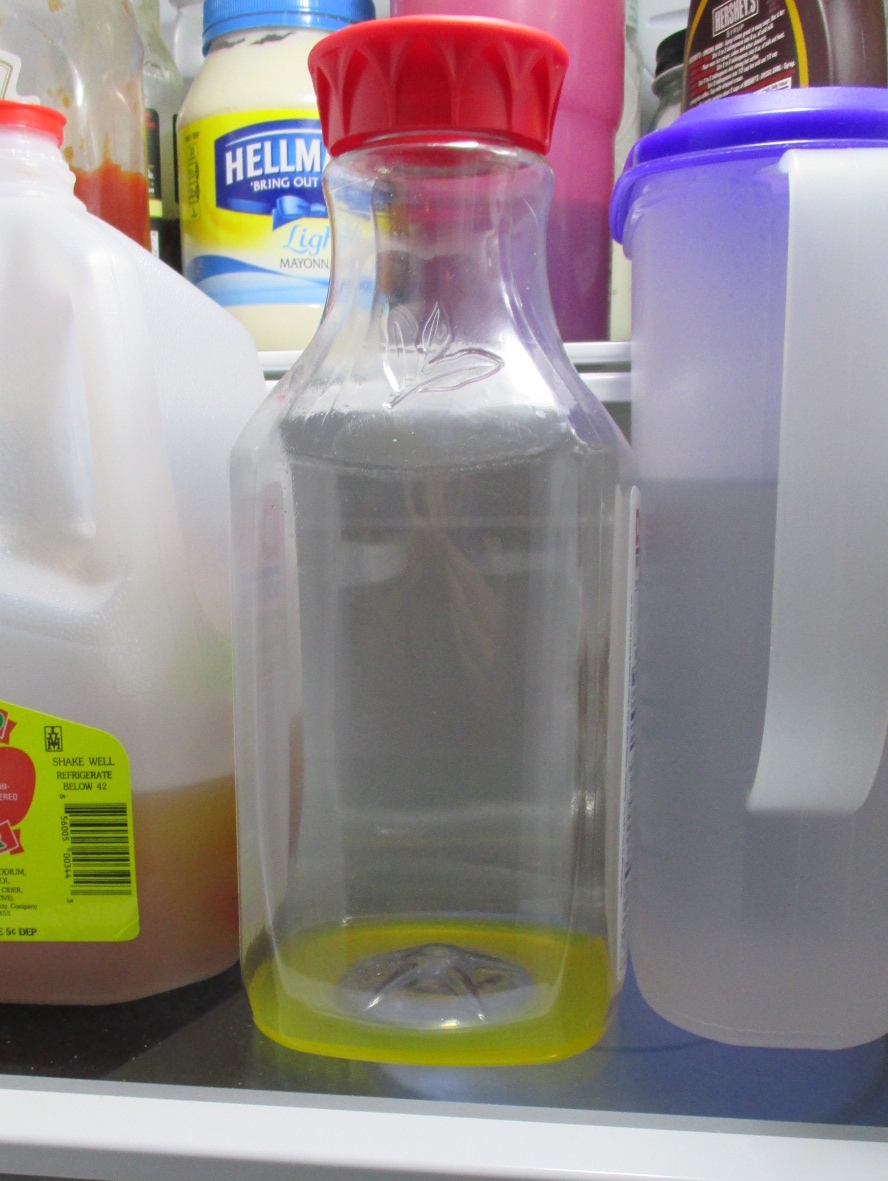
IMG_1233

In my refrigerator this morning, I found the juice container with half a sip of juice barely visible in the bottom. Essentially, it was empty. I poured myself the little that was left, just to see if it might be at all satisfying. It was not. There was not even enough to wash down one tiny Vitamin D pill. I have a difficult time believing that the person who returned this container to the fridge couldn’t possibly ingest even a few lingering drops of juice. Really, I can’t imagine.

My first thought is laziness. The person who—by all reasonable standards—finished off the juice didn’t want to have to rinse out the container and throw it in the trash. That’s a lot of work, right? Most likely, the culprit was also considering the fact that the next person who wanted juice might complain that the person who used it all should be responsible for the trip to the basement to grab more juice…. But I’m speculating here.

My next thought is consideration for the needs of the next person to want juice. In fact, the culprit did not finish all of the juice, thereby leaving some for the next person. Or not.

Possibility number three: Science experiment. While we typically have numerous science experiments going on in our house at any given time, they are more likely to resemble something that would be confiscated in an airport security screening—metal and wires and miniscule electronic parts and battery packs that might have started a small fire once or twice in the past week or two. So “science experiment” would be a stretch in this case.

No, I am left to believe that this is the work of the teen brain. The culprit took out the juice, poured a desired amount into the cup, and put the container back where it was. There is no hidden agenda here. It wasn’t consideration for or a lack of thought for the next person. It was, in fact, a lack of thought. Juice goes in the fridge. End of discussion.

With three teen brains wandering my house, I know there will be more bizarre discoveries for me to question and obsess over. In fact, my house most likely holds a treasure trove of the not-quite-right. Discovering these oddities gives me food for thought, keeps me on my toes, and—oddly enough—inspires creativity!

Mornings

It was crazy in our house this morning. On a Monday, waking up does not happen quickly, so I do what I can to fuel the flow of energy. This morning, as I made sandwiches and packed lunches, I made up a song about cheese. Yes, cheese. I dubbed it The single most boring song on the planet because all of the “rhyming” words were the same word—cheese. The cat didn’t seem to mind the song, but my younger son did his best to ignore me in our cramped kitchen. The other two children sleepily stumbled downstairs, my oldest stared blankly into the open refrigerator as teenagers so often do.

“I know!” I said, in an effort to spark conversation (or shock the Monday morning right out of them). “I think we should live a musical! From now on, we should sing everything!”

“Yeah,” C replied dismissively, shutting the fridge. “I’m not coming home anymore.”

“Well…. I’ll come home,” my daughter piped up. “But I’m not participating.”

“Oh….” I drew the word out long and slow. “You’ll participate.”

“I’m pretty sure I won’t, Mom,” she said as she popped two pieces of cinnamon bread into the toaster.

“I’m pretty sure you will,” I retorted.

“Whatever.”

“Wouldn’t that be fun?” I continued on my train of thought, daring someone to derail it. “We would just break out into song whenever we had something to say!” I broke out into song here in demonstration.

“Ugh!” I heard from the vicinity of the kitchen table. I put a sandwich in a lunch box and zipped up the top. I turned back to the sink to put spaghetti into a thermos.

C came walking through the kitchen with his backpack, whistling loudly. “Stop!” my daughter commanded. “That’s loud and piercing.”

C stopped in his tracks, feigning a look of shocked innocence. “What? I thought we were in a musical!”

I burst out laughing. I couldn’t help myself—his timing was perfect! If we had been keeping score, he would have been declared the winner, though my daughter would not have admitted it. But we were not keeping score. In fact, we all won. We all left the house wide awake, a little happier, and perhaps just a little sillier.

Flashbacks

It is just past eleven, and I am flying up the highway faster than I should be in my present state of exhaustion. Between my son’s work schedule and my own, I have been driving this highway too late every night this week. My son is in the car with me, and he chatters on, animatedly telling me about his night at work.

On this night, he trained the “new kid,” and I remind him that he is the new kid. I can hear the smile in his voice as he says, “Not anymore!” He’s been working not quite three weeks, and he is already training other workers older than he is. He’s in this job to move up, but he understands he has to start at the bottom.

He keeps talking, and I force my eyes to stay open. Just a few more minutes, I tell myself. Despite the fact that I believe I am driving faster than usual, my speedometer says 60. The speed limit is 65, and I blame fatigue and the fact that it is dark and rainy and the road surface could be slick at this time of year. I don’t linger for even a second on the thought that I am getting older, and driving in the dark is not what it used to be.

For a brief moment as my son talks, I have a flashback to a time when he was little. Very little. (Think Steve Martin in Father of the Bride when his daughter is sitting across the table telling him about her wedding, and all he can see is this tiny little child telling him about her plans.) My son was in pre-school and he was at a birthday party. I always thought of him as somewhat of a shy-ish kid, especially in social situations. At this party, I was in the kitchen and there was a bit of a chaotic scene in the family room as the children tried to work together on a project involving string and glue and various pieces. All of a sudden, I heard my son’s voice rise above the voices of the other children. “Guys,” he said. “GUYS!!” and then he proceeded to relay the vision he had to make order out of chaos. At the time, his authoritative voice caught me so by surprise that I quickly moved to the door to watch what his four-year-old self take charge. In that moment, I saw an early flicker of his leadership potential.

Now, as he navigates his late teens, he is beginning to find his niche. He is involved in activities in which he feels comfortable and confident, and his leadership abilities are beginning to burn brighter. What once was a flicker is now a steady flame. It is amazing what can happen when a kid—anyone, really—finds his or her passion. I only hope he will continue to follow his passions, and not get distracted by the things that don’t matter.

I look forward to watching his journey, sharing in it with him, and helping him along the way. And I am hoping for many more of those crazy flashbacks to his childhood to remind me how far we have come.

Layers

My daughter sits across the table, playing a cutthroat game of Connect 4 with my boyfriend. The competition between them is (playfully) fierce, and she is adamant that I not give him hints. Doing so would somehow constitute cheating, despite the fact that I am not a player in this particular game.

She arranges and rearranges the game pieces, jokingly scolding me when I even so much as look like I am going to help him with his next move. She knows that I am perceptive, and that somehow, most likely because I am her mother, I am able to anticipate her next move.

I find myself watching her with fascination. Her interaction has an ease and comfort to it. She laughs. She tries to trick him, and he laughs. She manipulates the pieces, looks up as though she is hiding something, and in the next moment, she is deep in thought. She is complicated and multi-dimensional, and watching her (and her brothers) grow throughout her life has given me insight into people—and their layers—that I might not have otherwise gotten. I know that she has grown this way by piling experience on top of interaction on top of practice and more experience. It is not a simple thing to create such a complex individual.

Recently, she and I took an art class in fused glass. We chose brightly colored pieces of glass, piled them on top of each other in a way that looked appealing, and sent them off to the kiln. The pieces came back smooth and beautiful, the layers had melted together and become inextricably combined. This process is much like what has occurred in my children as the incidents and experiences, both good and bad, have combined to make them who they are. Each of my children is multi-layered in his or her own way. The ways in which they navigate the world, the relationships, the simple moments of every day life make me marvel at all of the things each of them has learned. Even when they were little, I would watch—from across the table or across the room—as they worked on a craft project, a game, homework, etc.

I watch my daughter now, and in my mind, I trace the lines of her face, comparing the lines and expressions to what they were a decade ago… a year ago… yesterday. I memorize these same lines and expressions for tomorrow. This face, this moment, is fleeting, and I want to hold it in my head, a snapshot for the future. This is today, right now, and I want to be present in this moment.

Lessons

“It’s 4:13. It’s been exactly 24 hours since I set the microwave on fire!” My son proudly makes this announcement as he’s packing to leave for the holiday.

The previous day, when I drove up to the house, my youngest was sitting on the front steps. “What are you doing?” I ask.

“I was getting a headache in the house, so I had to come out here.” A man of few words, that one. It is unseasonably warm at 60° outside, so I thought he was just spending some time enjoying the weather.

My face must have been an indication of my lack of understanding. “C tried to set the house on fire, and it smells, so I had to come outside.” He gets up and starts walking toward the car.

“What happened?” I ask.

“He was heating pizza in the microwave, and the foil started a fire.”

“He put foil in the microwave??”

I see him hedge just a bit. “You’ll have to ask him. He put a pan on it to put it out.”

Now I am totally confused. A pan? Foil in the microwave? He is old enough to know better than to do that. I gather my stuff from the car and go in the house where I am greeted by the sharp odor of smoke and my oldest child. “Did he tell you the story?” His expression is cautiously smug.

“He told me his version. Now I want to hear yours.”

“Well, I was heating some pizza so I could eat before work.” He pauses. I recognize this tactic—giving me one piece of information at a time and making me work for the story. He thinks I’m going to feel sorry for him. He underestimates me.

“And…” I prompt in a tone that indicates my post-work lack of patience.

“I opened up the foil and put the whole thing in the microwave, and I put a paper towel across the top. The foil caught the paper towel on fire. So I picked up that pan,” he points to the 8×8 square baking pan that I had used the previous night for the overflow chicken parm, the few pieces that wouldn’t fit in the bigger pan. “I put that over it to put it out.”

I must say, as shocked as I am that he put foil in the microwave, I am impressed with his quick thinking. “So…” I choose my words and tone carefully. “Did you learn anything from this experience?”

“Don’t put foil in the microwave…?” he raises his eyebrows and smiles at me as he states the obvious. But I can see there is more. Even though he might not be able to articulate it in that moment, he knows that in his ability to respond quickly, he averted disaster.

As adults, we sometimes do things that are not very smart when we are not thinking. We are busy, and our minds are cluttered with the stress and goings on of everyday life. We should expect the same from our children. Putting leftover pizza in the microwave (foil and all) was an honest lapse in judgment—one that anyone could have made. The important thing is that he learned from it—he learned, first hand, that foil and microwaves don’t make a good combination. He learned that if there is a small emergency, he can handle it. And he learned that he can think quickly and solve problems under pressure. In this situation, real life experience provided better lessons than I could teach my son. And these lessons—they are priceless.