Invisibility

One day, when my children were fairly young, I discovered that I had the power of invisibility. While this discovery was totally unexpected, invisibility has been a useful trait over the years.

My children were preparing for bed one night. They were somewhere around the ages of four, six, and eight. I had set them to the task of getting into their jammies and brushing their teeth in preparation for bed.

I was exhausted, as I so often am at the end of the day. I went in my room to lie down for a minute—my own mommy “time out”—while I waited for them. I started to zone out, my mind drifted, though I remained attentive. I remember over-hearing their kid conversation. My oldest was talking about something that had happened on the school bus that day, and the manner in which he spoke was just a little different than when he spoke to me. The tone in his voice as he relayed the event to his sibling was one of authority. It was pure kid-to-kid conversation, and as the oldest, he knew the most.

I heard my name mentioned in the conversation. Then I heard little footsteps in the hall, stopping at the door to my room. My room was dark, but light shone in from the hallway.

“Mommy?” a tentative voice asked into the darkness. I was tired and almost asleep. I didn’t answer. The footsteps retreated. “Do you know where Mommy is?” the little voice asked her little brother.

“No,” brother responded.

“I can’t find her,” said the little voice. She had barely looked, but brother didn’t know that. “Will you come downstairs with me to look for her?” And two sets of footsteps padded down the stairs and around the first floor while I puzzled over the fact that she had stood in the doorway of my room and not seen me lying on the bed. I heard a far-off voice inquiring into the dark basement. And then the footsteps came back up to the second floor.

“Where is she?” the two little ones continued to look for me as they conversed about my whereabouts. Hand in hand, they walked into my dark bedroom and passed inches from the foot of the bed as they checked the bathroom—also dark. They turned around and walked out the door, still calling to me despite my presence just a hair’s breadth away. I smiled in fleeting satisfaction that I was somehow invisible.

However, the discussion right outside my door was growing emotional and slightly panicky as the children considered how I could possibly have disappeared. “Hey you two,” I piped up. “I’m right here. You walked right by me.” To myself, I marveled that I could be invisible while I was in plain sight.

These days, it’s not so easy to be invisible. But when I am, I have learned to use my invisibility carefully. Sometimes, I try hard to conjure this power with no success; other times it just happens. Driving the car—especially with a car full of kids—I tend toward invisibility. Other times, I might be invisible from a different room.

No matter where I am when this power overtakes me, I have come to realize that in my times of invisibility, I must remain quiet and listen in order to get the greatest benefit.

Periodic Table

We were discussing the periodic table at dinner last night because … well, doesn’t everyone discuss the elements at dinner? It was just the boys and me at the table—J was off doing whatever thespians do on opening night. The conversation started with, “Let’s see how many elements we can name that start with the letter….” It might have been a fun game when I was in high school and actually remembered the elements; but I’m resourceful, so I was making them up.

I made up elements that included the names of our cats (Potonium). I made up elements after some random foods (Maltedmilkballium). And I made some with names that were just plain silly (Phantomite), but elemental, nonetheless.

The boys were getting bored with my silliness (interesting role reversal), so they decided to switch it up. “Let’s name the elements in order,” W challenged his brother. “Hydrogen.”

“Helium!” I shot in before anyone else could. I knew it was the only one I had a chance of getting right.

“Lithium,” C added to the game.

“Beryllium,” W continued, and they both seemed to wait for me to jump in. Nope. I got nothing.

“Boron,” C guessed.

“If you took regular chem, this would be a piece of cake,” I told him. He looked offended. “No,” I back-pedaled. “You would have had to memorize the periodic table. I memorized it when I took chemistry.” Of course, I only took two years of science in high school because there was ART, after all.

“Yeah Mom, but that was back when the periodic table only had five elements,” W informed me. Ow.

Yes, to my children, I am “old,” and they love to tease me about it. And someday, they will be “old” to their children, as well. It’s the circle of life. One day, when W is talking about the periodic table of elements at his dinner table, the circle of life will come full circle, and I will be the one laughing.

Calculations

One never knows what is going to happen at the dinner table in my house, nor how that information might be used in future conversations. We have discussions that range from the sublime to the absurd, and everything in between. And the conversations tend to wander from one end of that spectrum to the other—often multiple times over the course of the same meal.

On Friday night, the boys became engaged in a conversation that was both entertaining and thought provoking. Dinner was going along smoothly until one of them dropped some food on the floor and started pondering the edibility of the morsel in question.

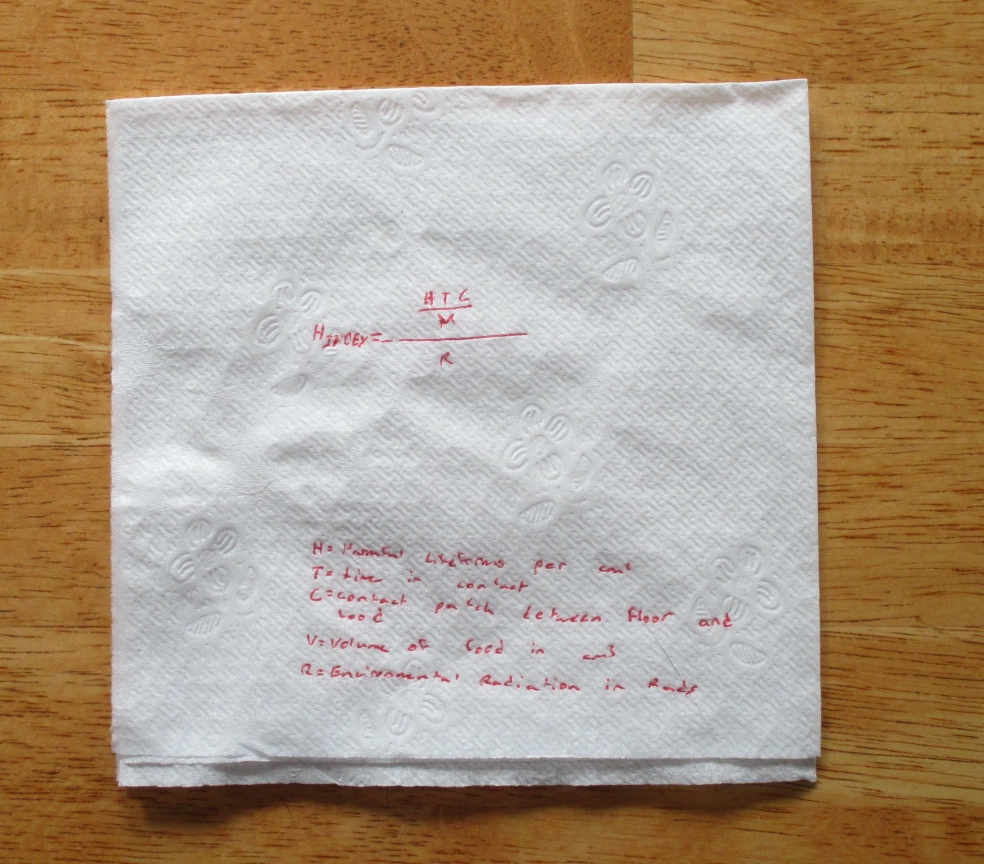
The next thing I knew, the older brother had pulled out his napkin, and was working through a formula to determine whether or not one should remove food from the floor and eat it. His napkin was the paper on which he was composing his formula—writing out the variables involved in making the necessary “calculations.”

The younger boy watched critically as his brother developed this idea, throwing in some of the factors he believed to be important. C had based his calculations on an “average bedroom floor,” using food on a plate and (basically) food in the cats’ litter box as his extreme conditions.

“Wait! Let me show you mine!” W said, grabbing the pen from C. The wheels in his head sped up, formulating, calculating. He developed a complicated equation in which one variable was “harmful life forms per square centimeter,” and another was “time in contact.” There were others, as well as a series of unknowns over other unknowns. They bantered back and forth as they considered whether they had covered all of the important elements.

Ultimately, the bite that fell on the floor made its way to the trash. Through it all, the boys were laughing and carrying on about various funny (i.e. “disgusting”) things that could happen to the food to affect edibility.

In my mind, I had to consider how this incident might have been different if I had been eating with two girls. The girls would have immediately picked up the food, thrown it out, and cleaned up the floor.

But in the interest of developing the boys’ talents at creating new formulas, I have some ideas. On Monday morning, I was texting my daughter—who spent the weekend with her father. I told her I missed her. She said she missed me more. “Tough to know,” I texted. “We can measure later.”

Perhaps the boys could write a formula for that.

IMG_1314 IMG_1315