Projects

image

This summer, more than any other I can remember, my children have been off in different directions, pursuing their own interests. I have one who can drive, so he will frequently take the car and go off with his friends.

My daughter trained for, traveled to, and competed in a national competition in her chosen sport. She returned home only to sequester herself in her bedroom so she can complete her many hours of summer reading and projects for the courses she will be taking in the fall.

The youngest has spent the better part of the summer in the woods. He has been to camp; he has been camping; he has hiked more than one mountain; and he went off on a multi-day canoe trip. In between his adventures, he has been pursuing his other interests by finding ways to “tinker” and improve one aspect of our house or another.

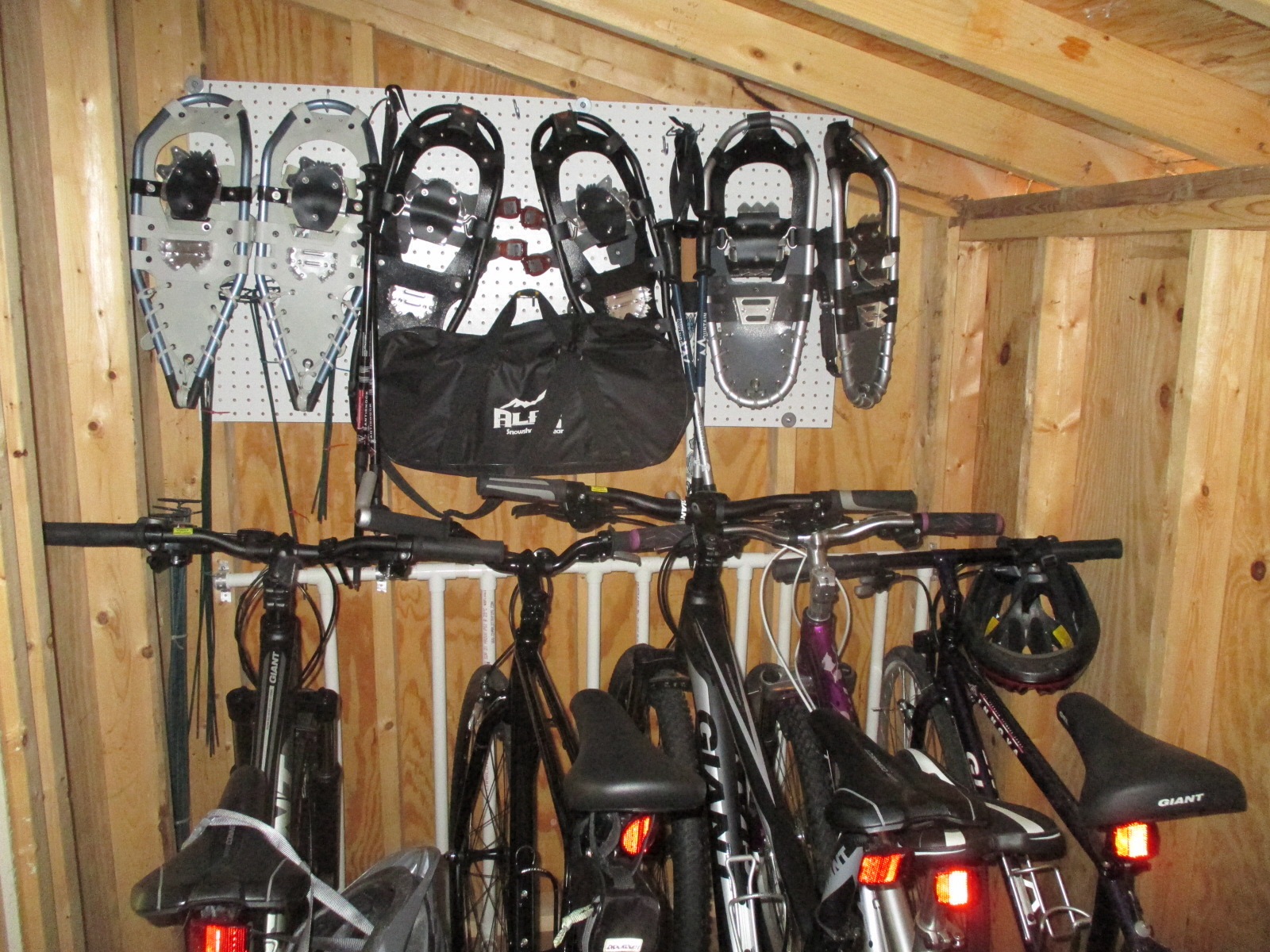
When I returned from several days away with my daughter, I found a fifth bike in my shed, and all of the bikes leaning against each other. Since my shed provides tight quarters for four bikes and the small amount of junk that usually resides there, the fifth bike had to be crammed in.

“These bikes shouldn’t be leaning against each other like they are,” I told W. “The gears are going to get bent.”

“They’re not leaning on each other,” W replied as he walked to the door of the shed and peered in. “Oh. Oops. They must’ve fallen over.”

“Right. That would be my point.” I walked back up to the house, but the seed had been planted, and a plan was beginning to develop.

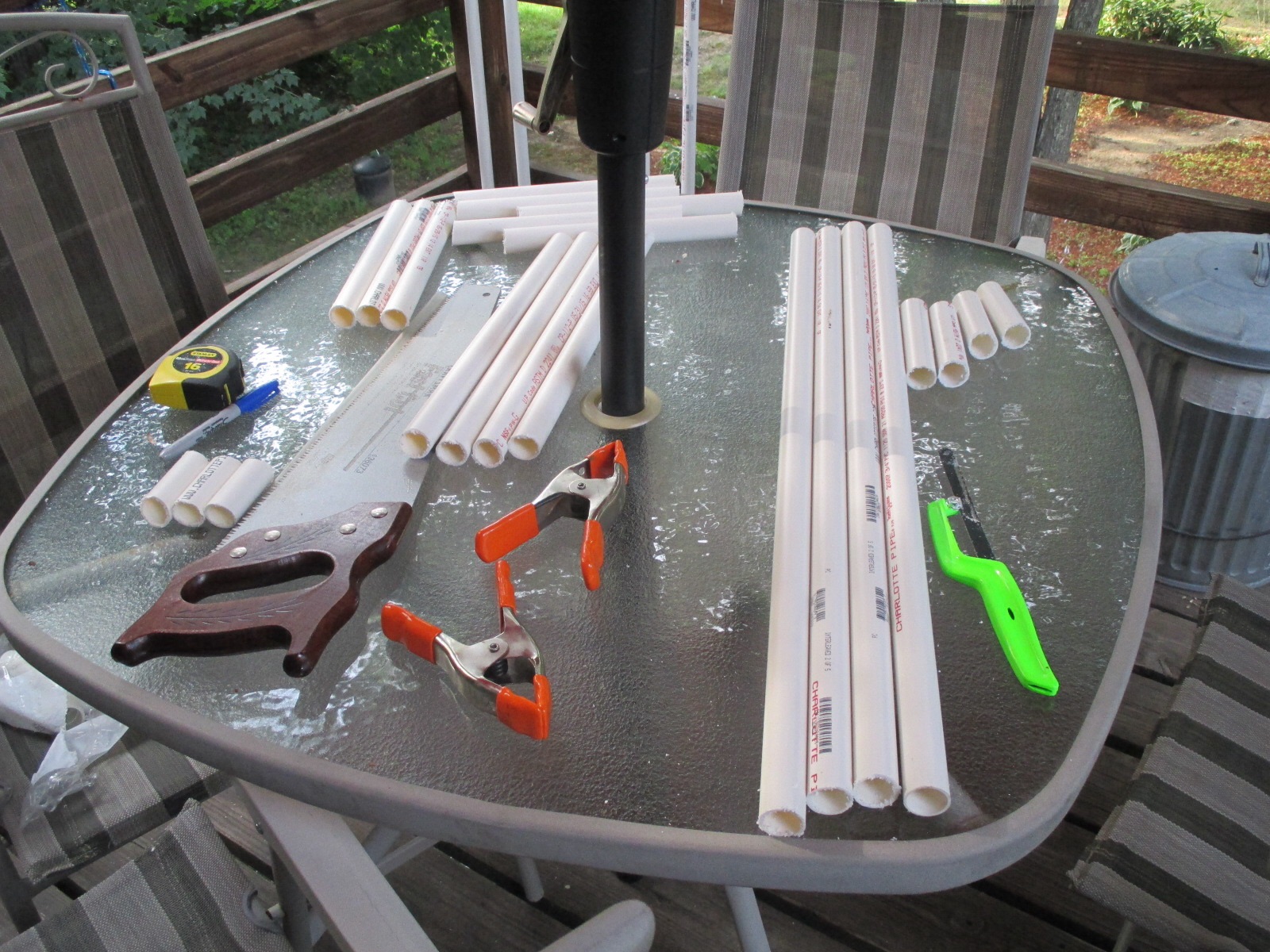
Two days later, I had several ten-foot lengths of PVC pipe, joints, and various hardware on my living room floor. Acquiring the materials was the first step of the project. But then the project leader left the house for a meeting to prepare for his next journey into the woods.

C, who had been out with a friend for the day, returned home around dinner time. He walked in the door and started to tell me about his day, and about his thoughts on the headaches he’d been having lately. He was walking into the bathroom while he was telling me this.

“This morning, I didn’t sleep late at all. I really don’t think that the headaches are from sleeping too—” His monologue stopped abruptly. He had apparently spied the “supplies” scattered on the floor of the living room. “Oh no,” he paused for effect. “What’s the new project?”

I burst out laughing. It seems there is always a project. Always “supplies” somewhere in the house. The supplies for the bigger projects end up in the living room for a time. The last time we had PVC pipe in the living room, there was a model “black hole” in the works for a school project.

But this time, the project was for the family. Together, W and I sketched and planned; he measured the space, considered distances, and manipulated the plans to get them to work. He tried the “prototype,” and revised his design. He cut the pipe into appropriate lengths, and connected them all together. And now, we have a bike rack in our shed that keeps the bikes upright.

Isn’t it amazing what summer boredom can do?
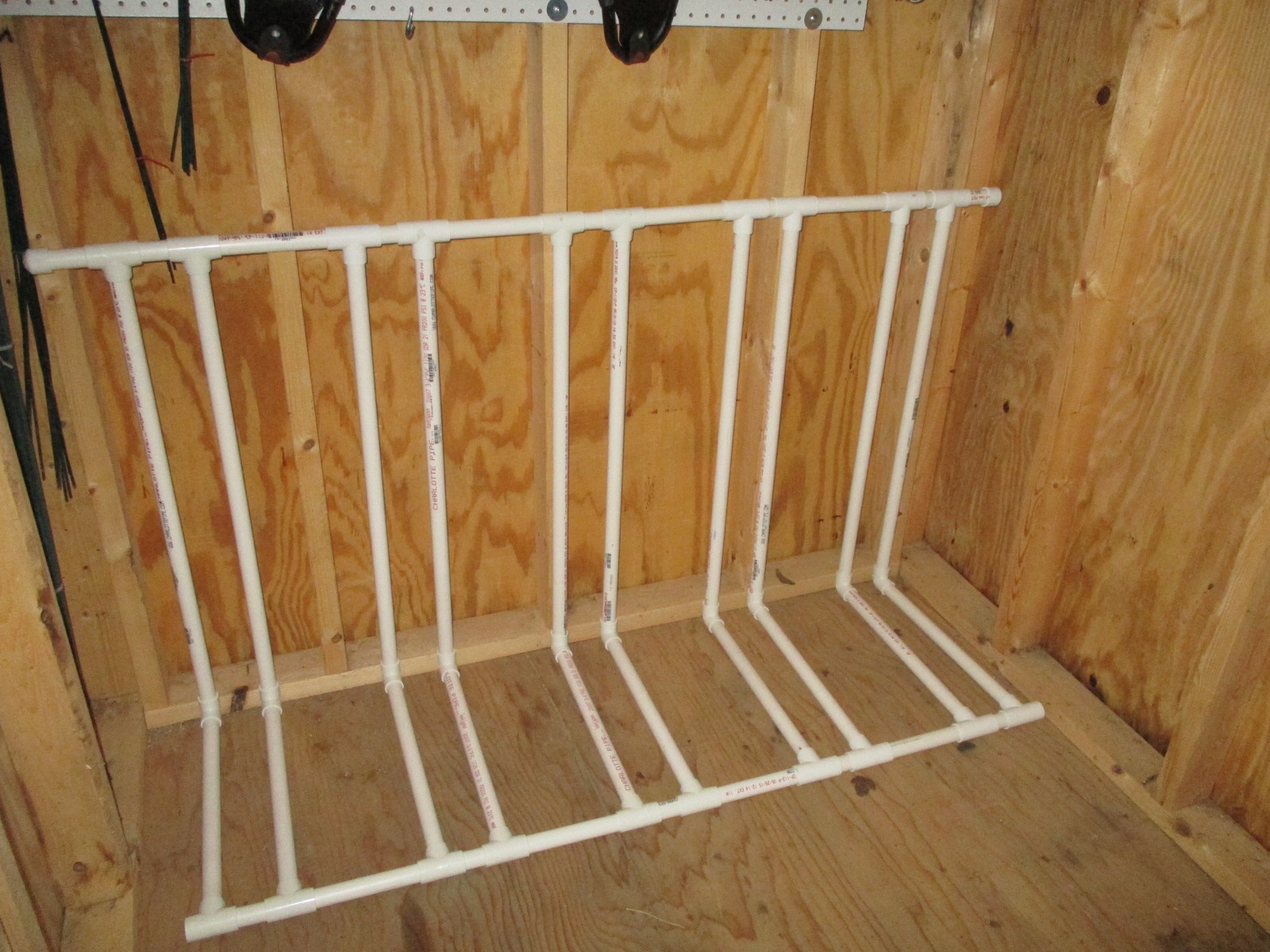
image   image

The Rules

“So have you been following ‘deflate-gate’?” my boyfriend asks J as she is cleaning up the dishes from dinner.

She turns and stares at him as if he has asked her what size jeans she wears. I can see her formulating a response, and it takes her a minute to answer. When she does, her tone is one of authoritative condescension. “P, you might not know this, but this is a ‘football free home.’ We do not talk about football in this house.”

In my head, I am silently cheering her. Really, I have no interest in football; I have never had an interest in football; and since I have single-handedly raised my children, they seem to have no interest in football, either.

“Come on,” he goads her. “Football is the American pastime. You have to have an interest in football.”

She shakes her head. “We don’t do football.”

Just to get her going, he launches into a discussion of some team or other with some coach or other who is supposed to be amazing. Or something. Truly, J is right. We don’t do football.

When she’s heard enough, and she can no longer ignore him by running the water and playing in the suds, she stops him. “If you want to live in this house, you’re going to have to give up football.”

P’s jaw drops in mock shock. “Give up football? Back when I was coaching….” And he starts yet another story about football. She scrubs the skillet just a little harder, no doubt trying not to listen.

“Football. Free. House,” she reminds him when he finishes his story. It was nice of her to let him finish.

“What are you going to do when you go off to college and some nice guy starts talking to you about football and asks you if you want to go to a game?” The hypothetical situation is fabricated to get her to consider the possibilities. “You’re going to have to be able to talk intelligently about football.”

“Not going to happen,” she says, as she rinses the pan in the sink. “We are football free.” She dries the pan, sets it on the stove, and flounces out of the room.

Apparently, we are. Football free.

The Dog

The expiration of the dog has come full circle.

Ever since my daughter went away to camp for the first time, and the paperwork said not to send mail that contained sad news (i.e. an announcement that the dog died), our non-existent dog has died each year while the kids are at camp. At some point during their week away, I send a letter announcing that the dog has died, and the kids are amused (although sometimes their bunk mates are horrified!). The expiration of the dog has been an ongoing joke for five years now.

This year, in a strange twist of events, I was the one who went away from home. J and I traveled out of state for an athletic competition. The boys were busy with their own activities back at home, so my boyfriend stayed with them, and kept them company.

When the kids go away, it has been my pattern to wait until a few days have gone by before I deliver any news about the dog. When I left, however, C couldn’t wait to tell me about the dog. Apparently, he felt the need to get it out of his system right away. Perhaps he thought he might forget as the week went by.

I had barely landed and settled in my hotel room halfway across the country when the message came. And it was a doozy of a message! Just in case you thought we’d be all right, Mom, here are some of the things you feared could go wrong. Oh, and the dog died.

Interestingly, when I got to the part about the dog, I knew that everything was under control, and I could relax. This trip was the first time that I had left home for more than a brief while, and I was on edge, concerned about what would go on in my absence. I had voiced my anxiety to the boys in the days leading up to my trip.

As it turned out, I had little to fear. The boys are older; my boyfriend is competent; and just maybe my neighbors were doing a little “neighborhood watch” in my absence….

But I’m glad ‘the dog died’ early in the week. That message relieved me of my worries!

Camp Mail

Sending letters to camp is not what it used to be. When I was a kid, my mother would send us off to camp, and each day, while she sat at home doing nothing (because what else does a mother do when her children are not home?), she would take out a pad of stationery and write a note about her day and inconsequential things that had happened. I remember the first time my sister went to camp, Mom asked me if I wanted to write her a letter. But then she cautioned, “Don’t write anything that will make her homesick.” I was eight and had no idea what would make my sister homesick. So I drew an elaborate picture, wrote that the cat had sniffed a blueberry, and I signed my name. We still laugh about that letter….

On Sunday, I dropped my son at camp for a week. Now, what with e-mmediate-mail, it’s quicker to drop the letters off with the child’s camp counselor, or in this case, Scout leader. Of course, W’s Scout leaders have worked hard to earn a reputation for handing out mail (the entire week’s worth) on the day parents are coming for pick up. I decided to circumvent that problem, and give the letters directly to W to read on the correct day(s). I labeled the letters with post-its and packed them in a Ziploc bag (the bag will prevent him from reading mail on the wrong day or reading all of the letters at once, of course).

Being seasoned camp-ers, we know all the warnings: Don’t send food, candy, electronics, or any bad news such as news that the dog died. And so…. Because we are cat people, every year, I send a letter to camp informing the child in question that the dog has expired.

On Sunday morning, I sat down at the kitchen table to compose five letters to be read over the coming five days. As the story in the letters began to unfold, I snickered to myself, unable to contain my amusement. W was walking through the kitchen. Knowing I was writing camp mail, he stopped and rolled his eyes. “Mom, what are you writing?”

“You’ll see!” I giggled in response.

Over the next few days, my son will read about our adventures in Paris, eating breakfast with a view of the Eiffel Tower; snorkeling off the coast of Australia; and walking the Great Wall of China. Believe it or not, we were able to walk the entire length of the Wall in one day—between our day in Australia and our trip home in time to pick him up.

On Thursday, my son will read that the dog accompanied us on our trek on the Great Wall, and did a fantastic job! He will read that the dog is doing well, though resting, after his intensive exercise. Sadly, on Friday W will learn that the trek was too much for our pup, and he expired overnight.

Yes, we had a grand adventure while my son was at camp—at least in my over-active imagination. And my son got to read about it from the comfort of his tent.

None of my kids can say camp mail isn’t entertaining!

Baking

IMG_1578

I was making fresh strawberry scones the other morning.

I dumped a small pile of flour on a piece of waxed paper so I could flatten the dough and cut it into scone-sized triangles.

“Is that your bench flour?” C asked.

“My bench flour?” I looked at him, unsure of his reference. “You mean this pile here? Is that what you call it?”

“Yeah. And you save it when you’re done.” I spread the flour with my hand and plopped the dough onto the flour where it (hopefully) wouldn’t stick. I rolled it into a ball, worked it for a minute, then started to spread it out.

“You save it?” I asked, a bit incredulous, knowing what my ‘bench flour’ looks like when I’m done. In fact, as the dough stuck to my hands, I would rub little bits of dough off my fingers and into the ‘bench flour.’

“Why wouldn’t you save it?” C asked. “It’s just flour and little pieces of pie crust.”

“Well, not really….” I thought for a minute. “What if you are making chocolate scones? Then your ‘bench flour’ has little bits of chocolate dough in it. When you roll out your pie crust, it gets chocolate in it.”

“That’s half the fun,” C replied, mischief creeping into his tone. “It’s like a treasure hunt. ‘What will I find in my bench flour today? Oh look! A whole blueberry!!’”

“That’s gross,” I stated, but I laughed in response. “I think I’ll throw out my bench flour. Thanks.” Funny or not, there will be no “treasure” traveling between my baked goods.

But from here on, every time I eat something from a bakery, I will wish there were some things I did not know.

Settings

One of my least favorite chores is buying groceries. I don’t really know why it’s my least favorite, other than it takes time out of my schedule; I have to physically touch every object I buy multiple times (way too many, in my book); and it’s EXPENSIVE (and getting even more so by the second). Nowadays, I tend to get groceries on my way home from work, which delays my arrival home AND our family dinner.

When my children were younger, we all went to the grocery store together much more often than we do now. Occasionally, when I had only a few items and I was feeling particularly adventurous, we would use the “self-scan” registers. One time, when C was about 10 or 11, he ran ahead of me into the self-scan lane, and hit the button on the screen indicating that we wanted our checkout experience to be in Spanish. Um… what?

First of all, it is important to understand that throughout junior high, high school and college, I took French. Back then, we didn’t have exposure to foreign languages before we hit 7th grade, and at that point, we had to choose our career language—the language we would take through high school. Nobody ever switched. Thus, I know English and French (and a little bit of Greek from a two-month exchange trip back in the dark ages). No Spanish. None.

I stared at the screen with no idea what to do. How do you fix the language setting when you can’t understand the language in which the machine is prompting you? Ugh! Out of frustration, I moved to another register and let that one time out and reset itself. And I made a mental note not to let C beat me to the self-scan registers anymore.

Yesterday, a new laptop arrived in the mail for C. He was in the living room running through the set up procedures, and I could hear him reading the options aloud. “Set language….” And BAM! Just like that, I was transported back to that day in the supermarket. I could see the sly smile he gave me that day, just like it happened yesterday.

“Set it to Spanish, C!” I called to the living room. “Just like you used to do to me in the grocery store!”

He snickered. “Yeah. Wouldn’t that be fun?”

Yes, I thought, my own sly smile brightening my face. It would be kinda fun, wouldn’t it?

Nothing Good

One day this week, my daughter came downstairs for breakfast. She opened the fridge and looked inside. She stood there just a moment too long, surveying. She sighed, “There’s nothing good in here.” No, there is never anything good to eat in my house.

This is one thing I dread about school letting out for the summer. My children will check the refrigerator, the cabinet, wherever, sigh and declare, “There’s nothing good to eat.” In an hour or so, they will come back to stare into the fridge and repeat the process. They don’t seem to notice that I have not left the house and no one has entered. “There’s nothing good to eat,” is a complaint I hear daily.

Last night, I made a batch of blueberry muffins—a dozen muffins in all. I got up this morning to make lunches and get the kids out the door. By the time I sat down for breakfast, the muffins were gone.

Monday afternoon, I came home from an errand to find C, who had just arrived from school, sitting at the kitchen table downing a rather large bowl of pasta salad. Actually, it was the “Family Sized” bowl, and I know this because we were going to have it for dinner.

“What are you doing?” I asked, trying to temper my accusatory tone into curiosity. I didn’t want him to think that I was accusing him of doing something wrong when he had made a relatively healthy snack choice.

“Mom!” he nearly yelled, immediately defensive that I should walk in and catch him eating, of all things. “I eat four meals a day! My school lunch is at 10:30. You can’t even call that lunch.

“So this is one of your meals?” I questioned.

“Yeah. This is my lunch!” Well, it’s good to know my pasta salad wasn’t merely a snack, I suppose.

And during the warmer weather—like now—I try to keep some cut up fruit in the fridge. I cut up an average of two whole watermelons a week. I cut it into bite-sized pieces and put it in a bowl, so it will be cold and delicious and ready to eat. Every time I think I might snack on some watermelon, I go into the fridge and it’s not there. The empty bowl sits in the sink with only a bit of pink juice remaining in the bottom. One of the teens in the house has consumed the contents of said bowl, though he or she blames another. “I only ate some of it. C ate the rest!” or “J ate the last piece….”

Come to think of it, I’m beginning to understand why my kids say, “There is nothing good to eat!” I can’t find anything, either….

Warped

DSC_0688

It started at the dinner table, our discussion of warped things. W looked out the window into the settling dusk of evening. “And… it’s started raining again!”

“It’s raining?” I questioned, glancing out the window. It had been raining for two days, but the rain had stopped earlier in the afternoon, and I thought it was done. According to the weather forecaster, it was done, at any rate. Then again, the weather forecaster doesn’t have a great track record.

“Or tiny morsels of something are hitting our window,” W continued. “I can hear it.”

“Oh, that’s not rain,” I informed him. I’d been sitting at the kitchen table all day, and I had heard the noise he was referring to. “I washed the window last week, and for some reason, the sun-catcher is now tapping against the window.” I leaned in toward the window to study the sun-catcher. “I must not have put it back in exactly the perfect spot. Or may it’s warped….” The discussion wandered to how a window might be warped, until I brought it back to the sun-catcher.

I stood up to put some dishes in the sink. I looked at W. “I have a son who’s warped….” He turned to look at me, startled for half a second before the mischief smiled on his face.

“You do have a warped son, don’t you?” He glanced at C who was getting up to bring his plate to the sink. C was also smirking.

“Yes, you do,” he agreed, as he moved out of the kitchen for his next activity.

“You can totally say that, Mom,” W commented, “Because we’ll both think it’s the other one.” He watched C walk out the door, and he leaned toward me, speaking just a little quieter. “But I’d be right!”

I smiled in response, and W started the dishes.

A few minutes later, the warm water had begun to lull the crazy day out of him. He looked up from the suds that he had been spreading around a pan. “You know Mom, I’m not warped. I’m just bent.”

Yes, my friend, we’re all a little bent. That’s what keeps us from breaking.

Stage directions

IMG_1555

Always, there are the insights of people who are part of our lives, but just outside the inner circle of our immediate home life, to bring an objective perspective to what we do. With a word, a phrase, we suddenly see our everyday actions in a different light.

Last night, my sister stopped by my house on her way home from work. I had picked up some plants that she wanted for the garden, but I did not want the responsibility of keeping them alive through the predicted weather of another night of drought or severe thunderstorms—either seemed a distinct possibility. So she agreed to pick them up.

She arrived as we were eating dinner, and since part of our meal contained none of the ingredients that trigger her allergies, I offered her some food, and she accepted. Which is a long-winded way to say she hung around for a while.

After dinner, there was some talk of who was responsible for the dishes, and it was determined that it was J’s night. She promptly left the room, stating that “the leftovers needed to be left-overed” before she could begin. She spent the next ten minutes flitting in and out of the kitchen—complete with her J-like theatrical flourish—while I talked with Auntie.

The cat came in from outside and proceeded to regurgitate the organic material he had ingested—as cats do—onto the kitchen floor. It was a lovely addition to the non-stop-ness of the evening.

J flitted back into the kitchen. “Steps wide over the cat vomit,” she announced as she lifted her foot in an exaggerated dance-step over the puddle the cat left behind.

Auntie scrutinized J’s action. “Does everything come with stage directions now? ‘J enters the kitchen. Steps wide over the cat vomit….’”

I laughed. How many times had I heard one of the kids narrate his or her actions? How many times had I done so myself? Often, I would make a similar statement as I stepped over a child sprawled on the floor; my objective was first, to let the child know that I was trying to avoid him or her, and second, to let the child know that he or she was smack in the middle of the pathway through the room.

But this statement—a simple observation—from my sister helped me to reframe these narrations. They are like stage directions, and they tell the actor or actors what to do and how to do it.

I wonder if there is some way that I can edit these narrations and add my own. “J enters the kitchen; cleans up the cat vomit….’”

I think I’ll work on that….

Bribes

For much of the week, the students at the school where C has his culinary program have been taking a new, way too time consuming standardized test (because another test is a good use of their time). So there has been no Voc program first thing in the morning. Needless to say, he has been getting up a few minutes later than usual. Friday morning, he was back to the regular schedule.

On Thursday night, he made it a point to tell me that he needed to get up in the morning; that I should not let him sleep in, as I have been. That is an interesting interpretation. I have been getting him up as usual, then calling to him more than usual—and more urgently than usual—to get him out of bed. “Make sure I’m out of bed early in the morning,” he told me.

“I am not the reason you have been sleeping in,” I informed him. “I have tried to get you up. You choose to stay in bed.”

“I know, but that’s because I don’t have to leave as early. Tomorrow, I need to get out of bed because I have to go.” True enough.

In the past, I have used a number of tactics to wake this sleepy head. When he was little, I would roll up socks and throw them at him. I tried a water gun once. I would sing to him. I tried tickling his nose. I put rings on all of his fingers while he slept. I contemplated applying make up….

Now, I have one tried and true way to wake my reluctant teen and get him moving, but it required just a bit of advance planning. I pulled out my supplies and started baking. We would have raspberry muffins for breakfast!

In the morning, after waking him, I made one simple statement. “If you don’t get up, all the raspberry muffins will be gone!”

W walked by me, fully dressed and ready for the day. “I’m going downstairs to eat all the muffins!” he reported.

That did the trick! I just hope C can find someone to bake for him when he goes off to college….

IMG_1552